
B2B Event Accessibility: The New Global Industry Standard
B2B Event Accessibility: The New Global Industry Standard
The B2B event industry is redefining its strategic priorities as Dr. Shani Dhanda joins 'The Business of Events' to lead inclusion at the highest level. This paradigm shift transforms accessibility—once viewed as a logistical constraint—into a powerful lever for economic performance and corporate social responsibility (CSR) for international summit organizers.
How Accessibility Transforms B2B Event ROI
Inclusion is no longer just a compliance checkbox; it is a driver of economic growth and a pillar of operational excellence. Historically, accessibility was treated as a costly logistical burden, often relegated to last-minute adjustments. However, the data tells a different story. With over one billion people living with a disability globally, ignoring accessibility means deliberately excluding a significant portion of the market and global intellectual capital. For decision-makers organizing summits in London or New York, integrating accessibility from the design phase ensures broader reach and increased attendee loyalty.
Return on Investment (ROI) is measured here by an expanded participant base and improved User Experience (UX) for everyone. This is known as the 'curb-cut effect': a ramp benefits a wheelchair user just as much as a delegate with heavy luggage or a delivery person. Similarly, clear signage, controlled acoustics, and accessible digital platforms benefit not only people with disabilities but also international travelers and executives working in noisy environments. By widening the pool of talent able to interact at a trade show, you maximize networking and closing opportunities.
In the context of rising ESG (Environmental, Social, and Governance) criteria, an event's ability to demonstrate real inclusion has become a major selling point for sponsors and institutional partners. Major tech and finance firms no longer want to associate their brands with gatherings that exclude, even unintentionally, parts of their own workforce. Analyzing accessibility trends in the event industry - BizBash, it is clear that brands ignoring these standards face growing reputational risks and loss of market share to more inclusive competitors. Accessibility is now the lens through which high-level professional event credibility is viewed.
Why Inclusion is Now a Strategic Pillar for 'The Business of Events'
The appointment of Dr. Shani Dhanda as a partner at 'The Business of Events' and a member of the All-Party Parliamentary Group (APPG) for Events is not a symbolic gesture. It is a decisive political and economic move aimed at professionalizing an often amateurish approach to inclusion. This global think tank recognizes that for the event industry to remain relevant post-pandemic, it must reflect the diversity and complexity of the modern workforce. Shani Dhanda, a leading figure in disability activism and systemic change, brings expertise that goes far beyond physical ramps. She addresses invisible barriers: unconscious bias, rigid registration processes, and non-adapted content formats.
This transition toward radical inclusion meets the growing demands of Marketing Directors and VPs of Events at Fortune 500 companies. Major gatherings are no longer just networking hubs; they are ecosystems where corporate culture is forged and thought leadership is expressed. If an event is inaccessible, it sends a message of exclusion that directly contradicts the brand values stated in annual reports. Shani Dhanda emphasizes that accessibility must be integrated into the initial budget, not treated as an add-on.
Collaborating with experts of this caliber allows organizations to transform legislative frameworks—such as the UK Equality Act or the European Accessibility Act—into competitive advantages. The question is no longer 'how much will it cost?' but 'how much will we lose by not being accessible?'. As highlighted in this discussion on industry inclusion - LinkedIn, the industry must move from awareness to concrete, measurable, and auditable action. Shani Dhanda’s influence within the UK government and international bodies ensures these standards will soon become the norm for obtaining event permits in major global hubs.
Authentically Documenting Event Accessibility Visually
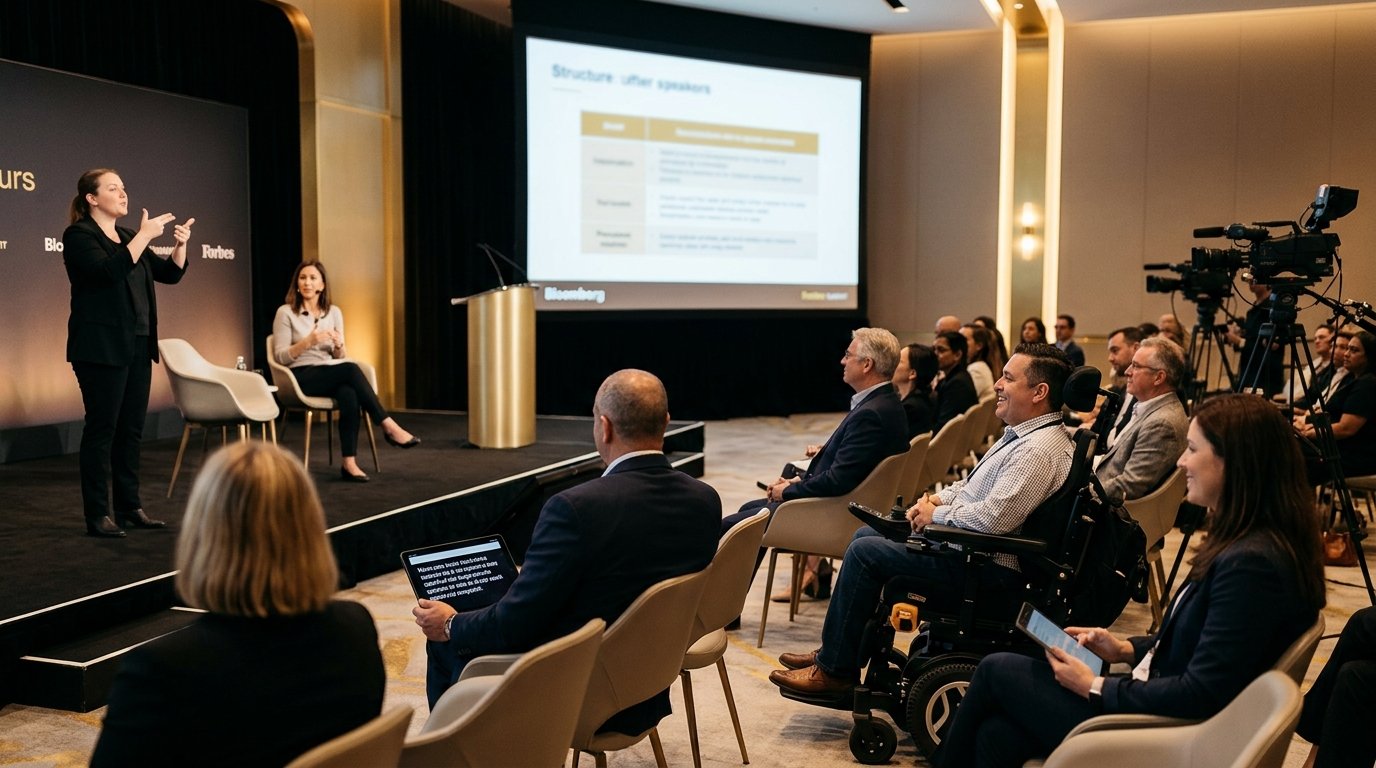
Visual documentation plays a crucial role in how inclusion is perceived and how future participants prepare. Too often, event photography relies on surface-level shots of dense crowds, which can be anxiety-inducing for neurodivergent individuals or those with limited mobility. To reflect true commitment, visual production must capture diversity without falling into 'tokenism.' This means photographing speakers with disabilities with the same authority, dramatic lighting, and dynamism as any other thought leader. At Alesia RSVP, we approach every project with this editorial sensitivity, as seen in our portfolio gallery.
As a premium visual production agency, we support this transition by producing natively accessible video content. This goes beyond automatic captioning, which is often riddled with technical errors. World-class production includes high-quality Closed Captions (CC), audio descriptions for the visually impaired, and increasingly, the integration of sign language interpreters (BSL or ASL) directly into the main video feed. Documenting the presence of assistive technologies on stage, such as hearing loops or real-time transcription systems, doesn't just flatter the organizer; it creates psychological safety for future attendees.
A successful after-movie should not only show the energy of the crowd and the prestige of the venue; it must illustrate the fluidity of the experience. Showing a wheelchair user navigating booths seamlessly or a speaker using a voice interface proves the event was designed for everyone. This documentary approach reinforces social proof of accessibility, transforming marketing content into a reassurance tool. By capturing these technical details with a cinematic aesthetic, we help brands prove that their commitment to inclusion is a tangible, operational reality.
The New Standards for International Gatherings
Standards are evolving rapidly, driven by innovation hubs like Paris, Singapore, and Dubai. Digital accessibility is now as critical as physical access. Event websites, networking apps, and streaming feeds must comply with WCAG 2.2 (Web Content Accessibility Guidelines). This includes sufficient color contrast, keyboard-only navigation, and screen reader compatibility. On the ground, the revolution is equally visible. We are seeing the emergence of 'sensory rooms' for neuroatypical attendees, stages with integrated ramps (rather than precarious add-ons), and universal signage including Braille and audio QR codes.
The future of B2B events belongs to agencies and organizers who integrate these parameters during the strategic design phase (Inclusive Design). Alesia RSVP positions itself as a partner for demanding brands, combining complex event management with high-end audiovisual production that respects these new standards. Whether for a financial summit in the City of London or a tech conference at Station F, our approach ensures our clients' messages are heard, seen, and understood by the entire audience, without exception.
Looking at our events list, it becomes clear that technical excellence and inclusion are two sides of the same coin: that of global leadership.
FAQ
What is the 'curb-cut effect' in the event industry?
It refers to the phenomenon where accessibility features designed for a specific group (like ramps for wheelchair users) end up benefiting a much larger audience (like delegates with rolling suitcases or delivery crews).
What are the key digital standards for accessible events?
The primary standard is WCAG 2.2, which ensures event websites and apps are usable for people with visual, auditory, or motor impairments through features like screen reader compatibility and keyboard navigation.
How does accessibility impact event ROI?
Accessibility increases ROI by expanding the potential audience size, improving overall user experience, and aligning the event with ESG criteria, which is a major requirement for high-level sponsors.
Questions Fréquentes
What is the 'curb-cut effect' in the event industry?
It refers to the phenomenon where accessibility features designed for a specific group (like ramps for wheelchair users) end up benefiting a much larger audience (like delegates with rolling suitcases or delivery crews).
What are the key digital standards for accessible events?
The primary standard is WCAG 2.2, which ensures event websites and apps are usable for people with visual, auditory, or motor impairments through features like screen reader compatibility and keyboard navigation.
How does accessibility impact event ROI?
Accessibility increases ROI by expanding the potential audience size, improving overall user experience, and aligning the event with ESG criteria, which is a major requirement for high-level sponsors.