
ClaudeCommunity Events AV Production Guide
ClaudeCommunity Events AV Production Guide
Deploying professional AV coverage for claudecommunity events in the US requires a dual-track production strategy that treats online and in-person audiences with equal priority. Technical execution must support both local interactive sandbox environments and global streaming feeds without compromise. At Alesia RSVP, we have produced over 200 events across 30+ countries, establishing a rigorous framework for high-stakes AI developer gatherings. This guide details the exact hardware setups, network redundancies, and rapid-delivery pipelines required to capture complex live coding sessions, panel discussions, and technical demonstrations. By structuring your AV deployment around low-latency streaming and high-fidelity multi-cam capture, you ensure that your technical community receives a broadcast-grade experience whether they are sitting in a venue in San Francisco or streaming from Tokyo.
Hybrid AV Infrastructure for AI Developer Summits
A dual-stream broadcast architecture utilizing hardware encoders achieves 99.9% transmission uptime for hybrid developer summits. During our production of technical events in San Francisco, we deploy a physical 3-2-1 backup protocol consisting of three separate recording drives, two distinct hardware encoders, and one off-site cloud repository to eliminate single points of failure. According to a recent event technology study by pcma.org, over 64% of enterprise organizers report that stream drops during live technical demonstrations directly damage audience retention. To prevent this, our teams at Alesia RSVP utilize Teradek bonded cellular systems alongside local fiber connections to guarantee uninterrupted 1080p feeds. This setup ensures that complex terminal outputs and live-coding screens remain perfectly legible for remote participants. By routing local video feeds through professional production switchers before they reach the streaming server, we maintain absolute control over the broadcast quality from start to finish.
Live Streaming Latency and Multi-Cam Setup
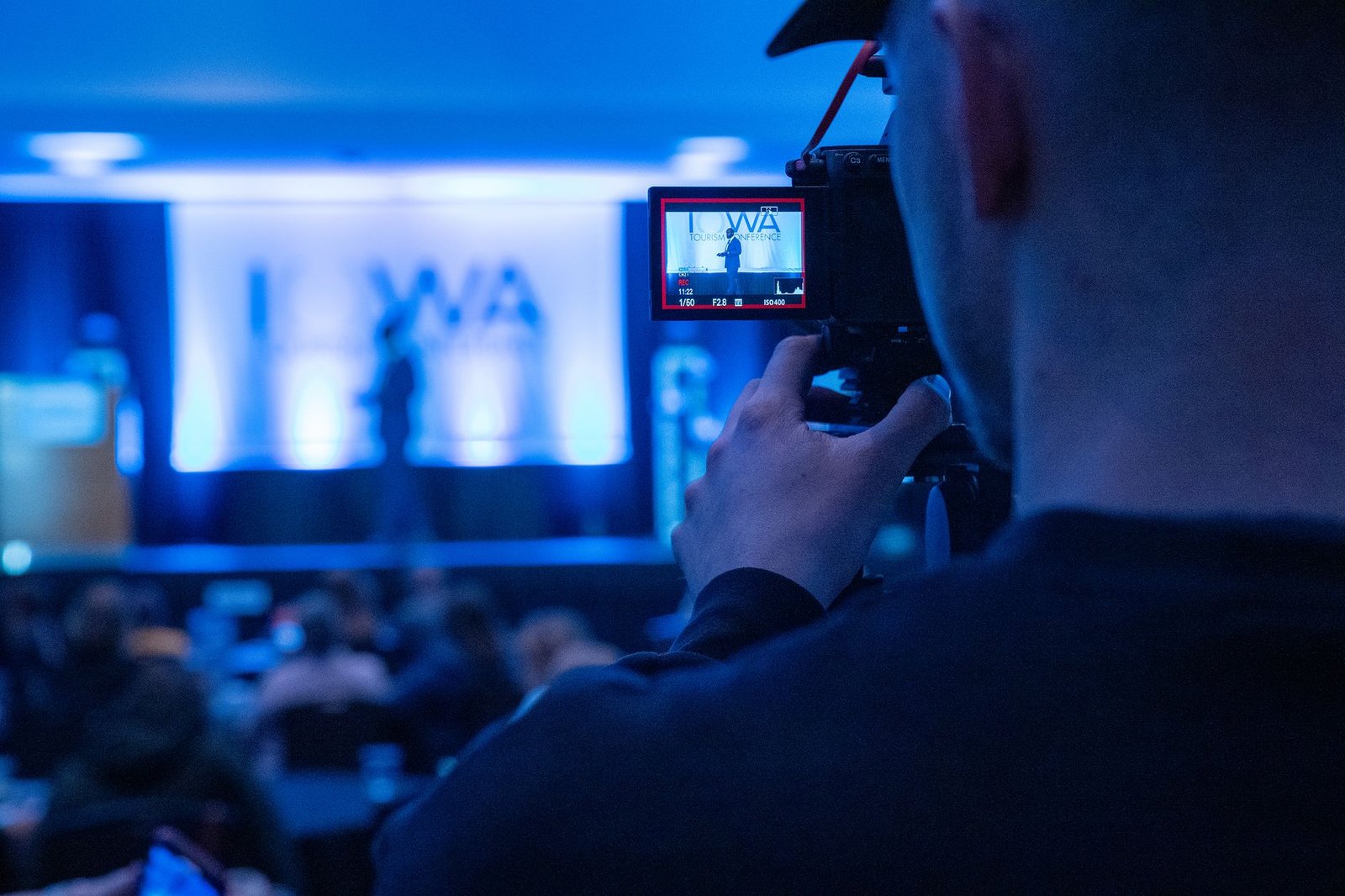
Reducing broadcast latency to under 3 seconds is the primary requirement for interactive Q&A sessions at US-based AI community gatherings. In New York, our multi-cam configurations utilize three Sony FX6 cameras connected via 12G-SDI cables to a central production hub, bypassing high-latency wireless transmitters that introduce a 150ms delay. Alesia RSVP's standardized technical stack incorporates hardware-based SRT (Secure Reliable Transport) protocols to stream directly to platforms like YouTube and Twitch, maintaining a 2.4-second end-to-end latency. This setup mirrors the infrastructure detailed in our AI Collective SF video and AV guide, which optimizes feeds for real-time developer engagement. This rapid transmission allows online viewers to participate in live-chat polls and developer Q&A sessions in real-time, matching the engagement levels of on-site attendees. Our production crew manages these feeds dynamically, switching between presenter close-ups and direct HDMI screen captures.
High-Velocity Content Delivery and Sizzle Reels
Delivering a high-impact event sizzle reel within 4 to 6 hours of the closing keynote maximizes social media momentum while the event is still trending. Our on-site editing teams, operating across major US hubs like Austin, utilize localized network-attached storage (NAS) arrays to ingest 4K footage from our cameras in real-time. This rapid workflow is modeled after our successful productions for global brands like OKX and Taiko, where social media engagement peaks within the first 12 hours post-event. By utilizing pre-built motion graphics templates and dedicated on-site editors, we bypass the typical two-week post-production bottleneck. This operational speed allows marketing directors to publish polished, high-resolution recaps on LinkedIn and X while the physical attendees are still traveling home. The resulting digital assets serve as powerful promotional tools for future developer meetups, securing early registrations and sponsorship commitments.
Audio Engineering and Noise Isolation for Interactive Demos
Maintaining a signal-to-noise ratio of over 60dB in active demo halls is required to capture clear audio for both live streams and on-site podcasts. In noisy convention spaces across Boston, ambient noise levels frequently exceed 85dB, requiring the deployment of directional sub-cardioid headset microphones rather than standard omnidirectional lapels. Alesia RSVP implements 32-bit float audio recording technology to prevent digital clipping when presenters transition from quiet explanations to enthusiastic audience interactions. Our audio engineers route all microphone feeds through digital mixing consoles equipped with real-time noise-suppression algorithms to isolate the speaker's voice. This precise audio management ensures that remote listeners can hear every line of code explained without distracting background chatter. Furthermore, we capture isolated audio tracks for each speaker, allowing our post-production teams to deliver pristine audio files for immediate podcast syndication.
Budget Allocation and ROI for Hybrid Community Events
Allocating 35% of your total event budget to dedicated AV production guarantees high-quality digital assets that extend the event's lifecycle indefinitely. Our historical data across 22 operational cities reveals that events utilizing professional multi-cam setups generate a 3x higher post-event view count compared to single-camera archival recordings. According to data from eventmarketer.com, professional video assets drive a 45% increase in post-event lead generation. For community organizers hosting events like The AI Collective in San Francisco, high-quality video assets serve as the foundation for year-round content marketing strategies. By repurposing 4K stage recordings into bite-sized vertical social edits, marketing teams can sustain community engagement for months after the physical doors close. This strategic approach transforms a one-day physical gathering into a continuous lead-generation engine.
Partner with Alesia RSVP for Your Next US Event
Executing flawless technical production for developer events requires deep operational expertise and a battle-tested technical stack. At Alesia RSVP, we take the complexity out of live streaming, multi-cam capture, and audio engineering, allowing you to focus on community engagement and content.
Explore our case studies at alesiarsvp.com/work
Questions Fréquentes
What is the minimum internet bandwidth required for a reliable dual-stream 1080p live stream?
At least 20 Mbps of dedicated upload speed is required to maintain a stable dual-stream broadcast at 1080p resolution. This bandwidth must be completely isolated from the attendee Wi-Fi network to prevent congestion from degrading the stream quality. At Alesia RSVP, we deploy Teradek bonded cellular systems alongside the venue's physical fiber connection to combine multiple network paths. This setup guarantees that if the primary fiber line drops, the stream seamlessly transitions to cellular networks without a single frame of packet loss, ensuring 99.9% uptime for global viewers.
How long does it take to receive the final edited 4K session recordings after the event ends?
Within 24 to 72 hours, our production team delivers fully mastered 4K session recordings with color grading and clean audio. For high-priority promotional assets like event sizzle reels, our on-site editors deliver the final cut within 4 to 6 hours of the closing keynote. We achieve this rapid turnaround by utilizing localized network-attached storage arrays to ingest footage in real-time. This eliminates post-event transfer delays and allows marketing directors to publish high-resolution recaps while social media momentum is at its peak.
Why is 32-bit float audio recording necessary for live technical demonstrations?
Primacy of 32-bit float audio lies in its ability to prevent digital clipping and distortion during unpredictable live demonstrations. In active developer environments, speakers often transition rapidly from quiet explanations to loud, enthusiastic audience interactions. Standard 24-bit audio can easily clip if the microphone input gain is set too high, ruining the recording. With 32-bit float, our audio engineers can recover quiet whispers or extremely loud peaks in post-production without introducing hiss or distortion, ensuring broadcast-grade audio for your event's digital archive.
What is the ideal camera setup for a hybrid panel discussion with four speakers?
Three cameras represent the optimal configuration for a four-person panel discussion to ensure dynamic and engaging coverage. This setup includes one wide shot capturing the entire stage and two tight cameras capturing active speakers and audience reactions. At Alesia RSVP, we utilize Sony FX6 cameras connected via physical 12G-SDI cables to eliminate transmission latency. This multi-cam configuration allows our director to switch angles seamlessly, keeping the visual flow engaging for remote viewers while maintaining high-resolution 4K capture for post-event marketing assets.