
Corporate Event Planning New York: AV & Vendor Guide
Corporate Event Planning New York: AV & Vendor Guide
A senior guide to navigating the complex logistics and production requirements of high-stakes B2B corporate events in New York City. This guide covers technical infrastructure, union labor nuances, and the strategic integration of visual assets to ensure long-term ROI.
How do you choose the right corporate event venue in New York City for high-end production?
Navigating the high-stakes world of New York corporate events requires more than just a venue; it demands a masterclass in logistics and premium visual storytelling. In a city where time is the most expensive commodity, a flawlessly executed event isn't a luxury—it's the baseline expectation for your brand's reputation. Selecting a space in Manhattan or Brooklyn isn't merely about the aesthetic or the zip code; it is about the technical infrastructure that supports high-end production. When evaluating a Corporate Events New York venue, the first assessment must be technical. Many historic NYC spaces, while visually stunning, lack the modern power distribution required for a full-scale LED wall or a multi-camera broadcast. You must ask for a detailed power plot early in the discovery phase. If the venue cannot provide at least 200 amps of dedicated three-phase power for production alone, you will likely face the additional cost and logistical headache of bringing in external generators or 'tie-ins' that require specialized electrical permits.
High ceilings are another non-negotiable factor for professional lighting rigs. In Midtown ballrooms or Chelsea lofts, a ceiling height of less than 14 feet often results in flat, unflattering shadows during keynotes because the light source is too close to the subject. To achieve a cinematic, three-dimensional look for your speakers, you need the vertical clearance to hang trusses and position 'key' and 'back' lights at the correct angles. Furthermore, internet stability is often the Achilles' heel of otherwise perfect venues. A shared guest Wi-Fi network is insufficient for a modern B2B summit. You must demand a dedicated fiber line with a redundant backup—ideally via a different ISP—to guarantee a seamless live stream to your global audience. Without this, a single local outage could silence your brand's message mid-presentation.
Beyond the technical specs, consider the flow of attendees and the 'hidden' logistics of the Manhattan grid. A premium conference requires distinct zones for networking, quiet work, and high-impact presentations. If the venue layout forces your AV team to run cables across high-traffic zones, the production quality—and attendee safety—suffers. You need a space that accommodates the 'behind the scenes' as gracefully as the 'on stage.' This includes a rigorous evaluation of the freight elevator capacity. In New York, logistics can quickly become a nightmare if your production team is stuck on a sidewalk during a 15-minute load-in window because the elevator is too small for a standard 4x8 stage deck or a pre-built LED rack. Always verify the 'clear opening' dimensions of the service entrance before signing a contract. The distance from the loading dock to the main stage area will directly impact your labor costs; every extra fifty feet of 'push' adds hours to the setup and strike times, which, in a union-heavy city like New York, can significantly inflate your budget.
What are the key logistics for managing vendors and AV in the NYC corporate scene?
Managing the vendor ecosystem in New York is an exercise in precision. Unlike smaller markets, NYC operates on a strict schedule of union labor, narrow delivery windows, and high-security protocols. Whether you are hosting a fintech summit at the Javits Center or a corporate town hall in a Financial District hotel, your vendor coordination must be centralized. Fragmented communication leads to technical glitches, such as audio interference between the stage and the podcast booth, or catering deliveries interrupting a live broadcast. In New York, the COI (Certificate of Insurance) is your first hurdle. Every vendor, from the florist to the lead videographer, must provide a COI that meets the specific, often stringent, requirements of the venue's management. Failure to have these documents approved 72 hours in advance can result in vendors being denied entry at the loading dock, a delay that cascades through the entire production schedule.
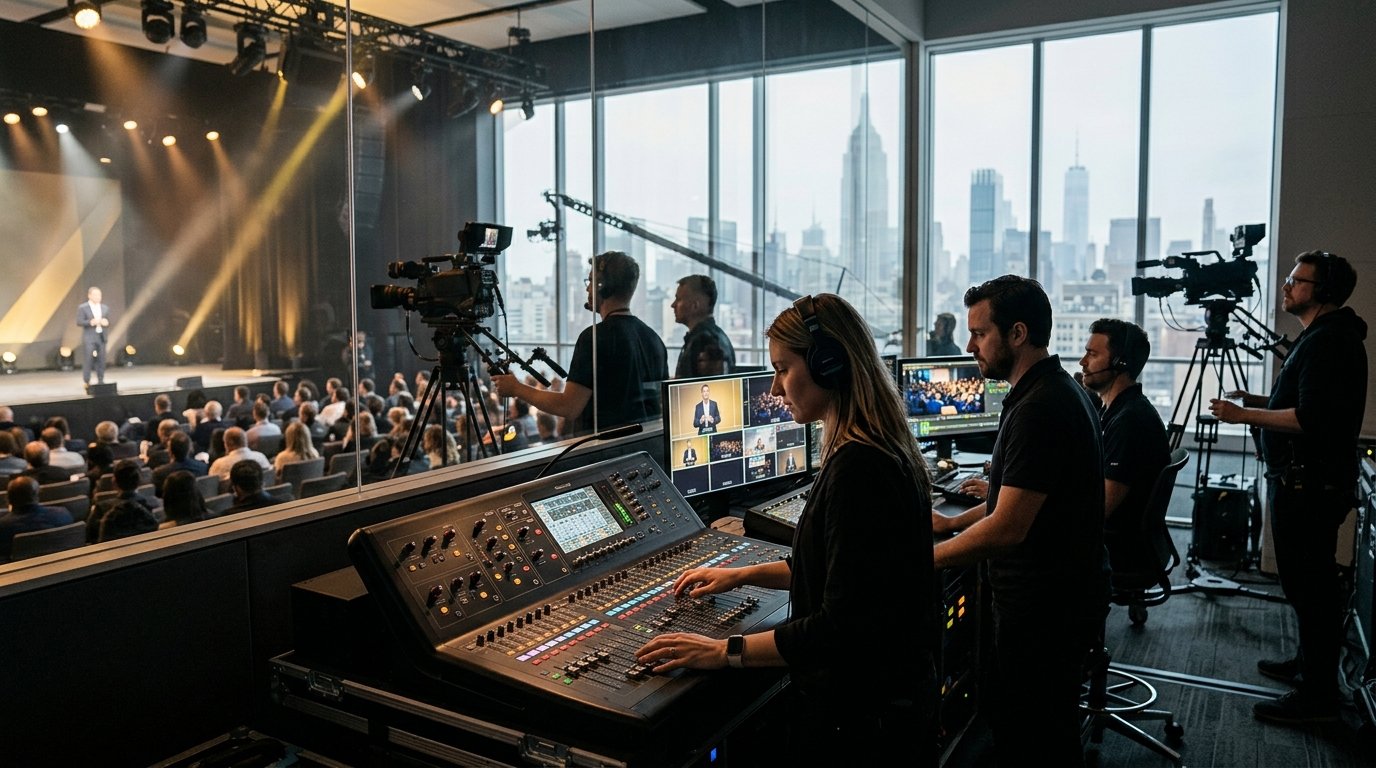
Professional AV production is the heartbeat of a modern B2B event. It is no longer enough to have 'a guy with a camera.' You need a dedicated technical director (TD) and a director of photography who understand the nuances of corporate branding. Every screen, microphone, and light must be calibrated to your brand’s visual identity. Color temperature consistency is vital; if your stage monitors are set to 6500K but your house lights are at 3200K, your recorded content will look amateurish and disjointed. When multiple vendors are involved—lighting from one company, sound from another, and streaming from a third—the risk of failure increases exponentially. Signal chain management becomes a game of 'he-said-she-said' when a video feed drops or an audio buzz occurs.
Centralizing these services under a single production partner ensures accountability. In the New York market, where every minute of downtime costs thousands of dollars, having a unified team that manages photography, video, and live streaming ensures that nothing is missed. This integration allows the photography team to know exactly when the stage lighting will change for a keynote, ensuring every shot in the Galerie Photo & Video is perfectly exposed and ready for immediate social media distribution. Furthermore, a unified team can manage the 'frequency coordination' required in a RF-heavy environment like Manhattan. With hundreds of wireless signals competing for bandwidth, a professional AV lead will use a spectrum analyzer to ensure your wireless microphones don't pick up interference from the Broadway show next door or the security radios downstairs. This level of technical foresight is what separates a standard corporate meeting from a world-class brand experience.
How can premium photo and video coverage elevate your New York B2B event ROI?
The true ROI of a New York corporate event is found in its digital legacy. The three days of your conference should generate three months of high-value marketing content. This is only possible if your visual production is handled with an editorial mindset rather than a purely documentary one. High-end photography and video coverage transform a fleeting moment into a permanent brand asset that can be used for investor relations, future event promotion, and thought leadership. In the competitive landscape of NYC business, your event's visual output serves as a proxy for the quality of your company. If your aftermovie looks like a generic smartphone recording, the perceived value of your insights drops instantly. You are not just capturing an event; you are producing a content library.
Professional coverage goes beyond capturing 'smiles and handshakes.' It involves documenting the energy of the room, the intensity of a panel discussion, and the sophisticated environment you have curated. This requires a team that understands 'the frame' as well as 'the floor.' For instance, a skilled event photographer in New York knows how to use the city's iconic architecture—whether it's the skyline through a window or the industrial grit of a Brooklyn warehouse—to anchor the event in its location, adding a sense of prestige and scale. On the video side, capturing high-quality 'B-roll' of networking sessions and product demos provides the raw material for social media 'sizzle reels' that can be deployed within hours of the event's conclusion. This real-time content delivery is crucial for maintaining momentum on platforms like LinkedIn, where the conversation moves fast.
Alesia RSVP bridges the gap between complex NYC event logistics and high-end brand representation, ensuring that every vendor coordination and AV setup is captured through a premium lens to maximize your event's digital legacy. We understand that in the corporate world, the image of the event is often as important as the event itself. Our team operates with the discretion and professionalism required for C-suite environments, delivering magazine-quality assets without disrupting the flow of the proceedings. We utilize a DIT (Digital Imaging Technician) workflow on-site, allowing us to ingest, cull, and color-grade assets in real-time. This means your PR team has access to 'hero' shots while the keynote speaker is still on stage.
Ultimately, New York events are high-pressure environments where the difference between success and failure lies in the details. Don't leave your brand's visual identity to chance. Partnering with a team that understands both the logistics of the floor and the demands of the frame ensures your next Manhattan summit is a definitive success. By treating your event as a broadcast production rather than a simple gathering, you ensure that the investment made in the venue and the speakers continues to pay dividends long after the final attendee has left the building. The goal is to create a 'content engine' that fuels your marketing strategy for the quarters to come, turning a one-time expense into a long-term asset.
FAQ
What are the most important factors when planning a corporate event in New York?
The most critical factors are technical infrastructure, union labor regulations, and strict load-in logistics. You must ensure the venue has sufficient power (ideally 3-phase) and high-speed dedicated fiber internet for AV production. Additionally, you must budget for the specific time constraints and labor rules imposed by NYC freight and security protocols, which often require specialized COIs and pre-scheduled loading dock windows.
How does Alesia RSVP integrate with existing AV and planning teams for seamless coverage?
We act as a specialized production layer that coordinates directly with your venue, AV leads, and logistics managers. By handling photo, video, and streaming under one roof, we reduce the communication overhead. We participate in site visits and production calls to ensure our technical requirements—such as camera placements, lighting needs, and data lines—are baked into the master event floor plan for flawless execution without interfering with attendee flow.
Why is professional vendor coordination essential for multi-day B2B events in NYC?
In NYC, fragmented vendors lead to scheduling conflicts and technical interference. A unified coordination strategy ensures that catering, security, and high-end AV production work in sync. This prevents costly delays, such as 'dark time' during union breaks or signal interference between different wireless systems. It also ensures that the visual brand remains consistent across all event touchpoints, from the stage design to the final digital assets.
How do you handle the unique security and insurance requirements of NYC venues?
NYC venues, especially high-profile hotels and corporate towers, have strict Certificate of Insurance (COI) requirements and security screenings. We maintain comprehensive insurance coverage that meets or exceeds the standards of major Manhattan venues. Our team is experienced in navigating the 'loading dock to ballroom' workflow, ensuring all personnel are vetted and all equipment is moved according to the building's specific security and freight elevator policies.
Questions Fréquentes
What are the most important factors when planning a corporate event in New York?
The most critical factors are technical infrastructure, union labor regulations, and strict load-in logistics. You must ensure the venue has sufficient power (ideally 3-phase) and high-speed dedicated fiber internet for AV production. Additionally, you must budget for the specific time constraints and labor rules imposed by NYC freight and security protocols, which often require specialized COIs and pre-scheduled loading dock windows.
How does Alesia RSVP integrate with existing AV and planning teams for seamless coverage?
We act as a specialized production layer that coordinates directly with your venue, AV leads, and logistics managers. By handling photo, video, and streaming under one roof, we reduce the communication overhead. We participate in site visits and production calls to ensure our technical requirements—such as camera placements, lighting needs, and data lines—are baked into the master event floor plan for flawless execution without interfering with attendee flow.
Why is professional vendor coordination essential for multi-day B2B events in NYC?
In NYC, fragmented vendors lead to scheduling conflicts and technical interference. A unified coordination strategy ensures that catering, security, and high-end AV production work in sync. This prevents costly delays, such as 'dark time' during union breaks or signal interference between different wireless systems. It also ensures that the visual brand remains consistent across all event touchpoints, from the stage design to the final digital assets.
How do you handle the unique security and insurance requirements of NYC venues?
NYC venues, especially high-profile hotels and corporate towers, have strict Certificate of Insurance (COI) requirements and security screenings. We maintain comprehensive insurance coverage that meets or exceeds the standards of major Manhattan venues. Our team is experienced in navigating the 'loading dock to ballroom' workflow, ensuring all personnel are vetted and all equipment is moved according to the building's specific security and freight elevator policies.