
India's MICE Revolution: Ambition Meets Premium Production
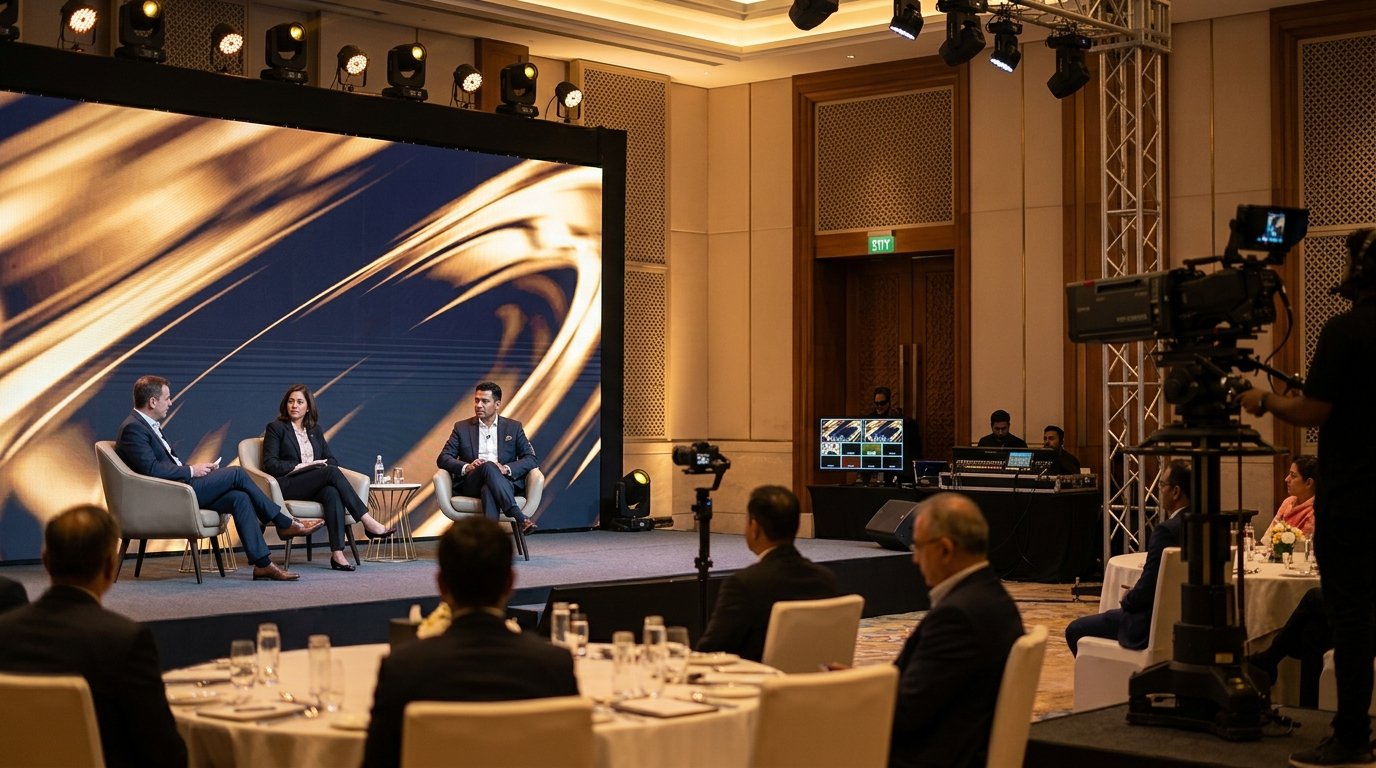
India's MICE Revolution: Ambition Meets Premium Production
India is radically transforming its event landscape with massive investments in world-class infrastructure. Discover how high-end visual production and technical expertise are elevating these new hubs to meet global corporate and luxury standards.
Why India is Emerging as a Global MICE Powerhouse
India is no longer just a back-office tech hub; it is aggressively positioning itself as the gravity center for global business gatherings. Riding a post-G20 wave of momentum, the nation generated $49.4 billion in MICE (Meetings, Incentives, Conferences, and Exhibitions) revenue last year. This is merely the baseline: Tourism Minister Gajendra Singh Shekhawat projects a doubling of this figure to $103.7 billion by 2030. This exponential growth is fueled by strategic destinations like Varanasi, Khajuraho, and Kochi, which complement the established powerhouses of Delhi and Mumbai. The government’s 'Meet in India' campaign is a clear signal that the country is ready to compete with traditional Southeast Asian and Middle Eastern hubs.
This trajectory mirrors the rapid ascent of hubs like Dubai, where infrastructure preceded demand to create a self-sustaining ecosystem. India is following suit with monumental investments in venues like Yashobhoomi (IICC) in Dwarka and Bharat Mandapam in New Delhi. These venues are designed to host tens of thousands of delegates with integrated, state-of-the-art technology. However, for international organizers, success isn't measured by square footage alone, but by the ability to deliver a seamless, secure, and predictable experience. Recent discussions on the Indian event industry highlight that the nation must still prove its operational maturity against rigorous Western standards.
For CMOs and B2B event planners, India offers a unique differentiation opportunity. Hosting a tech summit in Bangalore or a financial forum in Mumbai provides physical presence in one of the world's most dynamic markets. But this ambition requires flawless production. Large-scale events in India must be documented with surgical precision to justify ROI to headquarters in London, Paris, or New York. The transition from an 'emerging' destination to a 'top-tier' choice depends on perceived quality. This perception is rooted in imagery: high-end video capture, editorial-grade content, and the ability to broadcast absolute professionalism. India must move from being an 'exotic' destination to a 'premium' platform.
Navigating Logistical Hurdles for Luxury B2B Events
Despite government optimism, the ground reality for event organizers remains complex. As Ramanpreet Singh of SKIL notes, a successful MICE destination requires more than just a shiny convention center. Indian logistics, while improving via projects like the PM Gati Shakti master plan, still face structural challenges. Reliability is the primary concern for corporate decision-makers, especially following infrastructure hiccups at major hubs like Delhi’s Terminal 1. For a VP of Events, uncertainty is the enemy. Managing transport flows in congested cities, ensuring redundant high-speed fiber for live streaming, and coordinating local vendors require a level of field expertise that few agencies possess at scale.
Industry leaders are closely watching MICE trends by BizBash to adapt formats for modern delegates who demand 'invisible' but omnipresent technology. In India, the challenge is marrying traditional hospitality (Atithi Devo Bhava) with absolute technical rigor. Audiovisual production cannot be approximate. In vast spaces like the Jio World Convention Centre, broadcast-level video capture and complex audio engineering are mandatory to avoid the 'echo chamber' effect or signal drops. Premium brands don't just want a venue; they want a controlled environment where their message isn't diluted by technical glitches or mediocre visual execution.
Furthermore, standardizing quality across regions remains a hurdle. While Tier-1 cities boast 4K cameras, Tricaster rigs, and automated lighting, emerging spots like Kochi or Goa often require complex equipment and talent imports. For a strategic summit, relying solely on local teams without international oversight is a risk many global brands are no longer willing to take. Mastering the technical supply chain—from ATA Carnets for specialized gear to international lighting aesthetics (clean lines, natural colorimetry)—is the real bottleneck. The gap between a 'locally successful' event and a 'globally memorable' one lies in this execution.
How Premium Visual Production Validates New Infrastructure
Physical infrastructure is just the stage; visual production is the narrative that brings the event to life and grants it international legitimacy. For India’s new hubs, the goal is to transform massive, sometimes sterile spaces into prestigious brand environments. High-caliber photo and video coverage can smooth over peripheral logistical imperfections, focusing instead on the intellectual and networking power of the summit. By producing cinematic aftermovies, studio-quality interviews, and editorial galleries—similar to those found in our photo and video gallery—brands validate their investment and strengthen their authority in the Indian market.
Video capture is no longer just an archive; it is a strategic post-event marketing tool. In India’s rich but often visually saturated culture, standing out requires a clean, minimalist, international aesthetic. This includes 'three-point lighting' executive interviews, FPV drone shots to capture the scale of new centers, and real-time content delivery to fuel global social channels while the event is live. This responsiveness allows an event in Hyderabad or Pune to resonate instantly in the City of London or on Wall Street. Content becomes the bridge between local ambition and global recognition.
Alesia RSVP operates at this intersection: bringing European production rigor and a premium aesthetic to ambitious projects in expanding markets. We understand that for a Marketing Director, the event doesn't end when the convention center doors close; it begins its second life through the digital assets produced. By mastering the entire visual chain—from corporate photography to multi-camera live streaming—we ensure India’s ambition meets the exacting standards of global brands. It is about translating Indian scale into a visual language that speaks to international investors.
In conclusion, India is undeniably redefining its place on the global MICE map. For international firms, success won't just come from choosing the right city, but from partnering with those who can translate that local energy into a world-class brand story.
FAQ
What are the key MICE hubs in India for international B2B events?
Delhi (NCR) and Mumbai remain the primary hubs due to venues like Bharat Mandapam and Jio World. However, Bangalore, Hyderabad, and increasingly Kochi and Goa are emerging as specialized destinations for tech and incentive travel.
How does India's MICE infrastructure compare to Dubai or Singapore?
India's newest venues are comparable in scale and technology to those in Dubai and Singapore. The main difference lies in the surrounding urban infrastructure and logistical predictability, which India is currently addressing through massive national projects.
Questions Fréquentes
What are the key MICE hubs in India for international B2B events?
Delhi (NCR) and Mumbai remain the primary hubs due to venues like Bharat Mandapam and Jio World. However, Bangalore, Hyderabad, and increasingly Kochi and Goa are emerging as specialized destinations for tech and incentive travel.
How does India's MICE infrastructure compare to Dubai or Singapore?
India's newest venues are comparable in scale and technology to those in Dubai and Singapore. The main difference lies in the surrounding urban infrastructure and logistical predictability, which India is currently addressing through massive national projects.