
Hybrid Event Production Seoul: 2026 Corporate AV Guide
Hybrid Event Production Seoul: 2026 Corporate AV Guide
Seoul's 2026 event landscape demands a sophisticated mix of local flair and global broadcast standards to engage high-level B2B decision-makers. As the city evolves into a premier destination for high-tech corporate gatherings, the integration of advanced AV pillars is no longer optional—it is the baseline for success.
What are the essential AV pillars for a premium hybrid event in Seoul?
As Seoul cements its status as a global tech hub for 2026, the question for international marketing directors is no longer whether to host an event in the South Korean capital, but how to ensure that event resonates across time zones. The city’s infrastructure—from the sprawling COEX Convention & Exhibition Center in Gangnam to the architecturally stunning Dongdaemun Design Plaza (DDP)—is world-class. However, physical infrastructure is only half of the equation. To compete on a global stage, brands must deploy a five-pillar AV strategy: editorial-grade photography, cinematic video production, broadcast-quality live streaming, on-site podcasting, and integrated event management. This isn't about simply ‘covering’ an event; it is about creating a high-fidelity digital twin of the experience that serves a global audience. In the 2026 landscape, the convergence of 6G-ready networks and AI-driven production workflows means that the technical margin for error is zero.
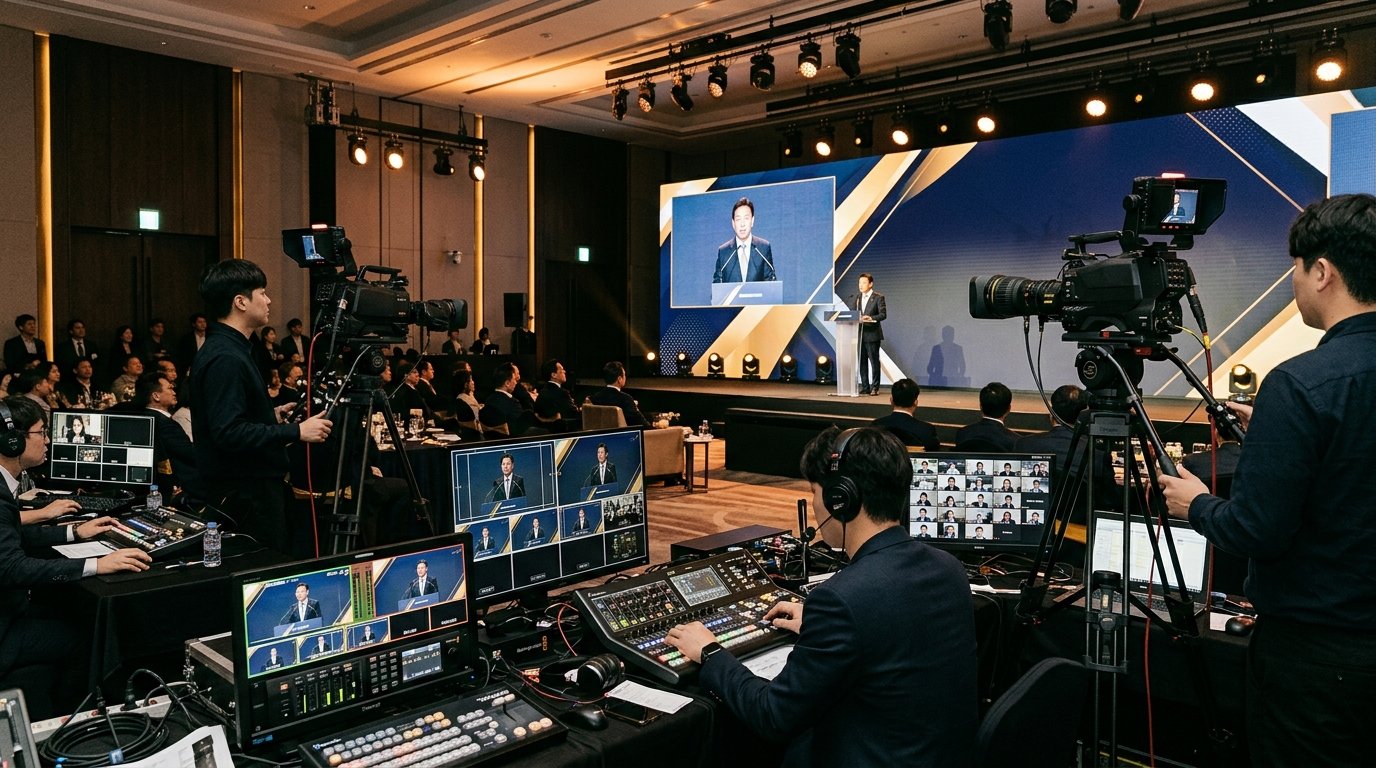
In the context of 2026, corporate events must move away from the static, one-way broadcasts of the past. The benchmark has shifted toward high-production value that rivals traditional television. For a summit in Seoul to be successful, the visual output must be indistinguishable from a major media network’s production. This requires multi-camera setups—often involving 4K or 6K sensors—that capture the energy of the room while delivering crisp, low-latency feeds to remote participants. Whether you are operating in Seoul or comparing the production standards to other Asian hubs like Singapore, the demand for visual excellence remains the same. Corporate stakeholders expect a seamless blend of on-site logistics and digital distribution that maximizes the shelf-life of every keynote and panel discussion. This involves a deep understanding of the local technical landscape, including high-speed fiber backbones and the specific power requirements of high-intensity LED walls often found in Seoul’s premium venues.
Photography in this environment cannot be an afterthought. We are seeing a move away from 'grip-and-grin' snapshots toward editorial-style coverage that tells a narrative. A multi-photographer team is essential for large-scale summits to capture both the high-stakes moments on stage and the nuanced networking in the wings. These images are the primary assets for post-event PR and sponsor reports. When the visual quality is high, the perceived value of the event increases. This is why we prioritize magazine-quality output with same-day delivery, ensuring that social media teams have professional assets while the event is still trending. To see the difference between standard coverage and premium editorial work, one only needs to view our visual production gallery. Furthermore, the 2026 standard requires photographers to work in tandem with the video team to ensure lighting consistency across all mediums, preventing the jarring color shifts that often plague lower-tier productions. The goal is a unified visual brand identity that persists from the first teaser post to the final wrap report.
How does professional live streaming and keynote recording ensure global reach for 2026 conferences?
By 2026, the 'hybrid' label will be redundant because every major B2B conference will be hybrid by default. In Seoul, a city known for its hyper-connectivity, the technical expectation for live streaming is exceptionally high. A standard Zoom link or a single-camera feed is no longer acceptable for enterprise-level summits. Professional live streaming requires a robust broadcast stack: redundant internet lines (often utilizing both local fiber and satellite backups like Starlink for mission-critical feeds), hardware encoders, and a dedicated gallery team managing multiple angles. This setup ensures that a CEO delivering a keynote in Gangnam is seen and heard with the same clarity in London, New York, or Dubai. The goal is to eliminate the 'second-class citizen' experience for remote attendees by offering them interactive elements, real-time polling, and high-definition visuals that keep them engaged for the duration of the session.
Keynote recording goes beyond the live broadcast. It is about the creation of a permanent content library. Every session recorded at a 2026 Seoul summit should be treated as a high-value asset for future marketing funnels. This involves post-production that adds polished graphics, clear audio mastering, and multi-language subtitling to cater to a global B2B audience. When a brand invests in high-end recording, they are essentially creating a year's worth of thought leadership content in a single weekend. This strategic approach to AV production transforms a localized event into a global brand moment. In 2026, we also see the rise of 'simulive' elements, where pre-recorded high-production segments are woven into the live stream to ensure perfect delivery of complex technical demonstrations or remote guest appearances, all managed through a centralized master control room.
At Alesia RSVP, we view the technical production as the bedrock of brand storytelling. Leveraging our global expertise from hubs like Paris and Dubai, Alesia RSVP brings a cinematic, high-end approach to Seoul's 2026 event landscape. We integrate all five AV pillars into a seamless premium brand narrative, ensuring that the technical execution never distracts from the message, but rather elevates it. For companies hosting summits in Seoul, this means a single point of contact for everything from the initial site visit to the final delivery of 4K recap videos. This integration is critical for maintaining quality control across the various digital outputs of a modern conference. By managing the signal chain from the microphone on stage to the server in the cloud, we eliminate the fragmentation that often occurs when multiple vendors are involved, ensuring that the brand’s voice remains clear and consistent throughout the global broadcast.
Why are on-site podcasts and cinematic aftermovies the new standard for B2B event ROI?
The true measure of a corporate event's success in 2026 will be the volume and quality of content generated on-site. Traditional event ROI was measured in badge scans; modern ROI is measured in content impressions and executive engagement. On-site podcasting has emerged as one of the most effective ways to capture this. By setting up a professional, glass-walled podcast studio in the heart of the networking lounge, brands can record intimate, high-impact interviews with speakers, sponsors, and VIP attendees. These recordings provide a raw, authentic perspective that structured keynotes often lack. They are also incredibly versatile, easily sliced into short-form video clips for LinkedIn or long-form audio for industry-specific podcast channels. The presence of a physical studio also acts as a visual magnet, signaling to attendees that the event is a center for thought leadership and active conversation.
Simultaneously, the cinematic aftermovie has evolved. The era of the generic montage set to upbeat stock music is over. A 2026 aftermovie must be a documentary-style narrative that captures the 'why' of the event. It should feature high-quality interviews, sweeping drone shots of the Seoul skyline—capturing the contrast between ancient palaces and futuristic skyscrapers—and candid moments of high-level networking. This video becomes the primary sales tool for the following year’s event, proving the caliber of the audience and the depth of the programming. Production teams now use cinema-grade cameras and anamorphic lenses to give these films a distinct, high-end look that stands out in a crowded digital feed. This isn't just about recording what happened; it's about crafting a legacy for the brand that justifies the significant investment of both the host and the attendee.
Ultimately, the transition from a local seminar to a global summit requires a partner who understands the nuances of corporate communication. Alesia RSVP provides this bridge, offering the strategic oversight of a management agency and the technical precision of a production house. In a market as competitive as Seoul, settling for 'good enough' AV is a risk to brand equity. Forward-thinking event planners are already looking toward 2026, securing production partners who can handle the complexity of multi-track summits while delivering a polished, cinematic finish. The future of events in Seoul is high-definition, high-engagement, and content-driven. By focusing on the long-term utility of the assets created—whether it's a podcast series that runs for six months post-event or a series of keynote highlights used for lead generation—brands can ensure that their Seoul summit continues to deliver value long after the stage has been dismantled.
FAQ
What makes Seoul a top destination for hybrid B2B events in 2026?
Seoul offers a unique combination of ultra-high-speed digital infrastructure and world-class venues like COEX and DDP. By 2026, the city's focus on integrating smart-city technology into the MICE industry makes it the ideal location for high-production hybrid summits that require reliable global broadcasting and a sophisticated urban backdrop.
How does Alesia RSVP handle technical production for international keynote speakers?
We provide a comprehensive technical suite including premium microphone systems, high-fidelity monitoring, and dedicated speaker support. For hybrid events, we manage the integration of remote speakers via low-latency broadcast protocols, ensuring they can interact with the on-site audience and moderators without the delays typical of standard web-conferencing tools.
What is the typical lead time for booking full AV production in Seoul?
For major summits in 2026, we recommend a lead time of 6 to 9 months. This allows for detailed site visits, custom set design, and the securing of high-end equipment and specialized crew. Early booking also ensures that the technical strategy can be integrated into the event's marketing plan from the outset.
Can on-site podcasting be integrated into the live stream?
Yes, on-site podcasting can serve as excellent 'interstitial' content. During breaks in the main stage program, we can cut to the podcast studio for live interviews and commentary, keeping the remote audience engaged and providing a more dynamic, multi-channel experience.
Questions Fréquentes
What makes Seoul a top destination for hybrid B2B events in 2026?
Seoul offers a unique combination of ultra-high-speed digital infrastructure and world-class venues like COEX and DDP. By 2026, the city's focus on integrating smart-city technology into the MICE industry makes it the ideal location for high-production hybrid summits that require reliable global broadcasting and a sophisticated urban backdrop.
How does Alesia RSVP handle technical production for international keynote speakers?
We provide a comprehensive technical suite including premium microphone systems, high-fidelity monitoring, and dedicated speaker support. For hybrid events, we manage the integration of remote speakers via low-latency broadcast protocols, ensuring they can interact with the on-site audience and moderators without the delays typical of standard web-conferencing tools.
What is the typical lead time for booking full AV production in Seoul?
For major summits in 2026, we recommend a lead time of 6 to 9 months. This allows for detailed site visits, custom set design, and the securing of high-end equipment and specialized crew. Early booking also ensures that the technical strategy can be integrated into the event's marketing plan from the outset.
Can on-site podcasting be integrated into the live stream?
Yes, on-site podcasting can serve as excellent 'interstitial' content. During breaks in the main stage program, we can cut to the podcast studio for live interviews and commentary, keeping the remote audience engaged and providing a more dynamic, multi-channel experience.