
India’s MICE Industry: A $100B Strategic Hub by 2030
India’s MICE Industry: A $100B Strategic Hub by 2030
India is radically transforming its infrastructure to position itself as a future global leader in the MICE sector. This deep dive analyzes the operational challenges and strategic opportunities for high-level international B2B events in the subcontinent.
Why is India becoming a strategic destination for international MICE?
India is no longer just a participant in the global business calendar; it is now aiming to dominate it. With a target of $103.7 billion in revenue for the MICE (Meetings, Incentives, Conferences, and Exhibitions) sector by 2030—up from $49.4 billion last year—the country is undergoing an unprecedented structural transformation. This isn't just optimistic forecasting; it is a state-backed strategy validated by the Ministry of Tourism. The G20 summit served as a masterclass in proof-of-concept, demonstrating that ultra-modern convention centers like Bharat Mandapam and Yashobhoomi (IICC) can rival, and in some cases surpass, the established standards of Corporate Events Singapore or Geneva.
For CMOs and VP Events, India represents a new frontier where explosive economic growth meets modernized infrastructure. The Indian government’s 'National Strategy and Roadmap for the MICE Industry' aims to double India’s global market share by 2025. This political push translates into tax incentives and streamlined administrative procedures for foreign organizers. Emerging hubs like Kochi, Varanasi, and Khajuraho are stepping out of the shadows of traditional metros to offer immersive experiences that blend millennial cultural heritage with cutting-edge tech. This geographic expansion allows brands to segment their offerings: tech summits in Bangalore, executive retreats in Rajasthan, and massive industrial conventions in Ahmedabad.
However, success depends on India’s ability to turn these investments into high-trust hubs for Fortune 500 companies that demand absolute operational fluidity. India’s appeal also lies in its talent pool and leadership in the tech and pharma sectors, creating an ecosystem where event content is as rich as the setting. Transitioning from leisure tourism to structured business tourism requires the professionalization of the entire value chain—from Destination Management Companies (DMCs) to technical providers. For global brands, establishing a presence in India through large-scale events is a way to assert dominance in the decade's most dynamic market while benefiting from competitive production costs compared to North American or European hubs.
What are the real-world challenges of hosting world-class B2B events in India?
Building a monumental convention center is one thing; orchestrating a functional MICE ecosystem is another. Industry experts, as seen in Professional discussions on the future of MICE in India, often highlight the gap between political ambition and on-the-ground operational reality. Organizing a world-class B2B summit in India requires overcoming logistical hurdles that construction budgets alone cannot solve: last-mile connectivity, streamlined visa processes for international delegates, and the standardization of technical support services.
A successful event is more than just four walls and high-speed Wi-Fi. It requires an integrated service chain, including premium transportation capable of navigating complex urban traffic, luxury hospitality suited for massive VIP flows, and local technical expertise aligned with Western expectations. Compared to mature hubs like Corporate Events Dubai, India still needs to prove its consistency in execution. The risk for international organizers is facing a fragmented service environment where communication between subcontractors lacks fluidity. While bureaucracy is decreasing through digitalization, it can still hinder the temporary import of specialized equipment or the acquisition of drone permits essential for high-end media coverage.
This is where partner selection becomes the ultimate ROI determinant. The user experience begins at the airport—with efficient Meet & Greet services—and ends with the quality of the content produced on-site. Managing the local supply chain requires a nuanced understanding of Indian business customs. For instance, concepts of punctuality and 'finishing' can vary, necessitating constant supervision by experienced production directors. Ignoring these operational details compromises brand reputation among demanding stakeholders. Success requires marrying legendary Indian hospitality (Atithi Devo Bhava) with Six Sigma-style project management rigor.
Ensuring premium media coverage in an emerging global hub
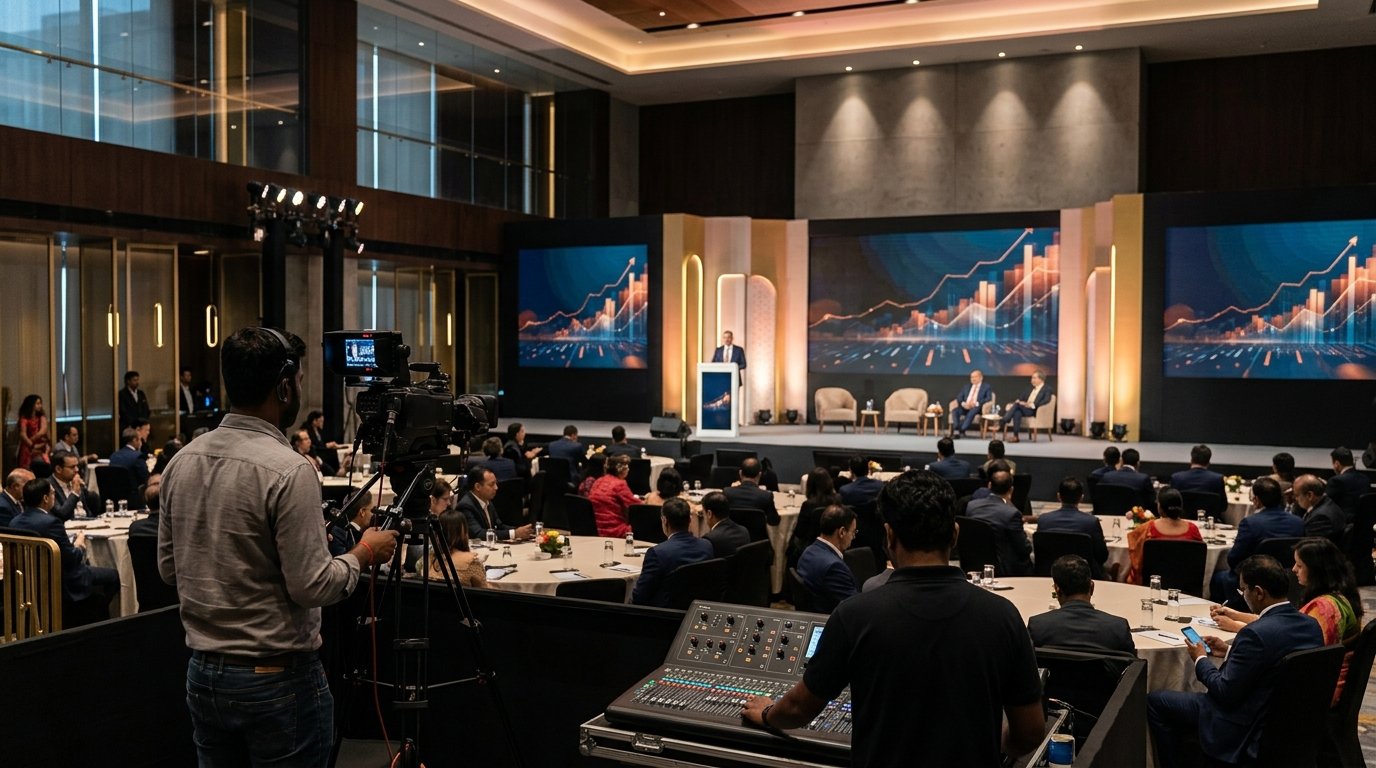
In emerging destinations like Kochi or Varanasi, visual documentation isn't a secondary line item; it is a fundamental lever of credibility. When a company chooses to move its annual summit to India instead of London or Singapore, it takes a perception risk. High-quality media coverage—editorial photography, recap videos, live streaming—is the tool that validates this strategic choice to investors, partners, and absent clients. Premium visual production transforms a local event into a global brand statement, proving the company can operate with excellence anywhere in the world.
B2B decision-makers need tangible proof to validate the success of an event in a new geography. To understand the impact of professional imagery, one can browse our Photo & Video Gallery: the clarity of a keynote captured in 4K, the precision of a magazine-style photo report, or the use of real-time motion graphics removes geographic distance and reinforces the organizer's authority. If India wants to capture that $100 billion market, it must ensure every major conference generates content that rivals the standards seen in Industry Trends on BizBash.
Post-event content production is the true value multiplier. A hard-hitting aftermovie, a podcast series recorded on-site in a mobile studio, or thought-leader interviews shared on LinkedIn extend the event’s lifecycle by months. In India, the diversity of landscapes and the architecture of new centers provide an exceptional visual backdrop, but this requires film crews capable of managing shifting light conditions and complex acoustic environments. The content shouldn't just document; it must tell a story: that of a company at the cutting edge of innovation, operating in the new center of gravity of the global economy. Without this premium production layer, the event remains confined to its physical attendees, losing 90% of its potential impact.
Essential infrastructure for a successful corporate event
The success of a corporate event relies on invisible but infallible technical infrastructure. In India, this means demanding guarantees on live streaming redundancy and audiovisual equipment quality. New Indian convention centers now integrate podcast studios, connected press rooms, and latest-generation broadcast galleries. However, equipment alone is insufficient without a technical direction capable of anticipating the unpredictability of emerging markets, such as power fluctuations or network latency spikes. For high-stakes events, such as those featured in Our Events, the management of lighting, acoustics, and video capture must be handled with absolute rigor.
Essential infrastructure also includes hybrid participant management solutions. With the rise of remote work, a convention center's ability to offer a seamless experience for both in-person and virtual delegates is non-negotiable. This involves not just bandwidth, but the ability to integrate interactive platforms that comply with international data standards like GDPR—a crucial point for European and US companies operating in India. By combining world-class venues with international-standard technical production, India is well on its way to becoming the premier destination for the next generation of global B2B summits.
FAQ
What is the projected growth of the Indian MICE market by 2030?
The Indian MICE sector is projected to reach $103.7 billion by 2030, driven by massive government investment in infrastructure and a national strategy to increase global market share.
What are the top venues for international conferences in India?
Key venues include Bharat Mandapam and Yashobhoomi (IICC) in New Delhi, which offer world-class facilities comparable to major hubs in Singapore and Europe.
How can international brands mitigate logistical risks in India?
Success requires partnering with experienced production teams and DMCs who understand local nuances, coupled with a focus on high-end visual documentation to ensure brand consistency.
Questions Fréquentes
What is the projected growth of the Indian MICE market by 2030?
The Indian MICE sector is projected to reach $103.7 billion by 2030, driven by massive government investment in infrastructure and a national strategy to increase global market share.
What are the top venues for international conferences in India?
Key venues include Bharat Mandapam and Yashobhoomi (IICC) in New Delhi, which offer world-class facilities comparable to major hubs in Singapore and Europe.
How can international brands mitigate logistical risks in India?
Success requires partnering with experienced production teams and DMCs who understand local nuances, coupled with a focus on high-end visual documentation to ensure brand consistency.