
Mastering B2B Roadshows: A Visual Production Strategy
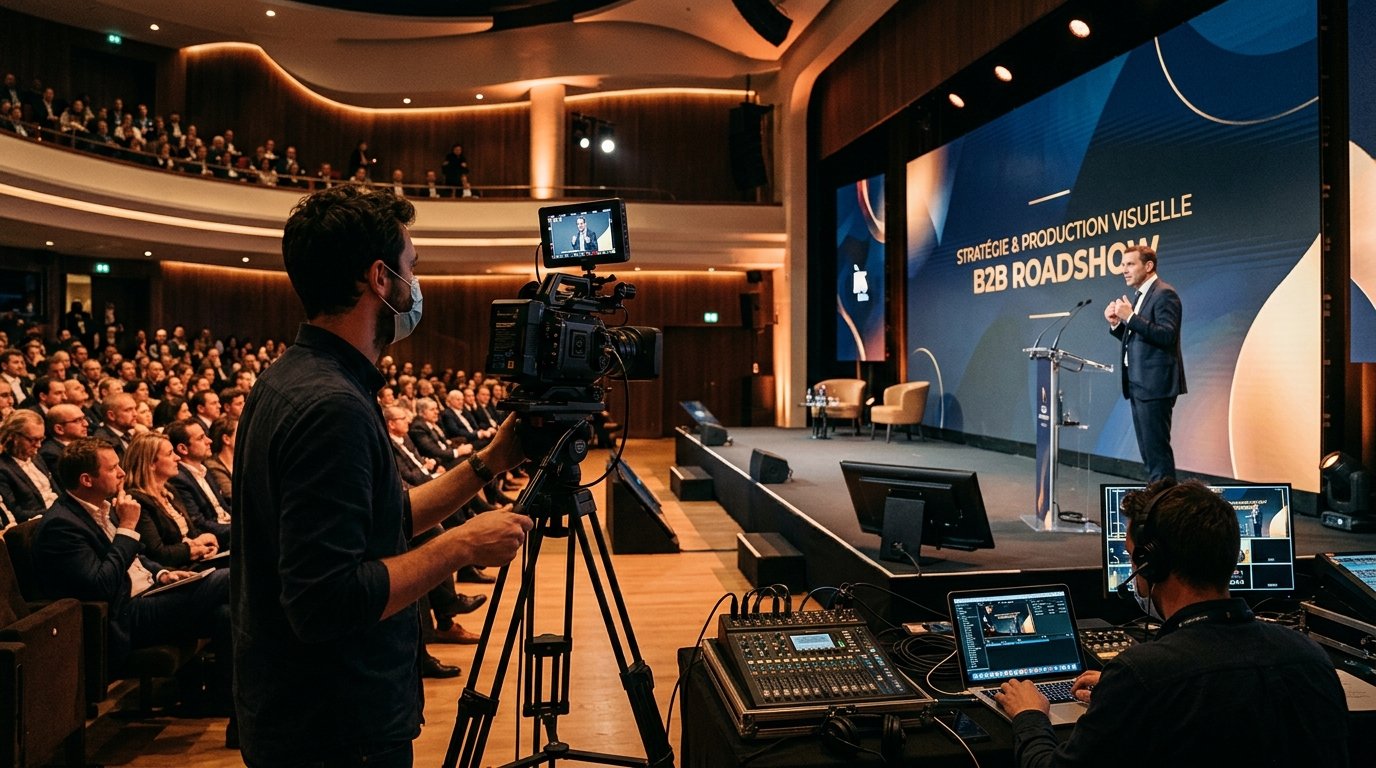
Mastering B2B Roadshows: A Visual Production Strategy
A roadshow is the ultimate tool for client proximity, but its success hinges on flawless and uniform visual execution at every stop. To transform a touring event into a powerful marketing asset, centralizing production is the key differentiator for global brands.
How to Organize a Successful International Brand Roadshow
Launching a roadshow is like orchestrating a touring symphony where every movement must reflect your brand’s excellence. But how do you capture the essence of a global tour without losing visual quality from one city to the next? For CMOs and VPs of Events, the challenge isn't just logistical; it’s a matter of strategic communication. A successful roadshow isn't just about showing up in ten different cities; it’s about creating a continuous narrative that resonates globally while adapting locally. Strategic planning begins with defining a 'red thread'—a narrative backbone—that supports the entire operation.
Organizing an international tour requires a 'hub-and-spoke' model. A central strategy defines the message and quality standards, but execution must be fluid on the ground. Experience shows that the most successful brands maintain the same intensity from the kick-off to the final date. This involves a rigorous selection of venues that embody the corporate identity, whether in Paris, Singapore, or New York. The venue choice isn't just about capacity; it’s a set design for your visual production. An industrial loft in Berlin and a historic townhouse in London must coexist in the same recap film without creating aesthetic dissonance.
Planning must also anticipate cultural nuances at every stop. A roadshow in Dubai will have a different rhythm than a series of executive briefings in London or San Francisco. However, for the digital audience following the tour on LinkedIn or via newsletters, the experience must feel monolithic and powerful. It is crucial to establish a production schedule that includes dedicated capture time, separate from networking sessions, to ensure 'clean' and professional imagery. This is where content production acts as the indispensable glue of your touring brand strategy. Without a global vision for capture during the scouting phase, you risk ending up with disparate content that dilutes the impact of your investment.
Why Visual Content Production is the Engine of a B2B Roadshow
Visual content is not a mere byproduct of an event; it is the engine of its ROI. A roadshow is a heavy investment, both financially and in terms of human resources. To make it profitable, every physical interaction must be transformed into a durable digital asset. High-quality editorial photography and cinematic recap videos allow you to extend the event's reach far beyond the few hundred attendees in the room. In the B2B world, where sales cycles are long and complex, this content serves as repeated touchpoints with your prospects.
By documenting every stage with surgical precision, you create massive social proof. Seeing engaged decision-makers, packed rooms, and high-level exchanges across multiple global capitals reinforces your brand authority exponentially. A series of photos showing authentic interactions between your experts and your clients is more valuable than any sales pitch. You can browse our realization gallery to see how a consistent aesthetic transforms a series of meetings into a true brand saga capable of captivating an international audience for months.
Captured content also fuels future marketing campaigns. Customer interviews filmed during a London stop can be used to target the UK market for months, while keynote snippets from your leadership become 'snackable content' for social channels. Visual production allows for audience segmentation: a global aftermovie for brand awareness, and thematic capsules for conversion. Without a production team capable of delivering immediately actionable assets, much of the roadshow’s strategic value evaporates the moment the lights go down. The goal is to turn the ephemeral into the permanent.
Maintaining Brand Consistency Across Geographical Borders
The greatest risk of a roadshow is brand fragmentation. Too often, companies hire disparate local vendors for the sake of logistical simplicity. The result is inevitably disappointing: a cinematic-quality video in Paris, but poorly framed, dark photos in Berlin, or inaudible interview audio in Madrid. This visual inconsistency sends a message of disorganization and a lack of professionalism to your partners and clients. For a premium brand, uniformity is a form of respect toward its audience.
To guarantee a uniform aesthetic signature, it is imperative to centralize the artistic direction of the production. This means partnering with an agency capable of deploying teams that share the same technical and artistic standards across all your key hubs. Utilizing event-specific 'style guides' is mandatory. These guides define everything from lens choices (for consistent background blur) to video color grading (custom LUTs) and portrait framing styles. For instance, for your corporate events in London, the quality requirement must be identical to your Paris or US legs.
Alesia RSVP acts as the guardian of this visual coherence. By deploying premium teams across global hubs, we ensure that color processing, framing styles, and interview tones remain strictly identical from city to city. This approach allows for the compilation of footage from ten different cities into a single global aftermovie without any break in tone. Post-production should also be centralized to ensure that editing, motion graphics, and sound design are perfectly aligned. This rigor transforms local steps into powerful global content, reinforcing the image of a solid, organized, and market-leading company.
Navigating the Logistical Challenges of Touring Video Capture
On-the-go video capture is a major technical challenge that leaves no room for improvisation. It’s not just about filming; it’s about data management, rapid editing, and file transmission under tight deadlines. Every stop of a roadshow generates terabytes of raw data that must be secured, backed up, and processed. Data Management (DIT) is often the weak link in touring productions, yet it is the only guarantee that no key moments are lost. Furthermore, in the EU, ensuring that all capture processes are GDPR-compliant regarding attendee privacy is a non-negotiable requirement.
Speed is the ultimate success factor on social media. Engagement drops drastically if content isn't published within 24 hours of the event. To meet this challenge, you need highly optimized cloud workflows or mobile editing units capable of delivering 'draft' versions by the end of the day. This reactivity allows you to capitalize on the enthusiasm of participants while the event is still top-of-mind. A 30-second clip posted the same evening will have ten times the impact of a 3-minute film published two weeks later.
Finally, managing equipment across borders can become a logistical nightmare. Crossing customs with high-tech gear requires ATA Carnets and rigorous documentation to avoid delays, especially post-Brexit for UK/EU travel or when entering the US. Choosing an agency with solid local networks and regional equipment hubs avoids excessive customs fees and the risks of damage associated with international shipping. This also ensures the use of the latest generation cameras and streaming systems, maintained to the highest standards. Visual production for a roadshow is not an option or a luxury; it is the very infrastructure of your B2B narrative—the vehicle that carries your message to those who couldn't be there in person.
FAQ
What is the primary advantage of a roadshow for a B2B brand?
The main advantage lies in creating direct, high-quality, and personalized engagement with key decision-makers in a controlled environment. Unlike large trade shows where attention is diluted, a roadshow offers total exclusivity. It builds trust, demonstrates local expertise, and shortens sales cycles through geographical and relational proximity, while generating authentic marketing content.
How do you ensure identical photo and video quality across different cities?
Consistency is achieved through centralized artistic direction and standardized technical protocols. By using a single agency that manages either a traveling core team or vetted local experts following a strict 'Style Guide' (covering lighting, framing, and color grading), you ensure that the visual output from New York looks and feels exactly like the output from Paris or London.
Questions Fréquentes
What is the primary advantage of a roadshow for a B2B brand?
The main advantage lies in creating direct, high-quality, and personalized engagement with key decision-makers in a controlled environment. Unlike large trade shows where attention is diluted, a roadshow offers total exclusivity. It builds trust, demonstrates local expertise, and shortens sales cycles through geographical and relational proximity, while generating authentic marketing content.
How do you ensure identical photo and video quality across different cities?
Consistency is achieved through centralized artistic direction and standardized technical protocols. By using a single agency that manages either a traveling core team or vetted local experts following a strict 'Style Guide' (covering lighting, framing, and color grading), you ensure that the visual output from New York looks and feels exactly like the output from Paris or London.