
$20B Sports Ad Spend: Lessons for B2B Event Production
$20B Sports Ad Spend: Lessons for B2B Event Production
Sports advertising investment is set to reach $20 billion by 2027. We analyze this strategic shift toward live production and how B2B brands can adapt.
Why Live Sports Remains the Last Bastion of Mass Attention
As sports advertising investments prepare to cross the $20 billion mark by 2027, a fundamental question arises for every CMO: how can your brand capture that same fervor during its B2B events? Sports is no longer just athletic competition; it is the final refuge of synchronized human attention—a bastion defying digital fragmentation and the mass cord-cutting hitting traditional media. This growth, four times faster than the converged TV market according to eMarketer, highlights a brutal reality for the corporate sector: audiences are no longer just looking for information; they are seeking live, high-stakes experiences and production quality that justifies their cognitive bandwidth.
Live sports possesses a unique property that B2B marketers should envy: unpredictability. Unlike on-demand content or pre-recorded webinars, sports demands immediate presence. Data shows that linear television retains the bulk of these budgets because it guarantees a massive simultaneous audience. For a corporate decision-maker, the parallel is striking. An annual summit or a leadership conference must be perceived with the same urgency as a championship final. If your event is seen as just another series of PowerPoint presentations, you’ve already lost the battle for attention. In a world of 'zoom fatigue,' especially across the US and EU markets, brands that succeed are those that treat their keynotes as 'appointment viewing.' This means understanding that value lies not just in the message, but in the collective experience of the live moment. An analysis of event trends on BizBash confirms that the emotional engagement tied to live broadcasting is the primary driver of brand recall.
Investing $20 billion isn't a gamble; it’s a strategy for mental space domination. Tech and finance firms must adopt this posture: stop 'holding an event' and start 'producing a show' where every second of content is optimized to retain the eye. Media fragmentation makes every physical or hybrid gathering more precious than ever. Sports teaches us that live is the ultimate premium format—the one that resists engagement erosion. For a CMO, this means the budget allocated to visual production isn't a support cost; it’s the main engine of brand impact. The convergence of traditional TV and connected platforms creates a new ecosystem where only high-production-value content rises above the noise.
Applying Sports Broadcast Standards to Premium B2B Events
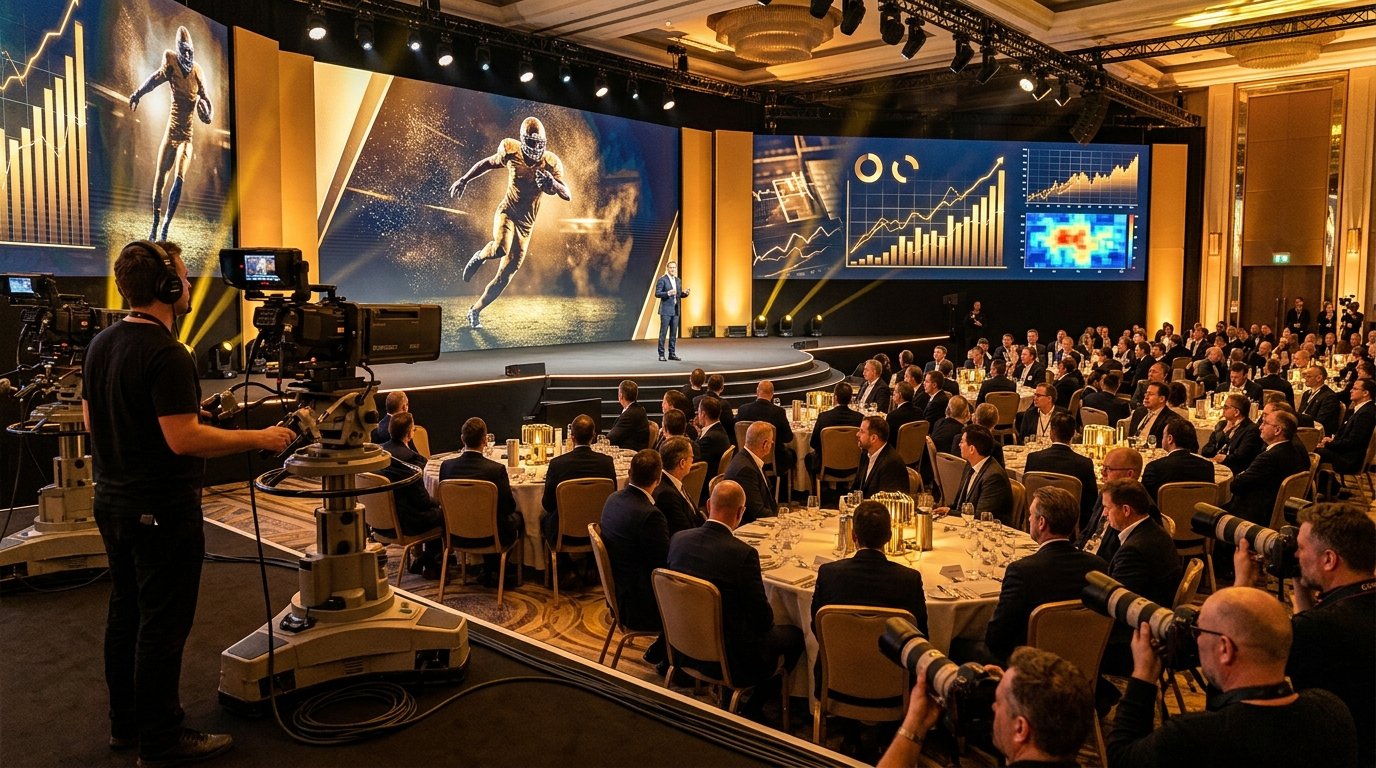
Applying sports codes to B2B doesn't mean putting a mascot in your conference hall. It means adopting a dynamic and demanding visual grammar: multi-camera setups, instant replays of key insights, real-time motion graphics, and 'sideline' interviews with speakers immediately after their keynote. This is the energy we bring to major gatherings like SXSW 2026. Production must be approached like a television broadcast. A static wide shot on a speaker for 45 minutes is the marketing equivalent of a forfeit. You need rhythm, angle changes, and visual storytelling that supports technical discourse. Utilizing cutting-edge live streaming technology allows you to break the barrier between the physical audience and the global one, creating a unified, high-end experience that respects GDPR compliance for EU viewers while delivering the high-octane delivery expected by US audiences.
Sports storytelling relies on conflict and resolution. In a corporate context, this translates to highlighting industry challenges and innovative solutions with dramatic intensity. High-level cinematography transforms a simple product announcement into a historic company milestone. This 'broadcast' approach ensures that even those watching the replay feel the live energy. Brands must invest in mobile production units capable of managing complex feeds, integrating live data, and social interactions. As noted in this discussion on sports advertising trends, the strength of sports lies in its ability to create a continuous narrative. Your event shouldn't be a one-off; it should be the climax of a content strategy that uses video as the primary vector of credibility.
The transition to broadcast-style production also requires a mindset shift for speakers. They are no longer just experts; they become protagonists in a media show. Preparation, coaching, and staging become essential to maintain the level of excellence required by today's standards. By adopting these codes, companies ensure better audience retention and a powerful, modern brand image. Technical professionalism in video capture is a direct mirror of the company's professionalism. A stuttering stream or poor audio is the equivalent of an empty stadium for a sports sponsor: a total failure of visibility.
Why High-Definition Video is the Key to Event ROI
Event ROI is no longer measured solely by the number of badges scanned at the door, but by the lifespan and reach of the content produced. If sports attracts so much advertising, it’s because every game generates thousands of 'highlights' consumed across social platforms and media outlets. Your event must function the same way. Mediocre video production condemns your ideas to oblivion the moment the closing cocktail ends. High-definition video and rapid-turnaround editing allow you to saturate your communication channels for months after the conference. A cinematic aftermovie, podcast snippets recorded on-site, and expert interviews become strategic assets for your sales and marketing teams. You can explore our Photo & Video Gallery to see how this standard of excellence materializes in practice.
By investing in premium visual coverage, you transform a logistical expense into a durable marketing investment. Image clarity, sound quality, and dynamic editing are not luxuries; they are indispensable prerequisites for turning a simple recording into a long-term lever for growth and credibility.
FAQ
How does B2B event production differ from traditional webinars?
Traditional webinars are often static and asynchronous. Broadcast-style B2B production uses multi-camera setups, live interaction, and high-production values to create 'appointment viewing' that rivals live sports in engagement.
Why is the sports industry a benchmark for B2B events?
With a $20B ad spend, the sports industry has mastered the art of capturing synchronized attention. B2B events can use these same 'live' codes to combat digital fatigue and increase brand recall.
Questions Fréquentes
How does B2B event production differ from traditional webinars?
Traditional webinars are often static and asynchronous. Broadcast-style B2B production uses multi-camera setups, live interaction, and high-production values to create 'appointment viewing' that rivals live sports in engagement.
Why is the sports industry a benchmark for B2B events?
With a $20B ad spend, the sports industry has mastered the art of capturing synchronized attention. B2B events can use these same 'live' codes to combat digital fatigue and increase brand recall.