
Event ROI: Why Value is Finally Overpowering Volume
Event ROI: Why Value is Finally Overpowering Volume
A strategic analysis of the global event industry's pivot toward qualitative engagement, intentional networking, and measurable impact over raw attendance numbers.
Why Event Success is Now Measured by Depth, Not Breadth
The trade show industry is undergoing a profound structural transformation. For decades, the success of an event was measured through raw attendance statistics: the number of badges scanned, square meters sold, and total visitor volume. However, as Hugh Jones, CEO of RX, points out, this era of 'growth in breadth' is reaching its limit. Today, B2B decision-makers are no longer looking to be everywhere; they want to be where the impact is highest. This shift toward value is driven by a drastic rationalization of marketing budgets and an unprecedented demand for measurable Return on Investment (ROI). Companies are no longer satisfied with a passive presence; they demand tangible results—whether in the form of signed contracts, strategic partnerships, or a significant acceleration of the sales cycle.
Data from the SASIE (Size and Scale Index for Exhibitions) confirms this trend, particularly in the UK market, but the phenomenon of selectivity is spreading across all mature markets, including the US and mainland Europe. Attendees now choose events based on the organizer’s ability to curate a relevant ecosystem rather than an anonymous crowd. In sectors like construction (Feicon) or security (ISC West), the challenge is no longer just 'networking,' but solving complex issues regarding digital trust and sustainability. For a CMO, a trade show attracting 5,000 qualified decision-makers is now far more valuable than a generalist fair with 50,000 visitors. This quest for depth is redefining how we design our events and how we justify investments to the CFO.
This increased selectivity forces organizers and agencies to rethink their value proposition. Content can no longer be mere filler; it must become the engine of the buying decision. Trend analysis shows that top-performing events are those that successfully create micro-communities within large-scale gatherings. This ability to generate high-value interactions is becoming the true KPI of the industry. To explore these dynamics further, it is helpful to consult the event industry trend analysis by BizBash, which examines how intentionality is replacing serendipity in experience design.
Crafting Transformational Experiences to Justify Modern Marketing Spend
To justify marketing budgets under intense scrutiny, the event experience must move from a transactional format to a transformational one. Immersion isn't just about giant LED screens or spectacular stage designs; it lies in the event's ability to alter the trajectory of a company or a career. At FIBO, for example, innovation and investment meet to drive the health and fitness industry forward. It isn't just an exhibition space; it’s a sector-specific growth incubator. To achieve this level of engagement, brands must invest in formats that foster deep dialogue: executive roundtables, co-creation workshops, and ultra-targeted networking sessions.
Modern event design must integrate the concept of the 'value journey.' Every interaction, from the first digital touchpoint to post-event follow-up, must be designed to maximize utility for the participant. This often means reducing noise to amplify the signal. Successful companies are those that dare to take a stand, transforming their booths into thought-leadership hubs rather than simple product showcases. By creating environments where thought leaders can exchange views on critical topics—such as digital trust or the future of the supply chain—brands secure a top-of-mind position with their most strategic prospects.
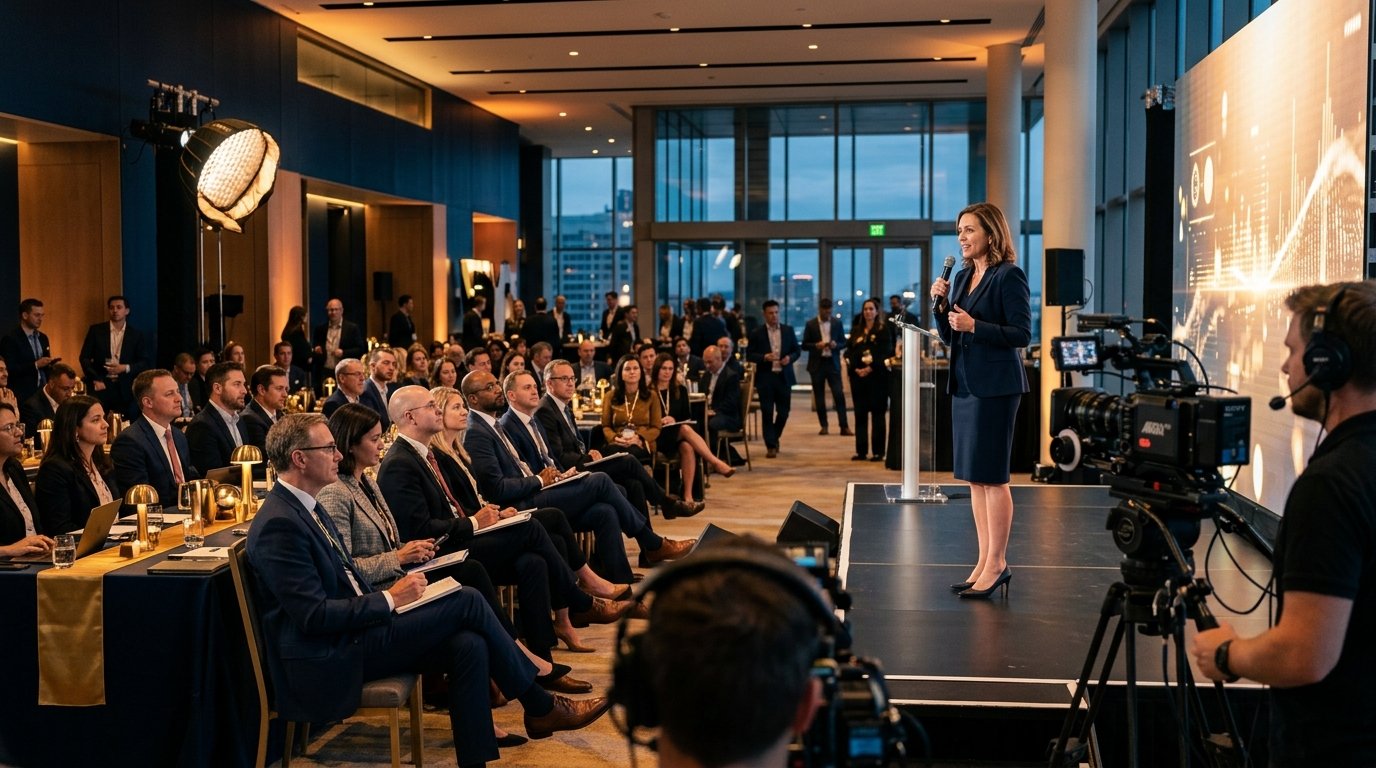
Immersion is also reinforced by the quality of technical production. Poor audio or an unstable livestream can instantly ruin the credibility of a high-level summit. Conversely, seamless, professional production signals to the participant that their time is respected and valued. This attention to detail is what separates generic events from memorable experiences that build long-term loyalty. As highlighted in this industry trend discussion (LinkedIn), the market now prioritizes quality of execution over the quantity of sessions offered.
The Strategic Role of Premium Visual Documentation in Proving ROI
If the value of an event lies in the depth of its connections, one must be able to prove it. Attendance figures are easy to export, but the quality of a handshake between two CEOs or the intensity of a debate during a closing session requires high-level visual documentation. This is where premium audiovisual production becomes a strategic reporting and marketing tool. An editorial-grade photo and video gallery doesn't just feed social media; it serves as tangible proof of a brand's influence and relevance within its industry. For a marketing department, having an aftermovie that captures the energy of a packed room or the focus of a strategic workshop is a major asset when justifying budget renewals for the following year.
Visual documentation allows the event's lifespan to extend far beyond its physical closing. By transforming key moments into thought-leadership content, companies maximize their initial investment. A two-day summit can generate six months of strategic content if the capture is planned from the start as an editorial resource. At Alesia RSVP, we understand that our role isn't just to take photos, but to capture the very essence of the 'depth' Hugh Jones refers to. We document the interactions that matter—those that testify to the real value created on-site. Whether for a financial summit in London or a tech conference in Singapore, our visual production serves as a bridge between the ephemeral physical experience and long-term brand strategy.
In conclusion, the shift from volume to value is an opportunity for event professionals who bet on excellence. By focusing on the quality of the experience and ensuring every interaction is carefully documented, brands can transform their events into true growth levers. Alesia RSVP supports companies in this quest for depth, providing event management and audiovisual production that reflect the ambition and prestige of their most strategic projects.
FAQ
How is B2B event ROI changing in 2025?
ROI is shifting from quantitative metrics (footfall, lead volume) to qualitative outcomes, such as the acceleration of the sales cycle, the depth of strategic partnerships, and the creation of long-term thought leadership content.
Why is visual documentation crucial for ROI?
High-end visuals provide tangible proof of engagement and influence that data sheets cannot capture. They also allow brands to repurpose event highlights into months of marketing content, increasing the value of the initial investment.
Questions Fréquentes
How is B2B event ROI changing in 2025?
ROI is shifting from quantitative metrics (footfall, lead volume) to qualitative outcomes, such as the acceleration of the sales cycle, the depth of strategic partnerships, and the creation of long-term thought leadership content.
Why is visual documentation crucial for ROI?
High-end visuals provide tangible proof of engagement and influence that data sheets cannot capture. They also allow brands to repurpose event highlights into months of marketing content, increasing the value of the initial investment.