
UK Event Industry Crisis: Staying Competitive via Production
UK Event Industry Crisis: Staying Competitive via Production
An in-depth analysis of the structural crisis hitting the British event industry and an exploration of how high-end audiovisual production maintains international competitiveness against rising European and Asian hubs.
Why is the UK Conference Sector Losing Its Competitive Edge?
The British conference and exhibition sector is currently at a dangerous tipping point, caught between its historical prestige and a slow erosion of its structural capabilities. Despite contributing a massive £33 billion annually to the national economy, the government continues to overlook the technical and strategic specificity of this industry. A recent and particularly alarming report from the Culture, Media, and Sport Committee highlights a brutal reality: without immediate financial and strategic commitment, the UK will lose its leadership position to European hubs like Paris, Berlin, or Barcelona, as well as increasingly aggressive Asian powers.
The decision to slash VisitBritain’s Business Events team from nine people to just two is symptomatic of a deep-seated lack of engagement. For context, even the Faroe Islands have more resources dedicated to promoting their business events internationally. This drastic reduction isn't just a budget issue; it's a strategic miscalculation. The MICE (Meetings, Incentives, Conferences, and Exhibitions) sector is not a sub-category of leisure tourism; it is a driver of knowledge transfer, trade diplomacy, and industrial innovation. By weakening national promotion, the government leaves local organizers to face global competition that benefits from direct state subsidies and logistical support.
This policy neglect creates a major strategic vacuum. Organizers can no longer rely on a cohesive national brand to attract the major international summits that once chose London by default. This situation is further exacerbated by a persistent confusion between mass tourism and business events. As highlighted in this discussion on the future of the UK event industry, the logistical needs, post-Brexit visa challenges, and infrastructure required for a B2B trade show are entirely different from those of a music festival or sporting event. The lack of distinction in public policy limits the ability of local players to compete with destinations offering streamlined visa processes and tax incentives for foreign exhibitors.
Attracting Global Delegates Amid Budgetary and Visa Constraints
Attracting high-level delegates to London, Manchester, or Birmingham has become an unprecedented logistical and financial challenge. Inflationary pressures on operational costs and the increasing complexity of visa processes are slowing down international participation that was once taken for granted. To offset the lack of state support, organizers must pivot toward increasing the perceived value of the event. If the government is no longer actively selling 'Destination UK,' the event itself must become the destination—a magnet whose quality justifies the administrative hurdles.
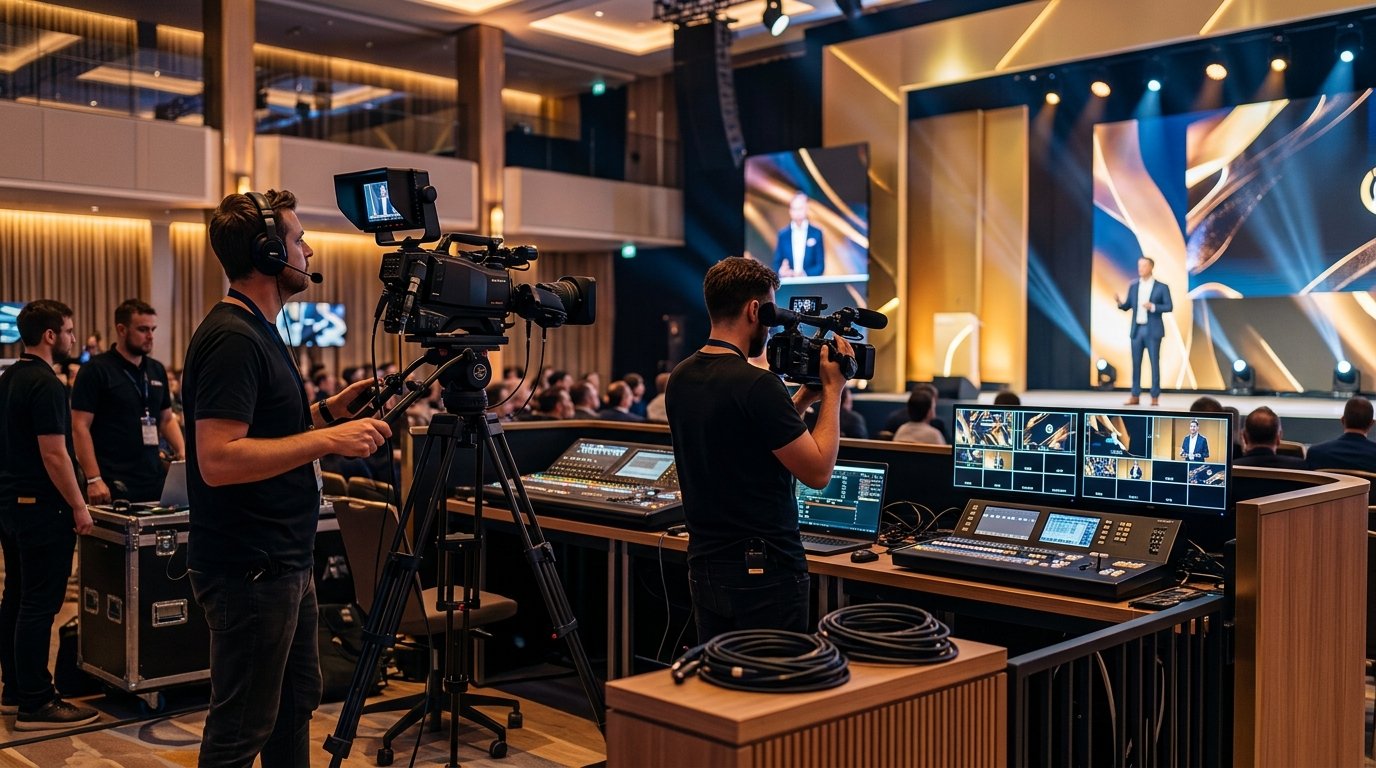
This requires an aggressive content strategy and a production quality that transforms a simple conference into an immersive experience. In this context, local production expertise is your greatest asset for guaranteeing a tangible ROI for participants. For an international organizer planning an event in the UK capital, collaborating with an agency that understands the nuances of corporate events in London helps reduce operational friction and navigate a complex ecosystem of vendors. The absolute priority must be the on-site experience: impeccable set design, broadcast-quality video capture, and seamless streaming for those who cannot travel.
Investing in AV technology is no longer an option; it is a retention lever. International delegates, accustomed to the high standards of Singapore or Dubai, expect flawless execution. Crystal-clear audio, high-resolution LED screens, and dynamic stage management are not luxuries—they are essential communication tools. These elements create the sense of exclusivity and importance necessary to maintain registration rates despite prohibitive travel and accommodation costs in British urban centers. In short, the quality of execution must compensate for the complexity of access.
Strategies for Scaling B2B Events Without Government Subsidies
Autonomy has become the new norm for British organizers. As public support wanes, funding and marketing models must become more robust and creative. The key now lies in the intelligent monetization of post-event content. A trade show should no longer be viewed as a fleeting two- or three-day occurrence, but as a 'content factory' capable of generating engagement and revenue year-round. By investing heavily in premium media production—thought leader interviews, on-site podcasts recorded in mobile studios, and cinematic aftermovies—you create a lasting digital asset.
According to industry trends and analysis by BizBash, brands and sponsors now prioritize events that offer multi-channel visibility. Without government grants, the direct ROI for exhibitors dictates the success or failure of a show. Visual production that highlights partner innovations and networking quality becomes the primary selling point when marketing booth space. It’s about transforming every session and keynote into a finished media product, ready to be consumed by a global audience, thereby virtually increasing the event's reach.
Furthermore, integrating sophisticated hybrid solutions allows for diversified revenue streams. Selling virtual tickets, providing access to premium video archives, or creating webinar spin-offs from show highlights turns AV costs into a profit center. In a market where every pound counts, the ability to transform a physical conference into a global media platform is what separates market leaders from those struggling with the crisis. Technical excellence thus becomes the engine of economic resilience.
The Strategic Role of Media Production in Global Event Branding
Media production is no longer a secondary line item at the bottom of the budget; it is the central engine of your international reach and long-term credibility. In a British market that is underfunded and politically uncertain, brand image is the only remaining lever for differentiation to attract foreign investment. High-end editorial photography that captures the atmosphere of innovation, combined with video production that conveys the real energy of a summit, projects a sense of power and stability. This is precisely what we demonstrate in our project gallery, where visual quality compensates for the austerity of current economic climates.
Alesia RSVP acts as a strategic partner for brands, trade associations, and agencies operating in the UK. By integrating a high-end AV production vision from the planning phase, we help our clients overcome the lack of institutional visibility. Whether through pop-up podcast studios in exhibition halls or zero-latency live streaming of keynotes to a global audience, we ensure the event's impact extends far beyond the physical venue. This extended reach is crucial for attracting international sponsors who demand visibility metrics that go beyond simple footfall.
Ultimately, if the British government fails to support its industry with visionary policies, it is through the excellence of private execution that the sector will survive and thrive.
FAQ
How is the UK event industry competing with EU hubs like Paris and Berlin?
While EU hubs benefit from more state subsidies, UK organizers are staying competitive by investing in high-end production and digital content strategies that maximize ROI for international sponsors.
What are the main challenges for international events in London post-Brexit?
The primary challenges include visa complexities for delegates and staff, as well as increased logistical costs, which require a higher quality of event execution to justify the investment.
How can AV production increase the revenue of a B2B conference?
By transforming sessions into high-quality digital assets (podcasts, webinars, premium VOD), organizers can monetize content long after the physical event has ended.
Questions Fréquentes
How is the UK event industry competing with EU hubs like Paris and Berlin?
While EU hubs benefit from more state subsidies, UK organizers are staying competitive by investing in high-end production and digital content strategies that maximize ROI for international sponsors.
What are the main challenges for international events in London post-Brexit?
The primary challenges include visa complexities for delegates and staff, as well as increased logistical costs, which require a higher quality of event execution to justify the investment.
How can AV production increase the revenue of a B2B conference?
By transforming sessions into high-quality digital assets (podcasts, webinars, premium VOD), organizers can monetize content long after the physical event has ended.