
The Experience Is Now the Product: B2B Event Strategy
The Experience Is Now the Product: B2B Event Strategy
In a world of digital noise, the physical event is no longer just a meeting—it is the product itself. If the experience is your brand's new currency, how are you documenting its value?
Why is the live experience now considered the core product for B2B brands?
We are currently navigating one of the most fragmented periods in media and cultural history. For the corporate decision-maker, this fragmentation has a specific consequence: digital saturation. When every whitepaper, webinar, and LinkedIn post feels like background noise, the physical, real-world experience gains an unprecedented level of urgency and value. It is no longer enough to host a conference for the sake of networking; the event itself must be the 'product' that attendees are willing to invest their most valuable resource in—their time. This shift represents a move from information-sharing to transformation-sharing. In the past, B2B events were utility-driven. Today, they are identity-driven. Attendees do not just want to learn; they want to belong to a specific ecosystem of thought leaders.
This shift is particularly evident in how global sporting and luxury events have rebounded. Attendance has surpassed pre-pandemic levels not because people need more information, but because they crave the atmosphere and emotional resonance of being 'in the room.' In the B2B sector, this means moving away from functional, utilitarian gatherings toward highly curated 'temporary universes.' When a brand like Dior or Ralph Lauren creates a pop-up, they aren't just selling clothes; they are selling a world. B2B summits must adopt this mindset. Industry trends on experiential marketing suggest that the organizations winning the next decade of market share won't be those with the loudest digital ads, but those who can blend hospitality, technology, and community into a singular, memorable moment.
For a Marketing Director or VP of Events, this requires a fundamental pivot in budget allocation. The 'product' is the feeling of the keynote, the exclusivity of the VIP lounge, and the cultural layers of the venue. If the experience is the product, then the quality of that experience's delivery—from the AV production to the lighting—is the manufacturing process. You cannot afford a defect in the manufacturing of your brand's most important physical asset. This means scrutinizing every touchpoint: the tactile quality of the badges, the acoustic warmth of the plenary hall, and the visual rhythm of the stage design. When the event is the product, the 'user interface' is the physical space itself. If that interface is clunky, outdated, or poorly lit, the brand's perceived value drops instantly. Conversely, a high-fidelity physical experience creates a halo effect that elevates every other digital touchpoint the brand has for the rest of the year.
How do you blend hospitality and technology to create a 'memorable' event universe?
Creating a memorable event universe requires a sophisticated marriage between high-end hospitality and technical precision. Take, for instance, the atmosphere of The Masters at Augusta. Fans don't just go to watch golf; they go for the rituals, the green jackets, and the immaculate environment. In the corporate world, this translates to the production of flagship summits in global hubs. Whether you are planning Corporate Events Paris or a high-stakes summit in Dubai, the environment must feel curated rather than assembled. This curation starts with the 'invisible' elements. Hospitality is not just about the quality of the catering; it is about the psychology of the guest journey. It is the way a guest is greeted upon arrival, the way the lighting shifts to signal the start of a session, and the way the technology supports human connection rather than distracting from it.
Technology should never be the center of attention; it should be the invisible infrastructure that elevates the human experience. This means broadcast-quality lighting that makes speakers look like icons, sound engineering that ensures every word of a keynote carries weight, and seamless transitions that keep the 'universe' intact. When technology fails, the immersion breaks, and the 'product' is revealed to be a mere meeting. Imagine a high-end luxury watch: you don't see the gears, but you feel the precision. The same applies to event technology. The LED walls should be calibrated for the human eye, not just for a camera lens. The audio should be spatial and immersive, preventing listener fatigue during long sessions.
To achieve this, event planners must look at their AV partner not as a vendor, but as a co-director of the experience. The goal is to create an environment where the attendee feels they are part of a historic moment. This sense of 'occasion' is what drives emotional engagement. Functional experiences are forgotten; emotional ones are shared, discussed, and returned to year after year. The blend of hospitality and tech is the secret sauce that turns a standard B2B conference into a cultural milestone for the industry. It requires a meticulous attention to detail, where the technical team understands the brand's aesthetic as well as the marketing team does. When the technical execution is flawless, it allows the hospitality elements—the networking, the conversations, the 'aha' moments—to flourish in a space that feels both safe and spectacular.
What role does cinematic storytelling play in the new experience economy?
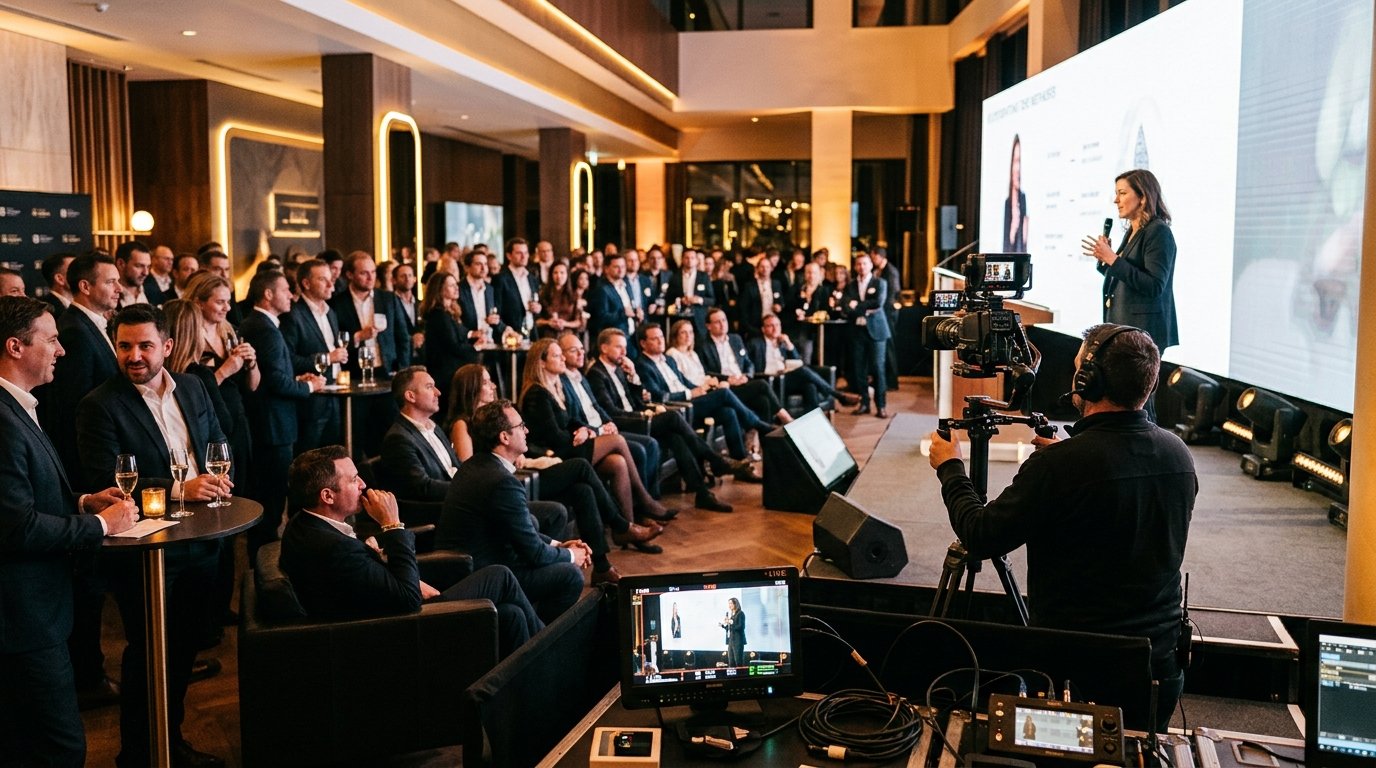
If the experience is the product, then the documentation of that experience is its long-term brand equity. In the new experience economy, an event that isn't captured with cinematic precision effectively ceases to exist the moment the doors close. High-end visual storytelling is the bridge between the fleeting physical moment and the permanent brand narrative. This is where many corporate events fail: they treat photography and video as an afterthought—a 'nice to have' record of who was there. In reality, the documentation is the 'packaging' of your product. Without high-end packaging, the product's value is diminished in the eyes of the broader market.
Cinematic storytelling involves more than just filming a speaker on a stage. It requires capturing the 'cultural layers' of the event—the candid interactions in the hallways, the tension before a major announcement, and the collective energy of the crowd. This type of editorial coverage turns a corporate recap into a documentary-style asset that can be used for months of post-event marketing. By viewing our Galerie Photo & Video, one can see the difference between 'event snapshots' and 'brand assets.' It’s the difference between a grainy photo of a stage and a carefully composed shot that captures the scale of the venue and the focus of the audience. It’s about using depth of field, color grading, and narrative pacing to tell a story of innovation and leadership.
Professional AV production houses like Alesia RSVP specialize in this exact transition. We don't just document; we archive the emotional atmosphere. This is essential because the 'product'—the experience—needs to be sold to those who weren't there, and reinforced to those who were. High-quality video production ensures that the investment in the physical event continues to pay dividends in the digital realm, providing content that fuels social media, PR, and internal communications for the rest of the fiscal year. Think of your event as a film set where the 'actors' are your executives and the 'script' is your brand's future. If you don't have a world-class cinematographer on set, you are wasting the performance of a lifetime. The goal is to create a visual legacy that makes the event's impact permanent, turning a three-day summit into a three-year strategic advantage.
How can premium brands leverage FOMO through high-end visual documentation?
In a world where everything can be watched on delay, the 'Fear Of Missing Out' (FOMO) has taken on a deeper meaning. For premium B2B brands, FOMO is a powerful tool for driving future attendance and establishing market authority. However, FOMO is not generated by a low-resolution livestream or a few shaky smartphone photos. It is generated by seeing a world that looks exclusive, professional, and intellectually vibrant. It is the visual proof that 'this is where the industry's future is being decided.' When a high-level executive sees a peer in a beautifully lit, expertly captured photograph at your event, the psychological trigger is not just jealousy, but a realization of a missed strategic opportunity.
Leveraging FOMO requires a strategy of 'real-time' prestige. This involves delivering same-day highlight reels and magazine-quality photography while the event is still trending. When industry peers see high-production value content appearing on their feeds in real-time, the psychological impact is immediate. They recognize that a significant cultural and professional moment is happening without them. Professional discussion on the experience economy often highlights that the perceived prestige of an event is directly correlated to the quality of its visual output. If the content looks like it belongs in a high-end fashion magazine or a Netflix documentary, the event's status is instantly elevated.
Alesia RSVP positions itself as the essential architect of this memory. We understand that for a VP of Events, the goal is to make the experience feel like a 'must-attend' universe. By capturing the emotional atmosphere and delivering it with the speed and quality of a newsroom, we help brands turn a single physical event into a global conversation. This involves a dedicated team of editors and colorists working on-site to ensure that the content being pushed to social channels matches the premium nature of the physical event. The experience is the product, and we are the ones who ensure that product is seen in its best possible light. In the end, memorability is the ultimate differentiator. If you can't be brilliant, at least be memorable—but with the right production partner, you can easily be both. By creating a visual narrative that exudes excellence, you ensure that your event isn't just a date on the calendar, but a permanent landmark in your industry's history.
FAQ
What defines an 'Experience-as-a-Product' in the B2B sector?
In the B2B sector, 'Experience-as-a-Product' refers to the strategic shift where an event is treated as a standalone, high-value asset rather than a mere marketing channel. This means the event must provide enough intrinsic value—through curated networking, exclusive insights, and high-end production—that it justifies the significant time investment of high-level executives. It is characterized by a focus on sensory details, emotional resonance, and a 'world-building' approach to event design, ensuring the brand is experienced physically and emotionally.
Why is high-end AV production critical for brand ROI?
High-end AV production acts as the 'manufacturing quality' of your event product. If the audio is poor or the lighting is flat, the brand's perceived authority diminishes. Professional production ensures that the event's content is captured as a high-value asset, allowing it to be repurposed for months of marketing. This extends the ROI of the physical event by creating a digital legacy that continues to drive lead generation and brand prestige long after the event has concluded.
How does 'real-time' documentation impact event success?
Real-time documentation—such as same-day highlight reels and live social media assets—captures the event's momentum while it is at its peak. This creates immediate 'Fear Of Missing Out' (FOMO) among industry peers who are not in attendance, positioning the event as the center of the industry conversation. It also provides attendees with high-quality content they can share with their own networks, effectively turning your guests into brand ambassadors with a high-fidelity visual toolkit.
What is the difference between event coverage and cinematic storytelling?
Event coverage is functional; it records what happened (e.g., a photo of a speaker). Cinematic storytelling is editorial; it captures how the event felt. It uses professional cinematography techniques—such as intentional lighting, narrative pacing, and emotional close-ups—to build a brand mythos. Cinematic storytelling focuses on the 'vibe' and the 'culture' of the event, turning a standard corporate gathering into a compelling visual narrative that resonates with a global audience.
Questions Fréquentes
What defines an 'Experience-as-a-Product' in the B2B sector?
In the B2B sector, 'Experience-as-a-Product' refers to the strategic shift where an event is treated as a standalone, high-value asset rather than a mere marketing channel. This means the event must provide enough intrinsic value—through curated networking, exclusive insights, and high-end production—that it justifies the significant time investment of high-level executives. It is characterized by a focus on sensory details, emotional resonance, and a 'world-building' approach to event design, ensuring the brand is experienced physically and emotionally.
Why is high-end AV production critical for brand ROI?
High-end AV production acts as the 'manufacturing quality' of your event product. If the audio is poor or the lighting is flat, the brand's perceived authority diminishes. Professional production ensures that the event's content is captured as a high-value asset, allowing it to be repurposed for months of marketing. This extends the ROI of the physical event by creating a digital legacy that continues to drive lead generation and brand prestige long after the event has concluded.
How does 'real-time' documentation impact event success?
Real-time documentation—such as same-day highlight reels and live social media assets—captures the event's momentum while it is at its peak. This creates immediate 'Fear Of Missing Out' (FOMO) among industry peers who are not in attendance, positioning the event as the center of the industry conversation. It also provides attendees with high-quality content they can share with their own networks, effectively turning your guests into brand ambassadors with a high-fidelity visual toolkit.
What is the difference between event coverage and cinematic storytelling?
Event coverage is functional; it records what happened (e.g., a photo of a speaker). Cinematic storytelling is editorial; it captures how the event felt. It uses professional cinematography techniques—such as intentional lighting, narrative pacing, and emotional close-ups—to build a brand mythos. Cinematic storytelling focuses on the 'vibe' and the 'culture' of the event, turning a standard corporate gathering into a compelling visual narrative that resonates with a global audience.