
Trade Show Market Intelligence: AI and Event Strategy
Trade Show Market Intelligence: AI and Event Strategy
Data-driven strategy is no longer optional for trade show success; it is the new baseline in the exhibition industry.
How is AI-driven market intelligence transforming the exhibition industry?
The exhibition industry has long suffered from a fragmentation of data that makes strategic planning more of an art than a science. Marketing directors and event planners often find themselves sifting through a chaotic mix of organizer brochures, outdated PDF reports, and anecdotal evidence to decide where to allocate their seven-figure budgets. The recent launch of the Tradeshow Strategy Compass by MBB-Consulting Group marks a significant shift in this dynamic. By utilizing AI to gather, validate, and harmonize vast volumes of market data, this platform offers a level of transparency that was previously unattainable for corporate decision-makers. This isn't just about having more data; it's about having accessible, validated intelligence that allows for real-time comparisons across global markets and segments.
For years, the industry relied on manual research that was both time-consuming and prone to bias. An AI agent capable of answering specific questions about individual exhibitions changes the workflow for a VP of Events. Instead of spending weeks on competitive analysis, teams can now drill down from a global overview to local-level dashboards instantly. This platform currently covers critical sectors including Agriculture & Horticulture, Fashion & Clothing, Food & Beverage, Food Packaging, Hospitality & Travel, and Textiles & Textile Processing. The ability to harmonize data from disparate sources means that a corporate communications lead can now see a unified view of market positioning without the noise of conflicting marketing materials from different organizers. This level of LinkedIn discussion on event industry intelligence highlights how the sector is finally moving toward a tech-first approach to intelligence.
The transformation goes beyond simple data aggregation. The real value lies in the strategic interpretation of this data. When AI handles the heavy lifting of validation, human consultants and event strategists can focus on high-level decision-making. For a premium brand, this means moving away from the 'we go because we've always gone' mentality. It allows for a more aggressive and calculated approach to market entry. If the data shows a specific segment in Southeast Asia is underserved but growing rapidly, a brand can pivot its resources with confidence. This intelligence-led approach is what separates the market leaders from those who are simply filling floor space. It forces organizers to be more accountable for their performance metrics, as their claims can now be benchmarked against global standards with surgical precision.
Why is data-driven event selection crucial for premium B2B brands?
For premium B2B brands, the cost of failure at a major summit or trade show is not just the price of the booth; it is the opportunity cost of missed high-value connections and the potential damage to brand prestige. Data-driven event selection is the only way to mitigate this risk. When a company decides to exhibit at a major hub, such as during corporate events in Paris, they are making a statement about their market standing. Utilizing a platform like the Tradeshow Strategy Compass allows these brands to perform nuclear portfolio strategy and market positioning analysis before a single contract is signed. It provides the empirical evidence needed to justify spend to the C-suite, moving the conversation from 'gut feeling' to 'growth potential.'
Market positioning is particularly sensitive in sectors like fintech, tech, and high-end manufacturing. In these industries, being seen at the wrong event can be as detrimental as not being seen at all. Data-driven insights allow brands to identify 'segment attractiveness'—a metric that looks beyond attendee counts to evaluate the actual quality and intent of the audience. Are the decision-makers there? Is the growth potential sustainable? These are the questions that define ROI. By analyzing exhibitor and visitor trends through an AI-powered lens, brands can spot shifts in the market before they become common knowledge. This proactive stance is essential for maintaining a competitive edge in a globalized economy where trade show calendars are increasingly crowded.
Furthermore, geographic expansion requires more than just a map; it requires a deep understanding of local market dynamics compared to global benchmarks. A brand looking to expand from Europe into the Middle East or Asia needs to know if the local version of a major show carries the same weight as its flagship counterpart. Data-driven selection provides this clarity. It allows for a nuanced understanding of how different regions respond to specific exhibition formats. This intelligence ensures that when a brand invests in a new market, they are doing so with a clear roadmap for success, backed by hard numbers rather than organizer hype. This shift toward analytical rigor is one of the latest event industry trends on BizBash that is currently reshaping how enterprise marketing budgets are allocated.
How can visual storytelling amplify the insights gained from market intelligence platforms?
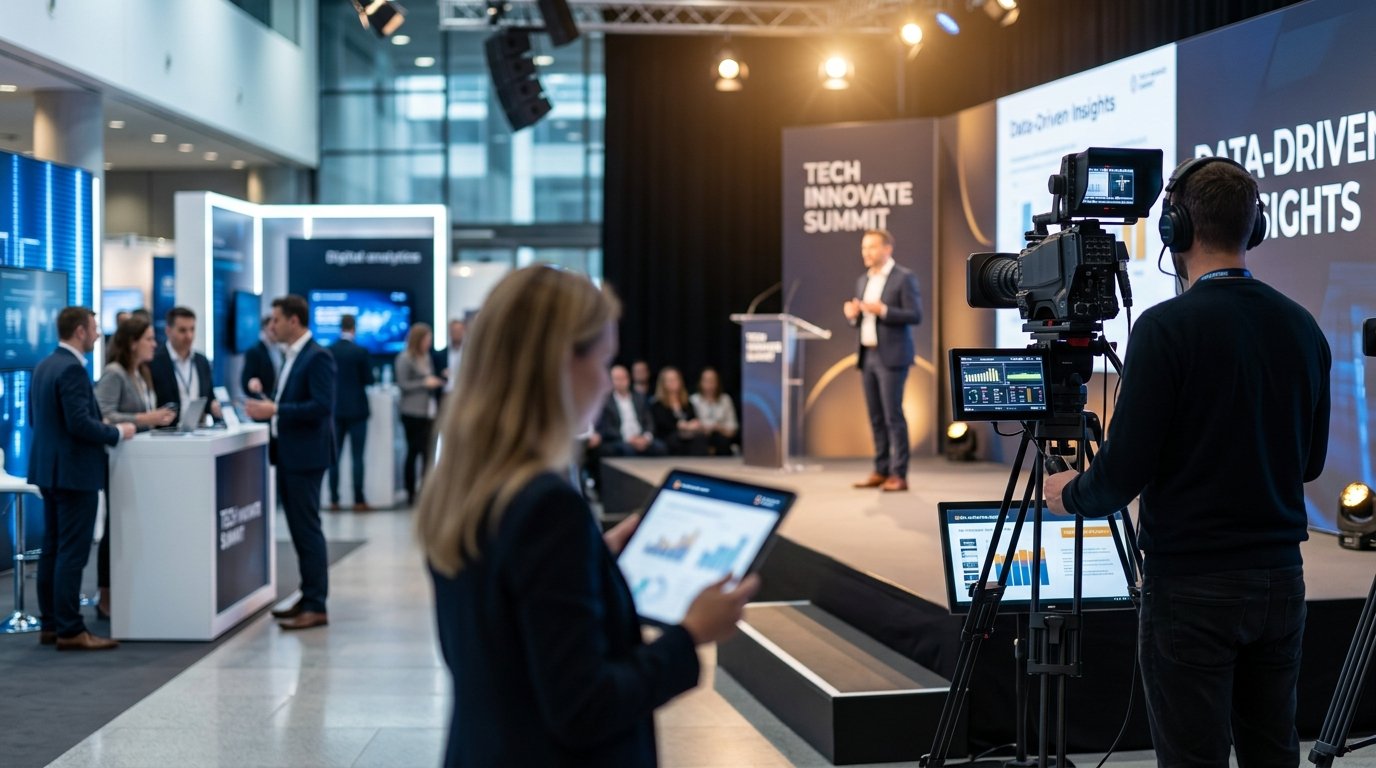
Data provides the map, but visual storytelling provides the proof of life. Once a market intelligence platform has identified the right event for a brand to dominate, the focus must shift to how that presence is documented and amplified. If the data suggests that a specific trade show is the 'must-attend' event for your industry, your presence there must look the part. This is where the intersection of market intelligence and premium AV production becomes critical. High-end photography and video coverage are not just about recording an event; they are about validating the strategic decision to be there. They turn a physical presence into a digital asset that can be used for months of post-event marketing.
When a brand uses data to select a high-growth segment, the visual content produced at that event should reflect that growth and leadership. Professional coverage captures the energy of the booth, the quality of the speakers, and the caliber of the attendees. This visual proof is what convinces stakeholders and clients who weren't in the room that your brand is a dominant force in that market. You can see examples of this high-stakes documentation in our Alesia RSVP's visual gallery, which demonstrates how professional imagery elevates brand perception. Without this visual amplification, the insights gained from market intelligence remain trapped in a spreadsheet. To truly capitalize on a data-backed event strategy, the output must be as sophisticated as the input.
Visual storytelling also plays a key role in sponsor activation and executive branding. If the Tradeshow Strategy Compass identifies a specific event as a key opportunity for executive thought leadership, that leadership must be captured with cinematic quality. A grainy smartphone video of a keynote speech undermines the strategic value of the event. Conversely, a multi-camera live stream or a professionally produced aftermovie reinforces the brand's position as an industry leader. The marriage of data-driven selection and premium visual production ensures that the intelligence-led strategy translates into a tangible, high-impact brand legacy.
Questions Fréquentes
Comment l'IA aide-t-elle à choisir le bon salon professionnel ?
L'IA analyse des volumes massifs de données historiques et en temps réel pour comparer les salons selon des critères de qualité d'audience, de croissance du segment et de présence concurrentielle, offrant ainsi une vision objective au-delà des brochures marketing.
Quel est l'impact du RGPD sur l'intelligence marché événementielle ?
En Europe, l'utilisation de plateformes d'intelligence marché doit garantir que les données collectées sur les exposants et visiteurs respectent la vie privée, privilégiant les données agrégées et anonymisées pour l'analyse stratégique.
Pourquoi le storytelling visuel est-il lié au ROI des salons ?
Le storytelling visuel prolonge la durée de vie de l'événement. En produisant du contenu premium, vous transformez un investissement ponctuel en un outil de vente et de marketing digital utilisable pendant plusieurs mois.