
2026 AV Trends: The Shift to Immersive Event Production
2026 AV Trends: The Shift to Immersive Event Production
A deep dive into the Olympia Events and Aztec 2026 report, exploring the move from traditional AV to immersive, content-driven event experiences. We examine how the 'invisible storyteller' concept is replacing traditional hardware-heavy setups to foster deeper audience engagement and authentic brand narratives.
What are the key AV trends shaping B2B events in 2026?
In 2026, technology is no longer the star of the show—it is the invisible storyteller. Is your event production ready to shift from hardware-heavy setups to immersive, content-led experiences? The latest AV Trends Review 2026, published by Olympia Events in partnership with Aztec Event Services, signals a definitive departure from the era of 'tech for tech's sake.' Drawing on insights from industry veterans like Richard Harris and Lisa Tyson, the report suggests that we have entered a phase where the hardware must recede into the background to allow the narrative to take center stage. For corporate decision-makers, this means the traditional 'black box' conference room—defined by visible cabling, bulky projectors, and intrusive speaker stacks—is effectively obsolete.
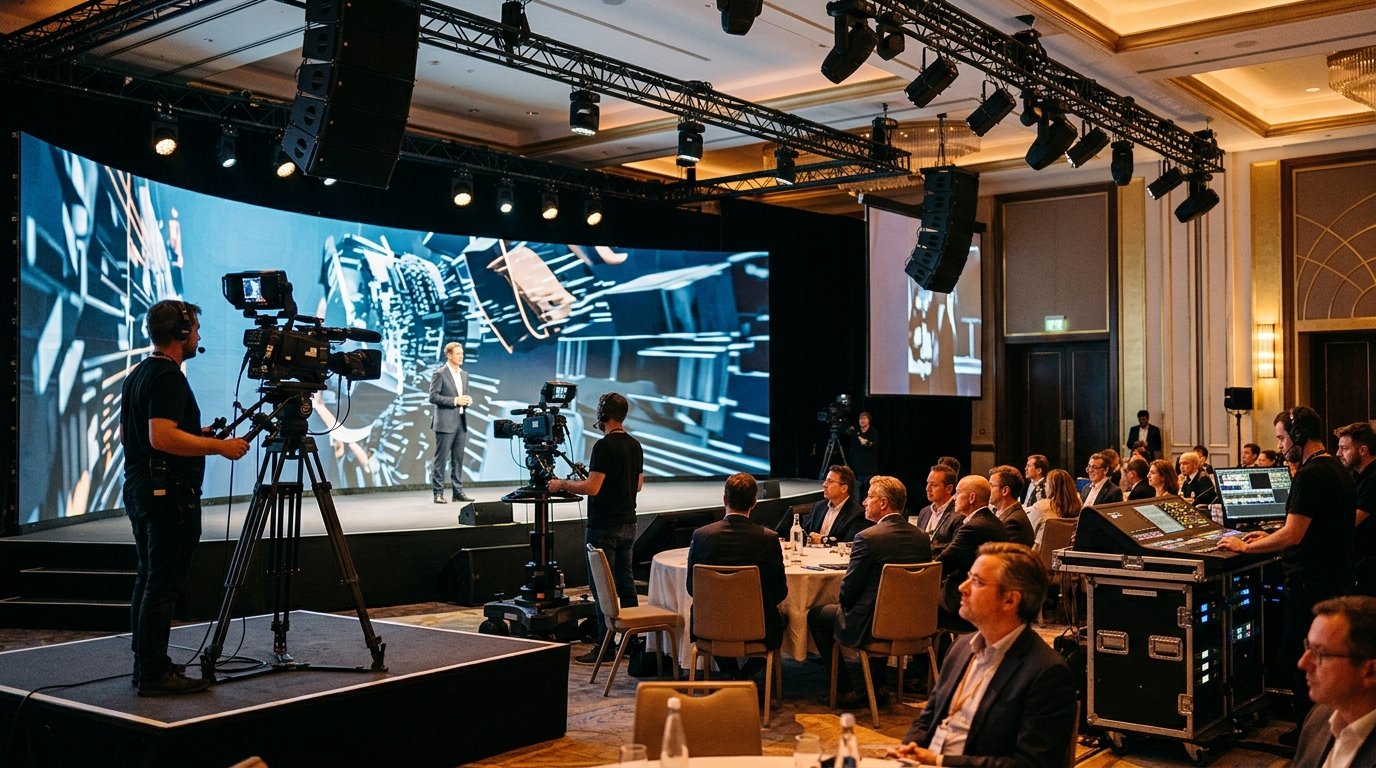
The report highlights a fundamental change in perception: AV is no longer viewed as a list of equipment but as a vehicle for audience journeys. While LED technology remains the dominant force in visual displays, its application has matured significantly. We are seeing a move toward creative deployments that prioritize architectural integration over standard rectangular screens. This includes curved COB (Chip on Board) LED screens that wrap around the audience to create a panoramic field of view, transparent displays that blend seamlessly with physical set pieces, and layered scenic environments that use depth to draw the eye. This isn't just about aesthetics; it’s about removing the psychological and physical barriers between the speaker and the attendee. When the technology becomes 'invisible,' the message becomes more impactful because it feels like a natural extension of the environment.
Industry leaders are now prioritizing integrated media over static presentations. This shift is reflected in how budgets are allocated, with a growing percentage of spend moving toward custom content creation, real-time interactive elements, and spatial audio mapping. As noted in recent industry discussion on 2026 AV trends, the goal is to create an environment where the attendee feels part of the story rather than a passive observer. This requires a sophisticated understanding of both technical capabilities and brand storytelling—a dual expertise that is becoming the benchmark for premium event agencies. We are seeing the rise of the 'Creative Technologist' role, bridging the gap between the technical crew and the creative directors to ensure that every pixel and every decibel serves a specific narrative purpose. Furthermore, the integration of AI-driven real-time translation and generative background visuals is becoming standard, ensuring that global audiences can engage with content in a way that feels personalized and immediate.
How does immersive production justify the need for in-person attendance?
The primary challenge for event organizers in 2026 is providing a compelling answer to one question: Why should I be there in person? With digital fatigue at an all-time high and high-fidelity remote collaboration tools more accessible than ever, the 'Experience over Everything' mantra has become the industry standard. The Olympia/Aztec report argues that in-person events must now function as spaces for authenticity and community that cannot be replicated through a screen. Immersive production is the primary tool that facilitates this. By creating high-production-value environments that engage all five senses, organizers can trigger emotional responses and neuro-chemical engagement that a standard webinar simply cannot achieve.
Shareable 'moments' are no longer accidental; they are engineered. These moments are the currency of modern B2B marketing. When an executive stands in a 360-degree immersive theater or interacts with a holographic data visualization, they are more likely to engage deeply and share that experience with their professional network. This is a significant post-pandemic shift where the event is positioned as a premium, exclusive destination rather than a mandatory corporate obligation. For more on how these environments are being built, you can explore the latest event technology insights on Bizbash. The focus has shifted from 'broadcast' to 'immersion,' where the physical space itself communicates the brand's values through reactive lighting, haptic feedback, and even curated scent-scapes.
At Alesia RSVP, we have observed this trend across global hubs from London to Singapore. The demand for high-end visual documentation has skyrocketed because these immersive environments are fleeting. To maximize the ROI of a high-concept production, the visual output must be as sophisticated as the event itself. Our curated visual galleries demonstrate how professional photography and cinematography can translate an immersive physical experience into a permanent brand asset. If the AV is invisible to the attendee, the role of the production agency is to make the impact of that AV visible to the rest of the world. We focus on capturing the 'human' reaction to the technology—the look of awe, the focused networking, and the dynamic energy of a room where the tech has successfully faded into the background. This documentation serves as the long-tail marketing proof that justifies the significant investment in immersive AV setups, proving that the physical presence of the audience was not just desired, but essential to the event's success.
Why is content-led experience design the future of corporate storytelling?
Content-led design flips the traditional event planning process on its head. Instead of asking 'What screens do we need?', organizers are asking 'What story are we telling, and how does the environment support it?' This approach ensures that every technical choice serves a strategic purpose. In the context of a corporate summit or a high-stakes conference, this means the AV production team must be involved in the creative process from day one. The 2026 review emphasizes that the most successful events are those where the content and the technology are indistinguishable. This requires a move away from 'off-the-shelf' solutions toward bespoke digital architecture designed specifically for the brand's narrative arc.
This evolution was particularly evident during our recent coverage of SXSW 2026, where the most impactful brand activations moved away from traditional booths toward narrative-driven spaces. These spaces utilized spatial audio to guide attendees through different 'chapters' of a brand story, reactive lighting that changed based on audience sentiment, and personalized content streams delivered via ultra-wideband (UWB) technology to create a unique journey for every attendee. For a B2B brand, this level of personalization builds a degree of trust and engagement that traditional marketing channels cannot match. It transforms a corporate message into a shared experience, fostering a sense of partnership rather than a simple vendor-client relationship. The technology acts as a conduit for empathy, allowing complex data or abstract corporate visions to be felt and understood on a visceral level.
As the industry moves toward 'invisible' AV and 'shareable moments,' Alesia RSVP acts as the primary bridge, capturing the authentic emotions and curated storytelling that these high-end immersive environments are designed to trigger. We don't just record what happened; we document the atmosphere and the executive presence that these productions are built to enhance. For decision-makers, the takeaway is clear: the future of events lies in the seamless integration of technical excellence and narrative depth. To stay relevant, your production strategy must move beyond the gear and focus on the experience. The era of the invisible storyteller has arrived, and those who master it will define the next decade of B2B engagement. This means investing in high-quality content creators, motion designers, and experiential architects who understand that the screen is not the destination, but the window into the brand's world. By 2026, the distinction between a 'technical director' and a 'creative director' will have blurred into a single, unified vision for event excellence.
FAQ
What does 'invisible AV' mean for event organizers?
Invisible AV refers to the strategic integration of technology into the event's architecture so that the hardware does not distract from the content. This involves using transparent LED screens, hidden spatial audio systems, and embedded lighting to create a seamless environment where the audience focuses entirely on the speaker and the story. It is about moving away from visible cables and bulky equipment toward a clean, immersive aesthetic where the technology is felt but not seen.
How can brands create shareable moments at B2B conferences?
Brands create shareable moments by designing high-impact, immersive environments that trigger emotional responses or provide unique visual perspectives. By utilizing creative LED setups, interactive installations, and professional lighting, organizers can encourage attendees to document and share their experience on professional networks like LinkedIn. The key is to create 'visual hooks'—moments of such high production value or unique interaction that they demand to be captured and shared, effectively extending the event's reach far beyond the physical room.
Why is content-led production more effective than traditional AV?
Content-led production is more effective because it prioritizes the brand's narrative over technical specifications. By starting with the story, every piece of AV equipment is selected specifically to enhance the message, leading to higher attendee engagement, better information retention, and a more cohesive brand experience. Traditional AV often starts with a gear list, which can lead to technology being used for its own sake rather than to support the strategic goals of the event.
What role does visual documentation play in immersive events?
Visual documentation is critical because immersive environments are inherently ephemeral. Professional photography and cinematography capture the atmosphere, the 'invisible' technology, and the audience's emotional reactions, turning a temporary experience into a permanent marketing asset. This documentation provides the ROI proof needed for stakeholders and allows the brand to leverage the high-production value of the event for months or years after the doors close.
Frequently Asked Questions
What does 'invisible AV' mean for event organizers?
Invisible AV refers to the strategic integration of technology into the event's architecture so that the hardware does not distract from the content. This involves using transparent LED screens, hidden spatial audio systems, and embedded lighting to create a seamless environment where the audience focuses entirely on the speaker and the story. It is about moving away from visible cables and bulky equipment toward a clean, immersive aesthetic where the technology is felt but not seen.
How can brands create shareable moments at B2B conferences?
Brands create shareable moments by designing high-impact, immersive environments that trigger emotional responses or provide unique visual perspectives. By utilizing creative LED setups, interactive installations, and professional lighting, organizers can encourage attendees to document and share their experience on professional networks like LinkedIn. The key is to create 'visual hooks'—moments of such high production value or unique interaction that they demand to be captured and shared, effectively extending the event's reach far beyond the physical room.
Why is content-led production more effective than traditional AV?
Content-led production is more effective because it prioritizes the brand's narrative over technical specifications. By starting with the story, every piece of AV equipment is selected specifically to enhance the message, leading to higher attendee engagement, better information retention, and a more cohesive brand experience. Traditional AV often starts with a gear list, which can lead to technology being used for its own sake rather than to support the strategic goals of the event.
What role does visual documentation play in immersive events?
Visual documentation is critical because immersive environments are inherently ephemeral. Professional photography and cinematography capture the atmosphere, the 'invisible' technology, and the audience's emotional reactions, turning a temporary experience into a permanent marketing asset. This documentation provides the ROI proof needed for stakeholders and allows the brand to leverage the high-production value of the event for months or years after the doors close.