
B2B Event Marketing: Is Attribution Killing Your Brand?
B2B Event Marketing: Is Attribution Killing Your Brand?
An in-depth analysis of the conversation between Jenny Rooney and Amanda Teder (Generac) at Brandweek, exploring the risks of excessive attribution in B2B event marketing.
Why Marketing Attribution Can Distort Your Event's True Value
Is your obsession with immediate metrics silently sabotaging your long-term brand strategy? During a series of live vidcasts at Brandweek, Jenny Rooney, a leading voice from the Marketing Vanguard, hosted a revealing discussion with Amanda Teder, CMO of Generac. Rooney’s central question was provocative: is over-attribution actually making marketing less effective? For decision-makers organizing international summits and large-scale conferences, the answer is a troubling yes. While attribution is essential for justifying budgets to CFOs, it often forces marketing teams to retreat exclusively into the bottom-of-the-funnel. In doing so, they neglect the crucial phase of building awareness and trust—the fundamental pillars of any high-value B2B transaction.
In high-consideration B2B sectors, the buyer’s journey is never a linear path from a single ad click to a conversion. As Amanda Teder highlighted, sales cycles in industries like infrastructure or energy can span months or even years. Treating immediate lead generation as the sole KPI for a corporate event is a major strategic blunder. An event is not just a conversion channel; it is a multi-sensory touchpoint that validates brand credibility. When we reduce the success of a London summit or a Dubai strategic conference to mere badge scans, we ignore 90% of the real value: brand authority, the quality of interpersonal relationships, and the lasting influence on key stakeholders.
This analysis, shared within the Marketing Vanguard series, resonates deeply across the event production industry. The discussion emphasizes that marketing must be viewed not as a series of isolated tactics, but as a connected 'operating system.' For an event to produce real, sustainable ROI, it must feed the entire funnel, not just the tip of the iceberg. This requires moving away from vanity metrics to focus on experience quality and message resonance. Direct attribution often fails to capture the 'halo effect' of an exceptional event, where physical presence reinforces reliability long after the doors close. By prioritizing short-term gains, brands risk entering a transactional efficiency race, losing their ability to inspire and lead their market through vision.
How High-Fidelity Visual Content Influences Complex Sales Cycles
Premium visual content is the true engine of a successful full-funnel strategy. Where traditional attribution stops the moment a lead is entered into the CRM, high-fidelity photos and videos continue to work, nurturing trust throughout multi-quarter sales cycles. In a B2B environment saturated with generic messaging, brand imagery is not an aesthetic luxury; it is tangible proof of competence. A C-level executive who attends a conference may not sign a multi-million dollar contract the next day. However, in the following weeks, they will revisit visual archives, share a cinematic aftermovie with their board, and rely on the perceived quality of the event to validate their intuition and secure their final choice.
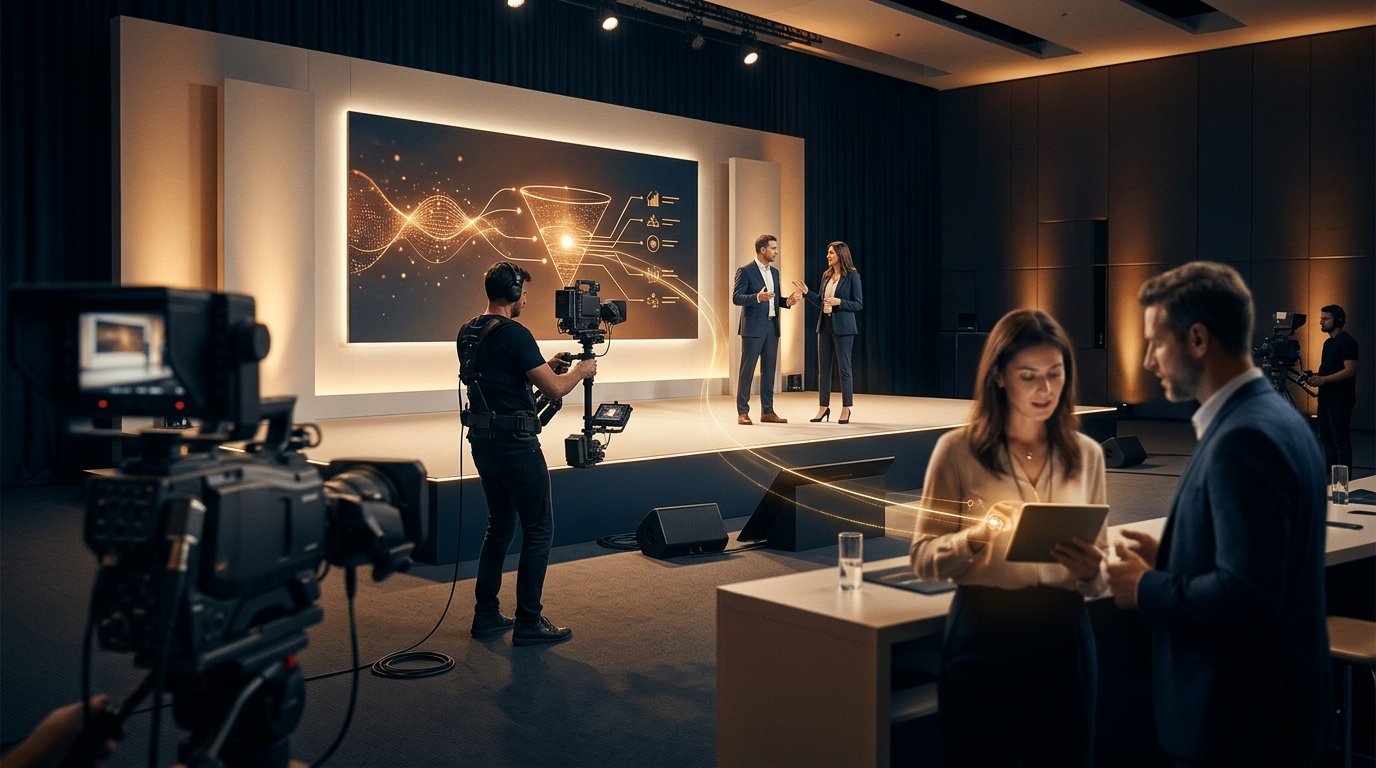
Investing in high-level audiovisual production—whether it’s editorial photography capturing the intensity of a keynote or multi-camera video capture—transforms a fleeting moment into a permanent, high-value marketing asset. The quality of your visual documentation is a direct reflection of your offering's quality. If your content is mediocre or amateurish, it contradicts the message of excellence you aim to convey. Conversely, premium visual documentation acts as a force multiplier for sales teams. It provides indisputable social proof that survives long after the booths are dismantled and the lights go out.
This content becomes the essential fuel for post-event nurturing. It allows you to maintain top-of-mind awareness in an elegant, non-intrusive way by reminding prospects of the intellectual value shared during the summit. Rather than following up with a generic email, sending a high-quality recap video or an exclusive photo gallery strengthens the emotional and professional bond. This is where traditional attribution fails: it cannot measure the value of a video watched three times by a management committee before a major purchase decision. By treating visual production as a strategic investment rather than a logistical cost, B2B companies bridge the gap between physical presence and digital conversion, ensuring total consistency across the customer journey.
Treating B2B Events as a Brand Operating System Rather Than a Lead Gen Channel
Adopting a 'builder' mindset—a vision championed by Amanda Teder at Brandweek—means designing your events as a true Brand Operating System (Brand OS). In this model, every conference, summit, or product launch is not an isolated action but a major 'update' to your market positioning. The event becomes the heart of a global content strategy that flows into all other channels: social media, email marketing, PR, and direct sales. Today’s dominant brands are those that integrate brand strategy long before automation or AI. They understand that human interaction, magnified by high-quality production, is the only safeguard against message commoditization.
At Alesia RSVP, we firmly believe that event production must serve this systemic and ambitious vision. Whether we are managing video capture for tech summits in New York or visual organization for economic forums in Paris, our approach is to maximize the value of every second of physical presence. On-site podcast studios, high-definition live streaming, and real-time social media content delivery are not technical gadgets. They are the essential components of a system that transforms a local physical interaction into global digital authority. We don’t just provide technical staff or equipment; we act as architects of your brand image, ensuring every pixel produced serves your long-term business goals.
Positioning Alesia RSVP as a premium partner is a strategic necessity: we understand that event impact must far exceed the narrow limits of traditional attribution tools. By aligning audiovisual production quality with your top-of-funnel objectives, we ensure your investment generates lasting value. In the coming years, the priority for CMOs should no longer be frantically counting every click, but ensuring that every image generated, every video shared, and every testimonial captured reinforces their company’s stature on the international stage. It is by escaping the trap of simplistic attribution that we restore the true power of event marketing: the power to build legendary brands.
FAQ
How does premium visual content help with long-term prospect nurturing?
High-quality visual content, such as cinematic recap videos and editorial photography, acts as persistent proof of authority. In long B2B sales cycles, this material allows you to re-engage prospects qualitatively, reminding them of the brand's expertise and stability long after the physical event, which builds the trust necessary for a final purchase decision.
Why does simplistic attribution fail in high-consideration B2B categories?
Traditional attribution often focuses on the 'last click' or the final touchpoint, ignoring the cumulative influence of brand awareness and trust-building. In B2B, multiple stakeholders are involved, and decisions are based on long-term credibility—factors that a simple lead-gen form cannot capture but that a high-end event experience solidifies.
Frequently Asked Questions
How does premium visual content help with long-term prospect nurturing?
High-quality visual content, such as cinematic recap videos and editorial photography, acts as persistent proof of authority. In long B2B sales cycles, this material allows you to re-engage prospects qualitatively, reminding them of the brand's expertise and stability long after the physical event, which builds the trust necessary for a final purchase decision.
Why does simplistic attribution fail in high-consideration B2B categories?
Traditional attribution often focuses on the 'last click' or the final touchpoint, ignoring the cumulative influence of brand awareness and trust-building. In B2B, multiple stakeholders are involved, and decisions are based on long-term credibility—factors that a simple lead-gen form cannot capture but that a high-end event experience solidifies.