
Choosing a Strategic Event Partner: Beyond the Tech
Choosing a Strategic Event Partner: Beyond the Tech
Stop settling for events that simply 'work.' Learn how to turn your production into a strategic storytelling engine to maximize the impact of your corporate messaging.
Why Flawless Execution is No Longer Enough for B2B Success
Today, technical perfection is no longer a luxury or a competitive advantage; it is the baseline—the price of admission. For CMOs and Communications Directors, a feedback-free sound system, flattering lighting, and seamless projections are invisible prerequisites. When everything works perfectly, no one notices. This is the paradox of production: it only exists for the audience when it fails. But in a saturated market where attention is the rarest and most expensive resource, this technical invisibility is a missed opportunity if it isn't leveraged for a larger purpose. A successful B2B event shouldn't just run without a hitch; it must resonate strategically long after the doors close and the stage is struck.
Mere logistical execution often ignores the ultimate goal of any professional gathering: building long-term brand equity and converting an audience into an engaged community. The shift from a service provider—who executes an order—to a strategic partner—who advises on impact—is now essential. Companies invest massive budgets into summits, product launches, and annual conferences. If the experience is limited to a series of well-lit slides in a climate-controlled room, the ROI remains superficial. As highlighted in discussions on evolving brand expectations (LinkedIn), decision-makers are no longer buying lumens or watts; they are buying a deep understanding of their business challenges and the ability to translate those challenges into tangible emotions.
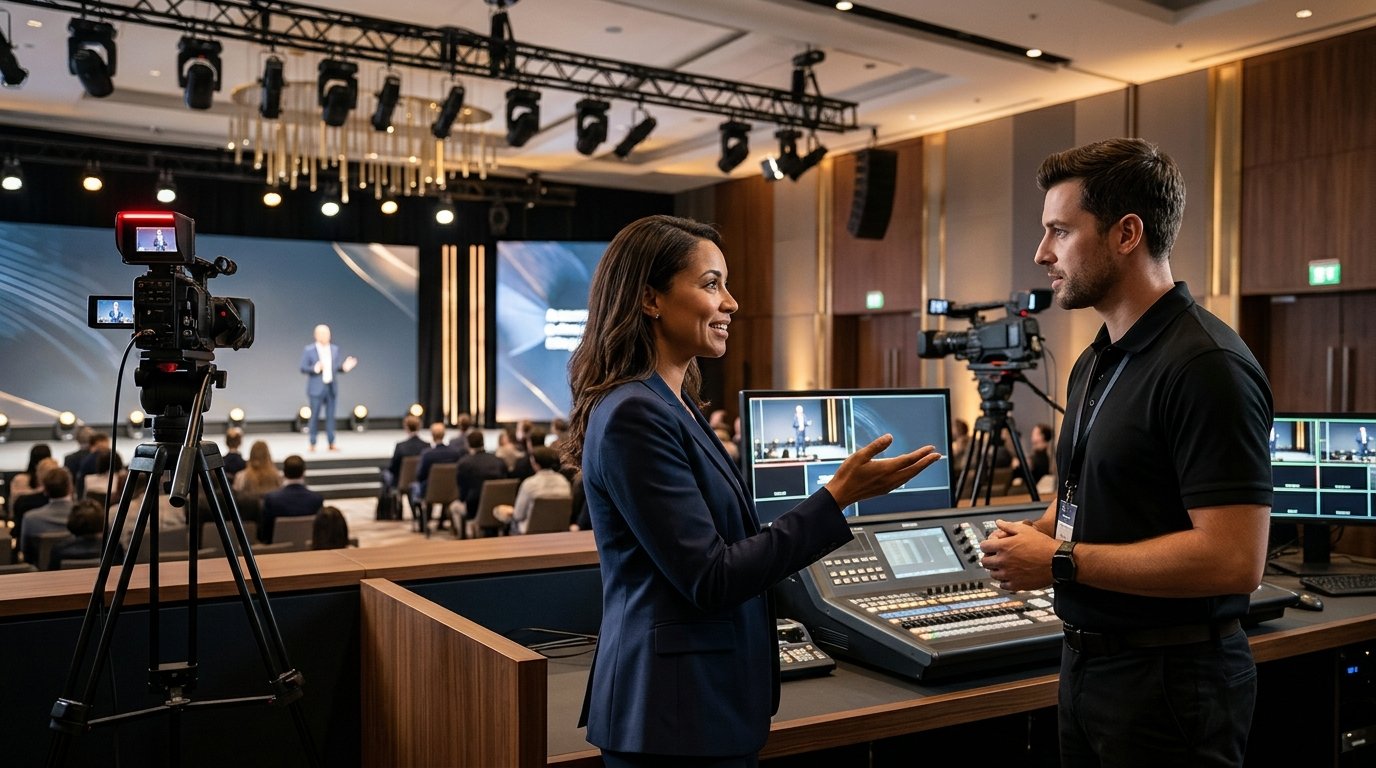
The obsession with the technical 'black box'—an exclusive focus on hardware—must give way to a holistic vision of production. An event isn't just a logistical expense on an Excel sheet; it’s a high-value content production platform. If your production partner simply plugs in cables without understanding your stakeholders, your conversion goals, or your brand DNA, they are delivering only 50% of the value. The real difference lies in the ability to transform physical infrastructure (stages, screens, mics) into a vehicle for industry authority. This requires viewing scenography as a storytelling tool, where every camera angle and visual transition serves to reinforce the speaker's message rather than just broadcast it.
Finally, we must view the event as the starting point of a multi-channel content strategy. A partner who understands this won't just stream the live feed; they will anticipate post-production needs, create short-form social media assets, and ensure the longevity of the conversations. Technology becomes the foundation for a global influence strategy. In 2025, technical excellence is a commodity; strategic excellence is the only true differentiator.
How a Visual Partner Transforms the Attendee Experience
The guest experience doesn't start at check-in and certainly doesn't end at the closing cocktail hour. It is amplified, stretched, and solidified by how the event is documented, shared, and relived. A top-tier visual partner doesn't just 'take photos' or 'film clips'; they capture the intangible. They track the energy of intense networking in the hallways, the palpable tension before a major announcement, or the authentic emotion of an inspiring keynote. This editorial approach to capture transforms a simple visual record into a true brand narrative. Looking at our portfolio gallery, it’s clear that visual quality is a direct mirror of a company's ambition.
When an expert agency steps in, photo and video capture become real-time engagement tools rather than passive archiving. Imagine the power of editorial portraits of your key speakers, retouched and delivered within an hour so they can share them on their own networks while the event is still trending. Or an aftermovie produced with cinematic sensitivity that doesn't just compile generic b-roll but tells the story of your innovation through the faces of those driving it. This is where production meets pure content strategy. You aren't producing an event for the 500 people in the room, but for the 50,000 who will see the content online in the following weeks. The quality of this visual output defines your leadership and professionalism to the outside world.
This radical transformation of the experience requires total integration of the production team into the event ecosystem. The partner must act as a natural extension of your marketing team. They need the situational intelligence to know that a smile shared between a CEO and a strategic partner in a corner of the lounge is worth more than ten photos of an empty ballroom. This ability to identify 'moments of truth' is what separates technicians from impact creators. For an event in Paris or any international hub, this agility and understanding of corporate codes are the keys to turning a one-off expense into a reusable marketing asset.
Furthermore, the chosen visual aesthetic must align perfectly with the brand identity. A strategic visual partner will discuss color grading, framing styles, and video tone long before day one. They ensure every image produced reinforces the company’s visual identity, creating harmony between the physical event and the brand’s digital universe. This attention to detail—often overlooked by purely technical vendors—is what creates a premium, memorable experience for guests and partners alike.
Criteria for Choosing a Partner Who Goes Beyond Production
The first and most crucial criterion is a deep understanding of the B2B ecosystem and its specific mechanics. Your partner must speak your language: ROI, lead acquisition, talent retention, and customer loyalty. If the initial discussion is stuck on lumen specs or camera models, you don't have the right partner for a strategic project. A valuable partner will ask about your communication goals, your audience profile, and the key message you want to anchor in minds before even proposing a technical rider. According to industry trends on BizBash, integrating content strategy from the planning phase is the number one success factor for premium events.
The second criterion is multi-format execution and mastery of hybrid environments. In today’s landscape, an event is no longer a single object; it is simultaneously physical, digital, synchronous, and asynchronous. Your partner must demonstrate simultaneous mastery of stage management (the live show), broadcast streaming (the remote experience), and the production of derivative content like on-site podcasts or 'snack content' video capsules. This versatility is vital to avoid fragmenting your message across multiple vendors who don't communicate. By merging these expertises, you guarantee total consistency: from global logistics to high-end audiovisual production, every element points toward the same goal.
Finally, responsiveness and a culture of immediate delivery have become paramount. The corporate world and media cycles do not wait. A partner who delivers your content three weeks after the event, when the news cycle has already moved on, is a partner who is losing you money. Immediacy is the new currency of influence. You must choose an agency capable of providing tangible results—social media videos, optimized photo galleries, keynote highlights—while the event is still fresh in everyone's mind. In the age of GDPR and rapid digital consumption, having a partner who manages data securely while delivering at the speed of social media is the ultimate competitive edge.
FAQ
What is the difference between an event provider and a strategic partner?
A provider focuses on technical execution (sound, light, video), while a strategic partner aligns those technical tools with your business objectives, ROI, and long-term content strategy.
Why is real-time content delivery important for B2B events?
Immediacy maximizes engagement. Sharing high-quality highlights while the event is happening leverages the peak of audience attention and extends the event's reach to a global digital audience.
How can event production improve brand perception?
Through high-end visual storytelling, cinematic capture, and consistent branding, production transforms a corporate meeting into a premium experience that signals leadership and innovation.
Frequently Asked Questions
What is the difference between an event provider and a strategic partner?
A provider focuses on technical execution (sound, light, video), while a strategic partner aligns those technical tools with your business objectives, ROI, and long-term content strategy.
Why is real-time content delivery important for B2B events?
Immediacy maximizes engagement. Sharing high-quality highlights while the event is happening leverages the peak of audience attention and extends the event's reach to a global digital audience.
How can event production improve brand perception?
Through high-end visual storytelling, cinematic capture, and consistent branding, production transforms a corporate meeting into a premium experience that signals leadership and innovation.