
B2B Conference Singapore: Planning & AV Production Guide
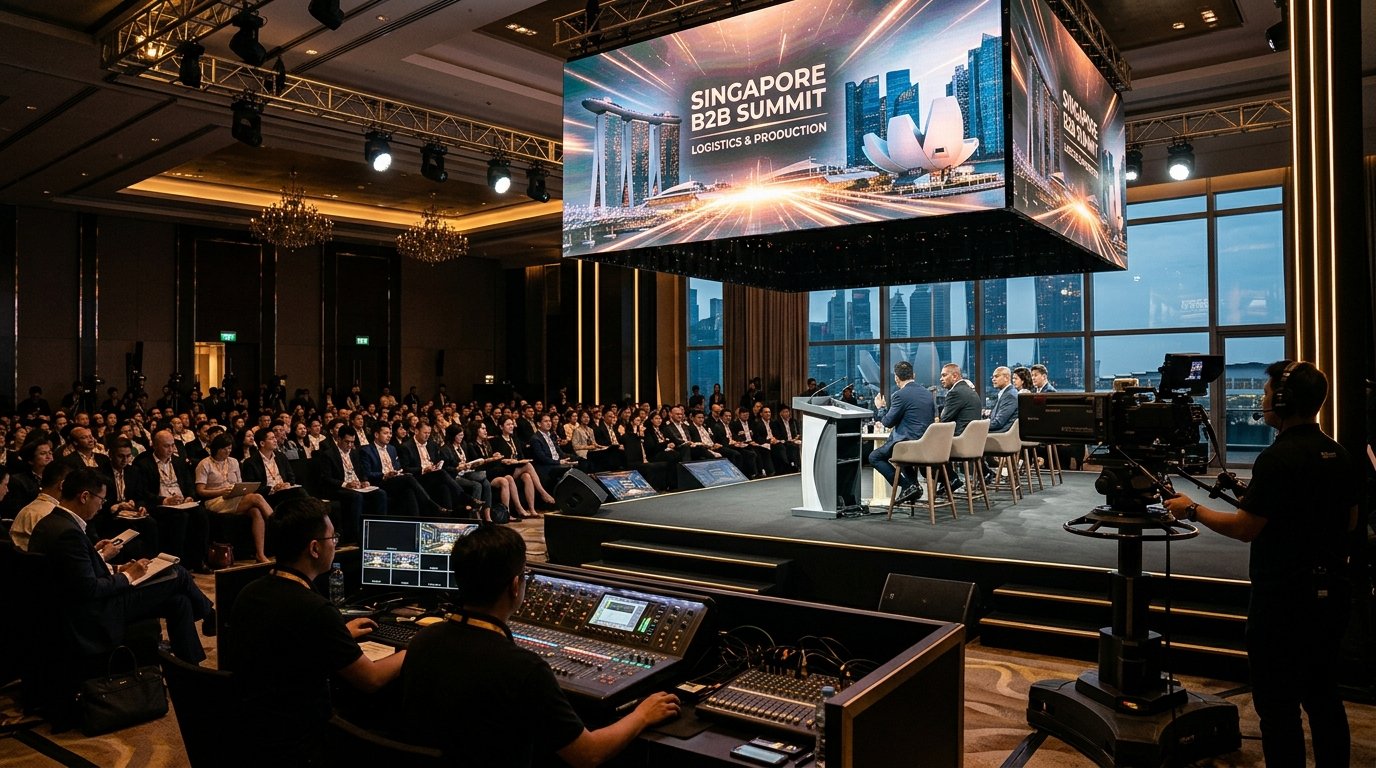
B2B Conference Singapore: Planning & AV Production Guide
Singapore is the gold standard for global B2B conferences, but success lies in the logistical details and AV precision that no one discusses.
What are the hidden logistical challenges of organizing a B2B conference in Singapore?
Singapore is widely regarded as the gold standard for global B2B conferences, yet the difference between a smooth execution and a logistical nightmare often lies in the granular details that rarely surface in standard planning guides. Beyond the iconic skyline and the hyper-efficient facade, success is built on a foundation of local technical precision and high-end visual storytelling. For a Corporate Events Singapore strategy to succeed, planners must look past the surface-level efficiency of the city-state. While Changi Airport and the MRT system are marvels of global infrastructure, the high-stakes world of MICE (Meetings, Incentives, Conferences, and Exhibitions) operates under a strict regulatory and logistical framework that can catch international planners off guard if they are not properly prepared.
One of the most significant, yet frequently overlooked, aspects is the 'Singapore pace.' In this market, efficiency is not merely a goal; it is a baseline expectation from every stakeholder involved. When you book a premier venue like Marina Bay Sands, Suntec Singapore Convention & Exhibition Centre, or the Raffles City Convention Centre, the load-in and load-out windows are often significantly tighter than those found in European or North American hubs. This environment demands a production team that possesses an intimate understanding of local labor laws, venue-specific technical riders, and the physical constraints of the loading bays. A delay of thirty minutes in the loading dock can cascade into a three-hour delay for the technical rehearsal, potentially compromising the entire event schedule.
Furthermore, the administrative complexity of operating in Singapore should not be underestimated. The Goods and Services Tax (GST) implications for international organizers, coupled with specific permit requirements for foreign speakers or specialized technical equipment, require meticulous attention. For instance, bringing in proprietary hardware often necessitates an ATA Carnet to avoid unexpected customs duties. On the ground, the density of the Central Business District (CBD) creates a challenging RF (Radio Frequency) environment. High-speed connectivity is ubiquitous, yet the sheer volume of signals can create significant interference for wireless microphone systems and high-bandwidth streaming if not managed with professional-grade frequency coordination. To navigate these hurdles, you need a partner who treats logistics not as a back-office task, but as the essential foundation of the brand experience. This involves proactive communication with the Singapore Tourism Board (STB) and venue management to ensure every permit is in place long before the first attendee arrives.
In our experience at Alesia RSVP, the most successful conferences in the Lion City are those that acknowledge Singapore’s unique position as a gateway to the broader Asian market. This means your event must cater to a diverse, multi-national audience with varying technical expectations and cultural nuances. The logistical challenge is not just the physical movement of people into a plenary hall; it is the creation of a flawless technical environment where the executive message remains the absolute focus, undisturbed by the friction of poorly managed infrastructure. Achieving this requires a deep dive into the venue’s internal power grids, internet redundancy protocols, and even the acoustic properties of the specific ballrooms, which can vary wildly even within the same facility.
How can premium AV and visual production elevate a corporate event's ROI?
In a market as competitive and visually saturated as Singapore, a standard keynote recording or a handful of social media snapshots is no longer sufficient to justify the significant capital expenditure of a major conference. Modern decision-makers must view their event as a content factory. Premium AV and visual production are the primary drivers of post-event ROI, transforming a three-day summit into twelve months of high-value marketing assets. When you invest in a high-tier hub like Singapore, the visual output must match the prestige of the location. This is where many agencies fail by hiring generalist photographers or videographers who lack the editorial eye required for sophisticated B2B storytelling.
Professional event photography must move beyond the tired 'handshake and podium' shots that have dominated the industry for decades. It requires an editorial approach that captures the intensity of the networking lounge, the architectural scale of the plenary hall, and the subtle nuances of executive interactions. These images are not just records of the day; they are the visual proof of your brand’s influence and authority. Similarly, video production should not be limited to a simple three-minute recap video that is watched once and forgotten. We advocate for a multi-tiered video strategy that maximizes the utility of every frame captured. This includes same-day highlight reels for immediate social proof, documentary-style executive interviews for thought leadership, and high-fidelity session recordings that can be repurposed as gated content for lead generation throughout the year.
By utilizing the physical presence of industry leaders in one location, you can generate a volume of content that would take months to produce in a studio setting. This content-first approach to AV production is what separates a standard corporate gathering from a world-class industry summit. Furthermore, the integration of on-site podcasting has become a significant differentiator, particularly for B2B conferences in the fintech, biotech, and deep-tech sectors. By setting up a professional, sound-treated glass-box studio in the middle of the exhibition floor, you provide sponsors and speakers with a high-value deliverable that is both interactive and permanent. This setup creates a 'hub of activity' that draws attendees in and provides a secondary platform for deep-dive discussions that the main stage might not allow.
This level of production ensures that the investment in the physical event continues to pay dividends long after the last attendee has checked out of their hotel. Every interview, every high-resolution photo, and every crystal-clear audio recording becomes a building block for your digital presence. You can see the tangible results of this approach in our Galerie Photo & Video, which showcases how we elevate the visual narrative of international events by focusing on the intersection of technical excellence and brand strategy. The goal is to create a digital legacy for the event that is as impressive as the live experience itself, ensuring that stakeholders who couldn't attend feel the weight of the missed opportunity and those who did attend have their professional status reinforced by the quality of the media produced.
What should you look for when hiring local vendors for high-stakes international events?
Reliability is the baseline; strategic integration is the ultimate goal. When organizing an international event in Singapore, the most common mistake is the fragmentation of services. Managing five different vendors for photography, videography, live streaming, audio-visual hardware, and logistics creates a disjointed workflow and, more importantly, a fragmented brand voice. You need a partner who understands the corporate aesthetic—clean, sharp, authoritative, and sophisticated. This is where Alesia RSVP acts as the strategic visual partner in Singapore, integrating seamlessly with local logistics teams to capture the high-end essence of your event while navigating the city's unique vendor landscape with surgical precision.
Our five core services—Photography, Video Production, Live Streaming, On-Site Podcasting, and Event Management—are designed to work in unison, not in silos. This all-in-one approach eliminates the 'vendor gap' where the photographer and videographer are competing for the same angle, or the streaming team is unaware of the lighting cues being used for the live audience. In Singapore, where venue costs are at a premium, every square meter of the floor plan and every minute of the schedule must be optimized. A unified production team ensures that the technical footprint is lean and efficient, but the creative output is maximal. This synergy allows for a more agile response to the inevitable real-time changes that occur during high-pressure summits.
When vetting a local partner, look beyond their equipment list. Any agency can rent a high-end camera, but few can provide the senior-led expertise required to manage the expectations of C-suite executives and global marketing leads. You need a team that doesn't just show up with cameras, but one that understands the geopolitical and business context of the event. Whether it is a fintech summit at the Sands Expo or a private C-suite gathering at the Capella on Sentosa, the production must be invisible in its execution but undeniable in its quality. This means having a team that knows how to dress for the room, how to move through a crowd without being disruptive, and how to anticipate the needs of the speakers before they even step onto the stage.
Ultimately, the choice of a production partner reflects directly on the host brand. For a VP of Marketing or a Corporate Communications lead, the goal is a 'zero-stress' execution where they can focus on their guests and their message, knowing that the visual legacy of the event is in expert hands. In Singapore’s high-pressure environment, having a partner who can navigate the local bureaucracy, manage the technical complexities of the venue, and deliver world-class creative assets is not a luxury—it is a strategic necessity. Alesia RSVP provides this level of comprehensive expertise, ensuring that your Singapore conference is remembered not just for the quality of the coffee, but as a benchmark for excellence and professional authority in your industry.
FAQ
What makes Singapore a top destination for B2B conferences?
Singapore offers a strategic location as the gateway to Southeast Asia, featuring world-class venues like Marina Bay Sands and Suntec. Its stability, safety, and highly efficient business environment make it the preferred hub for high-stakes corporate summits. Furthermore, the Singapore Tourism Board provides significant support and incentives for 'MICE' events, ensuring a high level of professional infrastructure that is difficult to match elsewhere in the region.
How do I manage multi-vendor coordination for a large-scale event in Singapore?
The most effective way to manage a large-scale event is to centralize production under a single agency that handles AV, photography, and live streaming. This eliminates the communication gaps that occur when multiple vendors compete for space and resources. Centralization ensures a unified technical direction, reduces the administrative burden on the event planner, and guarantees a consistent visual brand across all platforms, from the live stage to the post-event marketing assets.
What are the technical requirements for live streaming a conference in Singapore?
Live streaming in Singapore requires a dedicated high-speed fiber line from the venue, which should be supplemented by a 5G bonded cellular backup to ensure 100% redundancy. Given the city's advanced technological infrastructure, global audiences expect 1080p or 4K multi-camera broadcasts with professional-grade audio. It is also crucial to perform a full network stress test and frequency coordination to avoid interference from the dense wireless environment typical of the Singapore CBD.
Questions Fréquentes
What makes Singapore a top destination for B2B conferences?
Singapore offers a strategic location as the gateway to Southeast Asia, featuring world-class venues like Marina Bay Sands and Suntec. Its stability, safety, and highly efficient business environment make it the preferred hub for high-stakes corporate summits. Furthermore, the Singapore Tourism Board provides significant support and incentives for 'MICE' events, ensuring a high level of professional infrastructure that is difficult to match elsewhere in the region.
How do I manage multi-vendor coordination for a large-scale event in Singapore?
The most effective way to manage a large-scale event is to centralize production under a single agency that handles AV, photography, and live streaming. This eliminates the communication gaps that occur when multiple vendors compete for space and resources. Centralization ensures a unified technical direction, reduces the administrative burden on the event planner, and guarantees a consistent visual brand across all platforms, from the live stage to the post-event marketing assets.
What are the technical requirements for live streaming a conference in Singapore?
Live streaming in Singapore requires a dedicated high-speed fiber line from the venue, which should be supplemented by a 5G bonded cellular backup to ensure 100% redundancy. Given the city's advanced technological infrastructure, global audiences expect 1080p or 4K multi-camera broadcasts with professional-grade audio. It is also crucial to perform a full network stress test and frequency coordination to avoid interference from the dense wireless environment typical of the Singapore CBD.