
Corporate Event Planning in Singapore: Venues & AV Guide
Corporate Event Planning in Singapore: Venues & AV Guide
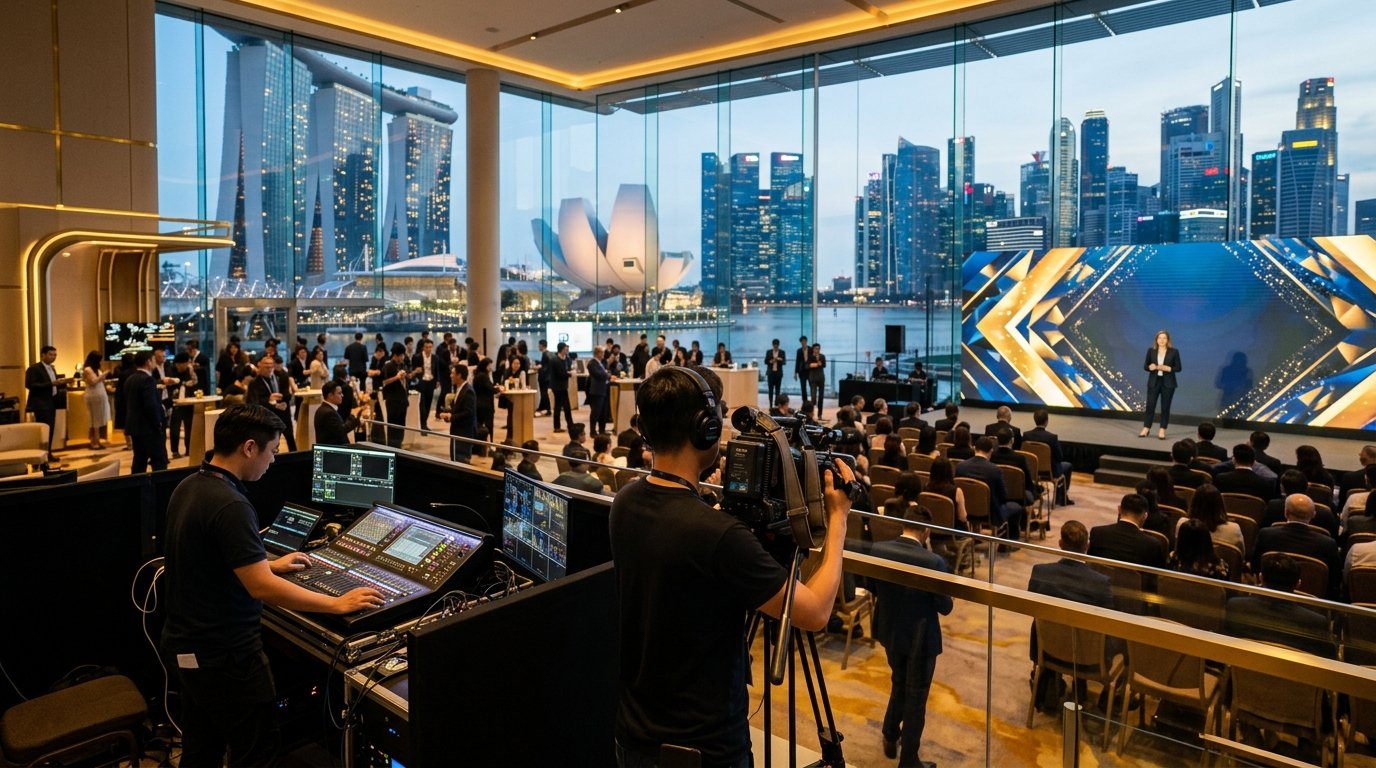
Mastering Singapore’s high-stakes corporate scene requires more than a checklist; it demands a strategic fusion of elite logistics and visual storytelling. In a landscape defined by efficiency and prestige, the difference between a standard conference and a market-leading summit lies in the technical execution and the ability to transform a physical space into a global content hub.
How do I choose the right corporate event venue in Singapore's competitive market?
Mastering Singapore’s high-stakes corporate scene requires more than a simple checklist; it demands a strategic fusion of elite logistics and world-class visual storytelling. Choosing a venue in the Lion City is a statement of intent for any B2B brand. While the Marina Bay Sands remains the titan for massive trade shows and large-scale exhibitions, it is the mid-scale, high-touch environments like the Capella Singapore on Sentosa or the warehouse-chic spaces in Tanjong Pagar and the Keppel Bay area that often provide the intimacy required for executive summits and high-level networking. The decision must be dictated by more than just square footage or a prestigious address. In a city where connectivity is a baseline expectation, the technical infrastructure of a venue—specifically its ability to support high-bandwidth broadcast and complex multi-camera setups—is the primary filter.
Singapore serves as the gateway to the APAC region, meaning your venue must act as a broadcast studio as much as a meeting hall. If the ceiling heights don't allow for professional rigging or if the power distribution is insufficient for a full-scale LED wall (P2.0 or lower), the venue is a liability. High-stakes B2B events require environments that facilitate networking while providing the acoustic isolation necessary for on-site podcast recording and executive interviews. When evaluating locations, prioritize those that have hosted major Singapore Tourism Board - MICE Events successfully, as they understand the rigorous standards of international corporate production. Furthermore, consider the logistics of the 'bump-in' process; Singapore's CBD has strict traffic regulations and limited loading bay windows. A venue with streamlined access for heavy AV equipment can save dozens of man-hours and significantly reduce the risk of delays. The goal is to select a space that enhances your brand's authority rather than one that forces technical compromises. You must also evaluate the venue's internal lighting temperature and natural light spill, which can drastically affect the quality of your video documentation. A venue that looks beautiful to the naked eye may require extensive (and expensive) lighting correction to look professional on a 4K broadcast feed. Always conduct a technical site survey with your production lead before signing a contract.
What are the essential AV and technical requirements for premium B2B summits?
For a corporate summit in Singapore, the AV setup is not a utility; it is the primary interface between your brand and your audience. Standard hotel-provided AV is almost never sufficient for a premium B2B experience. You require a broadcast-grade infrastructure that includes 4K multi-camera switching, redundant fiber lines for live streaming, and studio-quality lighting that renders skin tones perfectly for both the live audience and the digital archive. Low-latency streaming is non-negotiable for hybrid events that connect Singapore to London or New York. If your technical partner isn't discussing signal redundancy and fail-safe protocols—such as secondary encoders and diverse-path internet connections—you are at risk of a public-facing failure that no marketing budget can fix.
Beyond the screen, the audio environment is where most events fail. In the cavernous ballrooms of Singapore’s top hotels, managing acoustic reflections requires high-end line array systems and expert sound engineering. This technical rigor ensures that your keynote speakers are heard with absolute clarity, which is the bedrock of executive credibility. Furthermore, the integration of on-site podcasting booths has become a standard for Tier-1 conferences. This allows brands to capture thought leadership in real-time, transforming a two-day event into a six-month content engine. Technical specifications should include Dante-enabled audio networking to ensure clean, interference-free signals across the venue. Additionally, the use of high-refresh-rate LED panels is critical to avoid 'flicker' on camera, a common issue when using lower-tier rental equipment. Alesia RSVP elevates Singapore event planning by integrating premium photo and video production directly into the logistical framework, ensuring that AV setups and vendor coordination are optimized for both live impact and the creation of high-end brand assets. We focus on the 'Broadcast-First' mentality, where every technical decision is made with the final digital output in mind. This includes managing the color temperature of the stage wash to match the sensors of cinema-grade cameras, ensuring that your event looks like a high-end production rather than a standard corporate meeting.
How can I effectively manage multiple vendors for a seamless event experience?
The fragmentation of event services is the greatest threat to a successful summit. Managing a separate caterer, a venue coordinator, a local AV firm, and a creative agency creates a web of communication silos that inevitably lead to oversight. The most effective strategy is to consolidate your production and management under a single expert partner who understands the local ecosystem. In Singapore, professional associations like SACEOS - Singapore Association of Convention & Exhibition Organisers provide a framework, but real-world execution requires an agency that can bridge the gap between logistics and creative output. Navigating the Ministry of Manpower (MOM) safety regulations and the specific Risk Management and Analysis (RAMS) requirements for Singaporean venues is a full-time job in itself.
When you consolidate your Corporate Events Singapore management, you eliminate the friction between the technical team and the event planners. For instance, the lighting team needs to know exactly when the photography team is doing executive headshots; the live streaming lead needs to be in sync with the stage manager for every transition. This level of synchronization is only possible when the teams operate under a unified command structure. This approach doesn't just reduce stress; it optimizes the budget by eliminating overlapping service fees and ensuring that every vendor is working toward the same visual and strategic goal. Managing multiple vendors is about managing risks; consolidation is about maximizing the quality of the final deliverable. A single point of contact ensures that the brand's aesthetic is maintained across all touchpoints, from the registration desk to the final highlight reel. In the Singapore market, where vendor reliability is generally high but communication styles vary, having a lead agency that speaks the language of both the C-suite and the technical crew is invaluable. This lead agency acts as the 'buffer,' absorbing technical complexities and presenting the client with clear, actionable decisions. It also allows for more agile responses to last-minute changes, such as a speaker's schedule shift or a sudden technical requirement for a remote presenter.
Why is professional visual documentation the key to ROI for Singapore corporate events?
The true ROI of a B2B event is rarely found in the room itself; it is found in the content that lives on after the doors close. A two-day summit is a goldmine for high-end marketing assets—if you have the right production team to mine it. Professional photography and videography should never be an afterthought. They are the primary tools for post-event sponsor reporting, social media authority building, and future event promotion. High-quality editorial coverage provides a level of prestige that stock imagery can never replicate. By documenting the event with the same rigor as a magazine shoot, you create a visual legacy that justifies the significant investment of a Singapore-based conference. In a market as saturated as Singapore, visual distinction is your greatest competitive advantage.
Every keynote, every panel, and every networking session is an opportunity to generate months of thought leadership content. This is why our Galerie Photo & Video showcases more than just highlights; it demonstrates the depth of storytelling required for modern corporate brands. When you treat your event as a content production hub, the cost of the event is amortized across your entire marketing calendar. The aftermovie is not just a recap; it is the sales tool for next year's sponsors and attendees. It should capture the energy, the intellectual weight, and the high-level networking that occurred. This requires a film crew that understands corporate narrative, not just someone who can operate a camera. They need to identify the key moments of 'social proof'—the handshake between industry titans, the engaged audience during a breakthrough presentation, and the candid moments of executive collaboration. Alesia RSVP ensures that every frame captured serves a strategic purpose, turning a fleeting moment into a permanent brand asset. We utilize cinema-grade equipment and an editorial eye to ensure that the final output matches the premium nature of your brand. In the end, the quality of your event's documentation is what determines its lasting impact on your industry standing.
FAQ
What are the best districts for hosting corporate events in Singapore?
The Central Business District (CBD) and Marina Bay are the premier choices for high-stakes corporate summits due to their proximity to financial hubs and luxury hotels. For more exclusive or creative gatherings, Sentosa Island and the heritage buildings in the Civic District (such as the Victoria Theatre or National Gallery) offer unique backdrops that stand out from standard ballroom settings. Each district offers different logistical advantages, from ease of transport to proximity to high-end dining for post-event networking.
How does Alesia RSVP coordinate with local Singaporean AV vendors?
Alesia RSVP acts as the primary production lead, bringing our own senior technical directors to oversee local equipment providers. We handle all technical specifications, site visits, and quality control to ensure that local AV setups meet international broadcast standards and integrate seamlessly with our photography and video teams. This 'top-down' management style ensures that there are no technical gaps between the equipment provided and the creative vision of the event.
What is the recommended lead time for planning a B2B summit in Singapore?
For a high-stakes summit, a lead time of 6 to 9 months is ideal. This allows for the securing of top-tier venues, which often book out a year in advance, and provides ample time for the development of a comprehensive content and marketing strategy. However, for smaller executive retreats or press events, a 3-month window is manageable if the production partner has a strong local network.
Are there specific permits required for event filming and drone usage in Singapore?
Yes, Singapore has strict regulations regarding drone usage (CAAS permits) and filming in public or heritage areas. When filming at a corporate event, indoor drone use requires specific safety protocols. Alesia RSVP manages all necessary permits and ensures compliance with local laws, including data protection (PDPA) considerations for attendee photography and videography.
How do you ensure the quality of live-streamed content for international audiences?
We utilize dedicated, high-speed fiber lines with 4G/5G bonding as a secondary failover. Our broadcast workflow uses professional hardware encoders and multi-CDN distribution to ensure that viewers in Europe, the US, and across Asia experience minimal latency and high-definition clarity. We also conduct extensive 'stress tests' of the venue's network infrastructure at least 24 hours before the event begins.
Frequently Asked Questions
What are the best districts for hosting corporate events in Singapore?
The Central Business District (CBD) and Marina Bay are the premier choices for high-stakes corporate summits due to their proximity to financial hubs and luxury hotels. For more exclusive or creative gatherings, Sentosa Island and the heritage buildings in the Civic District (such as the Victoria Theatre or National Gallery) offer unique backdrops that stand out from standard ballroom settings. Each district offers different logistical advantages, from ease of transport to proximity to high-end dining for post-event networking.
How does Alesia RSVP coordinate with local Singaporean AV vendors?
Alesia RSVP acts as the primary production lead, bringing our own senior technical directors to oversee local equipment providers. We handle all technical specifications, site visits, and quality control to ensure that local AV setups meet international broadcast standards and integrate seamlessly with our photography and video teams. This 'top-down' management style ensures that there are no technical gaps between the equipment provided and the creative vision of the event.
What is the recommended lead time for planning a B2B summit in Singapore?
For a high-stakes summit, a lead time of 6 to 9 months is ideal. This allows for the securing of top-tier venues, which often book out a year in advance, and provides ample time for the development of a comprehensive content and marketing strategy. However, for smaller executive retreats or press events, a 3-month window is manageable if the production partner has a strong local network.
Are there specific permits required for event filming and drone usage in Singapore?
Yes, Singapore has strict regulations regarding drone usage (CAAS permits) and filming in public or heritage areas. When filming at a corporate event, indoor drone use requires specific safety protocols. Alesia RSVP manages all necessary permits and ensures compliance with local laws, including data protection (PDPA) considerations for attendee photography and videography.
How do you ensure the quality of live-streamed content for international audiences?
We utilize dedicated, high-speed fiber lines with 4G/5G bonding as a secondary failover. Our broadcast workflow uses professional hardware encoders and multi-CDN distribution to ensure that viewers in Europe, the US, and across Asia experience minimal latency and high-definition clarity. We also conduct extensive 'stress tests' of the venue's network infrastructure at least 24 hours before the event begins.