
Digital Dollars vs SWIFT: The Battle for Fintech Summits
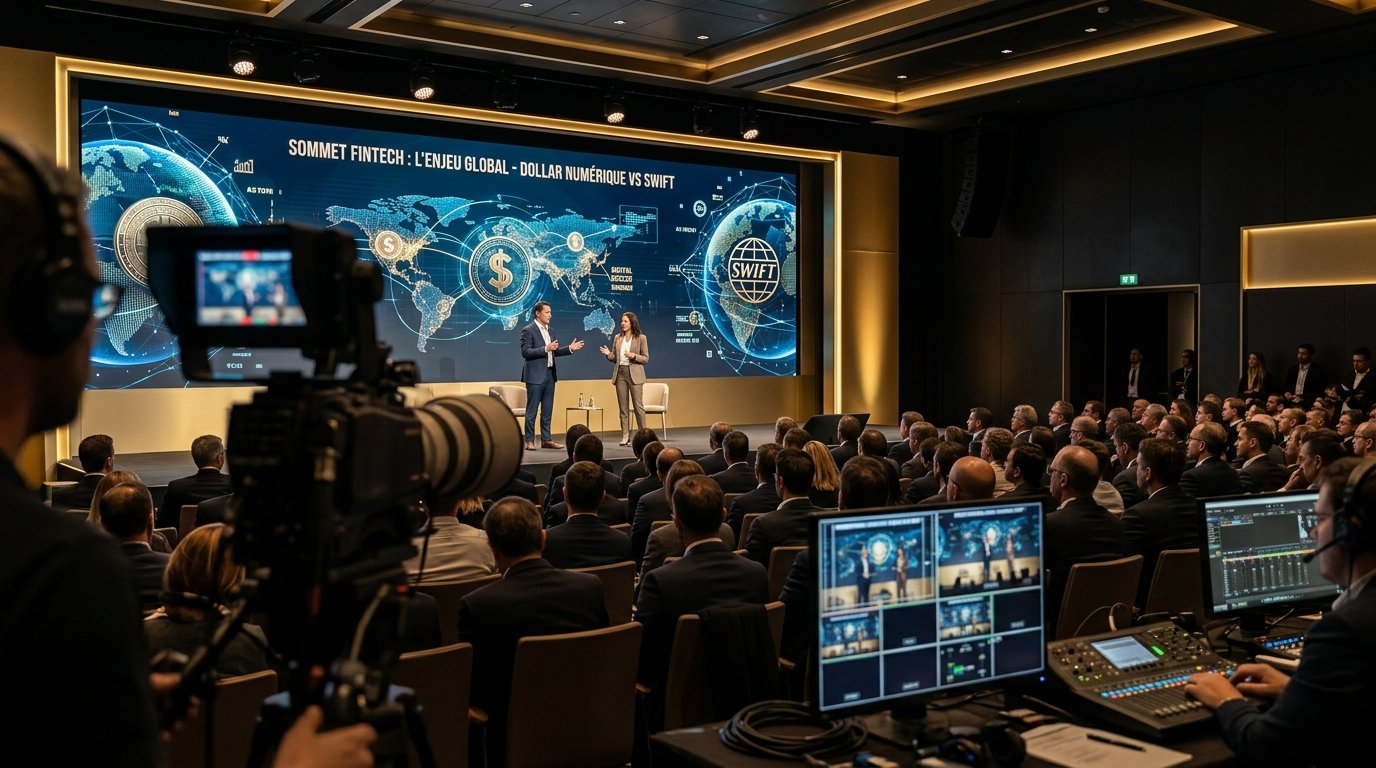
Digital Dollars vs SWIFT: The Battle for Fintech Summits
As digital dollars challenge SWIFT's legacy dominance, discover how high-stakes financial summits are documenting the future of global money movement.
How is the digital dollar vs. SWIFT debate shaping the visual identity of fintech summits?
As the financial world collides in a high-stakes battle between legacy systems and digital dollars, the real action isn't just on the ledgers—it's happening live on stage at the world's most exclusive summits. For decades, SWIFT has been the invisible plumbing of the global economy, moving $150 trillion annually with a visual identity rooted in traditional banking: dark blue suits, sterile boardrooms, and a general aura of institutional stability. However, the rise of stablecoins and Central Bank Digital Currencies (CBDCs) has triggered an aggressive shift in how financial power is presented to the world. We are seeing a clash of aesthetics that defines the current fintech market. On one side, legacy institutions are attempting to modernize their image without losing the trust of conservative stakeholders. On the other, digital asset pioneers are moving away from the 'hacker' aesthetic of early crypto and toward a high-gloss, institutional professionalism that commands respect from traditional regulators.
This shift is clearly visible at events like Consensus, where the conversation has moved from technical experimentation to large-scale institutional adoption. The visual storytelling at these events is no longer about the technology itself, but about the people and the infrastructure ready to replace or augment the existing financial engine. This is a narrative war. If a digital dollar is to be perceived as a viable alternative to a 50-year-old messaging system, the events hosting these discussions must look and feel more established than the banks they are challenging. The photography must be sharper, the live broadcasts more reliable, and the overall production quality must exceed the standards set by the traditional finance sector in cities like London and New York.
Industry leaders are no longer satisfied with amateur coverage or standard corporate headshots. They require editorial-grade documentation that captures the friction and the momentum of this transition. When a major stablecoin issuer shares a stage with a central bank governor, the visual output must convey the gravity of that moment. This isn't just another panel; it is a historical record of the changing guard in global finance. The tension between legacy and digital isn't just a data point—it is a visual story of power, and capturing that power requires a deep understanding of the financial industry's nuances and the high expectations of its executives. Industry discussion on financial infrastructure trends suggests that the winners in this space will be those who can most effectively project an image of both innovation and absolute reliability.
Why is premium event documentation critical for high-stakes financial industry shifts?
In a market where trust is the primary currency, the quality of event production and documentation serves as a proxy for the reliability of the financial systems being discussed. When the debate involves the replacement of SWIFT’s massive money engine, there is zero margin for error. If a summit’s live stream glitches during a pivotal announcement about digital liquidity, or if the event photography looks dated and low-budget, it subconsciously undermines the credibility of the speakers and the institutions they represent. High-stakes financial shifts require a level of production that mirrors the precision of the systems being debated. This is why many organizations are moving away from generalist AV providers toward specialized agencies that understand the unique demands of the fintech and banking sectors.
Events like the Digital Asset Summit serve as the primary arenas where these new financial protocols are stress-tested in the public eye. The documentation of these events provides the visual proof of concept that institutional investors and regulators need to see. Premium video production, particularly multi-camera broadcasts and high-definition recaps, allows these conversations to reach a global audience of decision-makers who cannot attend in person. This secondary audience is often more important than the people in the room; they are the ones who will ultimately decide whether to allocate capital toward digital asset infrastructure or stick with the SWIFT status quo. High-quality visual assets are mandatory for any brand looking to establish a dominant position in this evolving market.
Furthermore, the speed of the financial sector demands a similar speed in content delivery. In the 24-hour news cycle of the digital dollar debate, a recap video delivered three weeks after an event is worthless. Real-time content production—same-day highlight reels and instant social cuts—is now the baseline for top-tier fintech summits. This rapid turnaround ensures that the event remains the center of the global conversation as it happens, rather than becoming a footnote. As noted in BizBash: Trends in high-stakes corporate event production, the ability to produce high-end content in real-time is a significant differentiator for corporate events targeting high-net-worth and institutional audiences. This isn't about mere coverage; it's about owning the visual narrative of the financial revolution.
What are the best ways to capture the intensity of networking at global crypto and banking conferences?
The most significant developments in the digital dollar vs. SWIFT battle often happen off-stage, in the hallways, VIP lounges, and closed-door meeting rooms of major conferences. Capturing the intensity of this networking requires an editorial eye that understands the difference between a casual conversation and a high-level negotiation. Traditional event photography often fails in these environments because it is too intrusive or lacks the sophistication to recognize the 'power players' in the room. To document these moments effectively, photographers must operate like photojournalists, using long lenses and candid techniques to capture the genuine energy of the event without disrupting the participants.
In hubs like Dubai and Singapore, the scale of these networking sessions is immense. The visual documentation must focus on the scale and the density of the crowds, while also zooming in on the micro-interactions that signify high-level deal-making. This duality—capturing both the macro and the micro—is what creates a compelling visual narrative for a conference. It shows that the event is not just a gathering of individuals, but a concentrated center of influence where the future of global money is being negotiated. Using cinematic video techniques, such as slow-motion b-roll and stabilized gimbal shots, can further elevate the perceived importance of these networking sessions, making the event feel like a pivotal moment in financial history.
While SWIFT and digital assets fight for dominance, Alesia RSVP is on the front lines, providing the high-end documentation needed to capture this evolution.
Frequently Asked Questions
Pourquoi la qualité visuelle est-elle cruciale pour les événements fintech ?
La qualité visuelle agit comme un indicateur de professionnalisme et de fiabilité. Dans un secteur basé sur la confiance comme la fintech, une production médiocre peut nuire à la crédibilité des innovations présentées.
Comment la réglementation RGPD impacte-t-elle la documentation des événements financiers ?
En Europe, la capture d'images lors de sommets financiers doit respecter le RGPD, notamment en informant les participants et en gérant les droits à l'image, tout en assurant la sécurité des données collectées.
Quel est l'avantage du contenu en temps réel pour un sommet bancaire ?
Le temps réel permet de dominer la conversation sur les réseaux sociaux et les plateformes d'actualités financières, garantissant que l'événement reste au centre de l'attention mondiale pendant qu'il se déroule.