
Edinburgh Tourist Tax: Impact on B2B Corporate Events
Edinburgh Tourist Tax: Impact on B2B Corporate Events
As Edinburgh prepares to introduce a 5% tourist tax affecting business travelers in 2026, corporate event planners must recalibrate their fiscal strategies. This analysis explores the implications for multi-day summits, venue reinvestment, and the necessity of high-end content production to offset rising costs.
How does the Edinburgh visitor levy affect corporate event budgets?
The introduction of a 5% levy on overnight stays in Edinburgh, scheduled to take effect in July 2026, represents a fundamental shift in the fiscal math of hosting conferences in Scotland. For senior event planners and procurement leads, this is not a minor administrative adjustment; it is a direct hit to the bottom line of any multi-day summit or executive retreat. When you calculate the impact on a 500-delegate conference with a three-night stay at an average room rate of £250, the tax alone adds nearly £19,000 to the total expenditure. This levy applies to the first five consecutive nights and, notably, makes no distinction between a leisure tourist and a high-value business traveler. Unlike VAT, which some international corporations can reclaim depending on their jurisdiction and the nature of the event, this visitor levy is a sunk cost that must be justified to CFOs who are already scrutinizing travel and entertainment (T&E) budgets in a high-inflation environment.
Industry veterans are already discussing the impact of the Edinburgh tax on event logistics as it forces a difficult choice for 2026 and 2027 planning cycles. Agencies must decide whether to absorb the cost, pass it directly to delegates via increased registration fees, or reduce spend in other critical areas like premium catering or off-site social programming. In a competitive global market where cities like London offer vast infrastructure without a specific per-night visitor tax (for now), Edinburgh is taking a calculated risk. The city is betting that its unique heritage, status as a global financial hub, and burgeoning tech sector will outweigh the friction of additional taxation. For planners, the immediate requirement is transparency. Budgets for the 2026 fiscal year must account for this 5% variance immediately. Failure to do so will lead to year-end shortfalls that inevitably compromise the quality of the event experience, from the technical rider to the hospitality standards.
Furthermore, the timing of the implementation is critical. Most large-scale B2B events operate on an 18-to-24-month lead time. This means that contracts being signed today for late 2026 must include specific clauses regarding the levy. We are seeing a shift in contract negotiations where 'force majeure' or 'change in law' clauses are being scrutinized to ensure that the hotel partners and the event organizers are aligned on who carries the administrative burden of collecting and reporting these funds. The complexity increases for 'room block' bookings where the corporation pays centrally; the tax must be clearly itemized to avoid accounting discrepancies during the reconciliation phase.
Will the new tourist tax improve the quality of event venues in Scotland?
The silver lining of the Edinburgh visitor levy lies in its ring-fenced reinvestment strategy. The City of Edinburgh Council expects to generate nearly £50 million annually by 2029, with a legal mandate under the Visitor Levy (Scotland) Act 2024 to reinvest these funds into local facilities and services used by visitors. For the corporate event sector, this is where the value proposition shifts from a simple tax to a long-term infrastructure play. A significant portion of this revenue is earmarked for the restoration of historic landmarks and the modernization of public spaces. Projects like the restoration of the Leith Theatre and the conversion of the Old Royal High School into a national music centre are prime examples. These are not just cultural wins; they represent an expansion of the city’s portfolio of premium, character-rich venues for corporate galas, keynote sessions, and high-level networking events.
Beyond venue availability, the levy funds are intended to support a new city centre policing unit and enhanced municipal services, including street cleaning and lighting. While these sound like basic city management, they are critical for the 'arrival experience' of high-net-worth delegates and international executives. A cleaner, safer, and more aesthetically maintained city center directly correlates with the perceived prestige of a conference. When we document our past events, the backdrop of the host city plays a starring role in the aftermovie and social media collateral. If the levy successfully transforms Edinburgh’s public realm into a more polished, accessible environment, the visual ROI for brands increases.
However, the success of this reinvestment depends on the governance of the funds. The business events industry is lobbying for a seat at the table to ensure that the revenue isn't just spent on general tourism marketing, but on the 'hard' infrastructure that events require. This includes better digital connectivity in historic districts, improved transport links between the airport and the EICC (Edinburgh International Conference Centre), and sustainable energy solutions for outdoor event spaces. If these improvements materialize, Edinburgh could eventually position itself as a more 'premium' and sustainable choice compared to rival European cities that are struggling with aging infrastructure and declining public services. The goal is to create a virtuous cycle where the tax pays for the very quality that justifies the city's premium price point.
How can event planners maintain ROI despite rising travel costs in Edinburgh?
When the cost of hosting increases, the efficiency and output of the event must increase proportionally. Planners can no longer afford to view an event as a three-day isolated moment in time; it must be treated as a high-yield content engine. If you are paying a 5% premium to be in Edinburgh, you must extract significantly more value from every hour of the program to maintain the same ROI. This is achieved through aggressive content repurposing and a shift toward high-fidelity production. Instead of a standard speaker recording, the focus should shift to cinema-grade cinematography and on-site podcasting studios that extend the life of the event by months.
According to recent event planning trends regarding city levies, successful agencies are pivoting toward a 'quality over quantity' model. This might involve reducing the total number of delegates to maintain a higher standard of hospitality and production for a more targeted, influential audience. The ROI is found in the depth of the engagement and the quality of the digital assets produced. If the city is investing in its 'brand' through the levy, corporate hosts must do the same. This involves moving away from generic conference setups in windowless hotel ballrooms and utilizing the newly restored, character-rich venues that the tax is helping to fund.
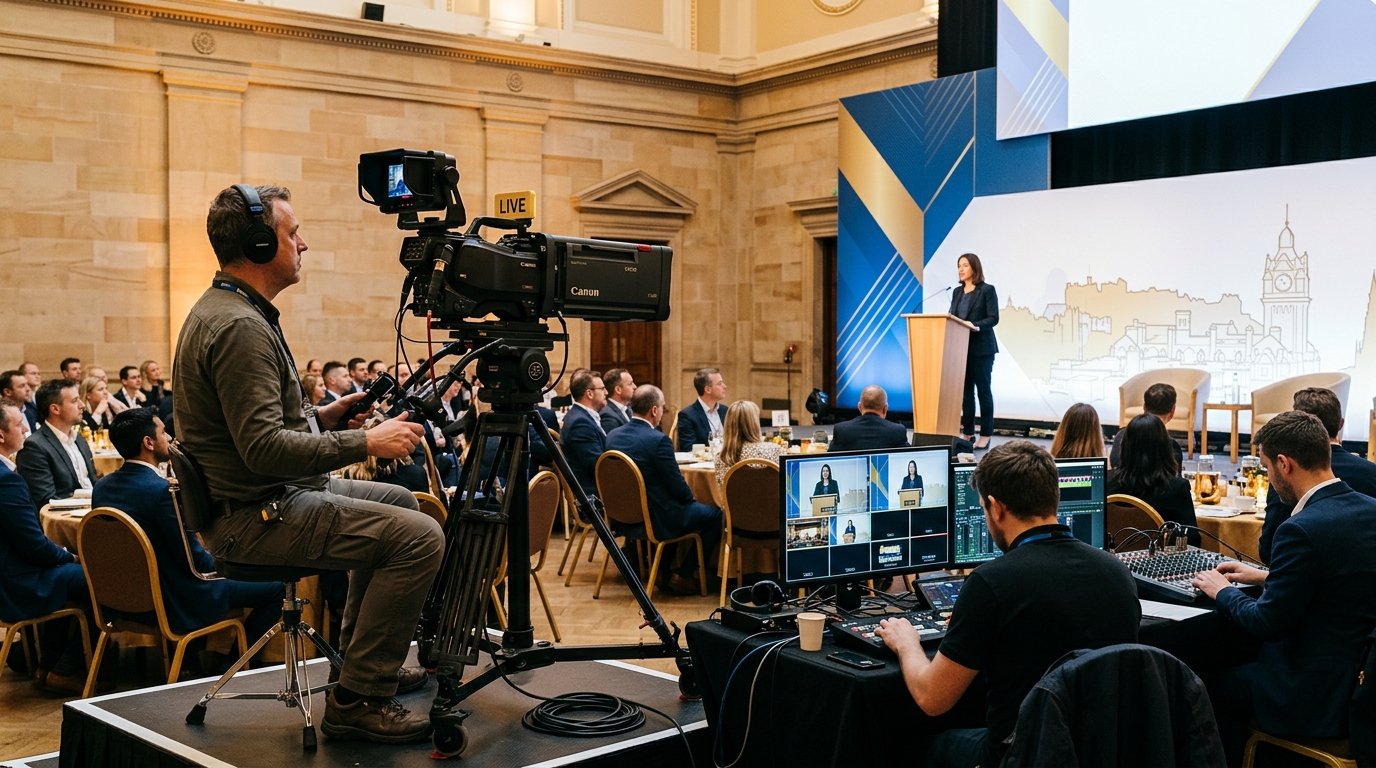
Technically, this means investing in multi-camera setups, professional lighting design that complements the historic architecture of Edinburgh, and robust live-streaming capabilities that allow a global audience to participate in the 'Edinburgh experience' without the physical travel cost. By aligning the event’s visual identity with the upgraded aesthetic of the city, planners can justify the higher costs to stakeholders as a move toward a more exclusive, high-impact environment. The 'Edinburgh Tax' then becomes a catalyst for better storytelling. If the physical presence is more expensive, the digital legacy must be more valuable. We recommend integrating 'behind-the-scenes' editorial photography and executive interviews that leverage the city's unique atmosphere, ensuring that the brand is associated with the prestige of the location long after the delegates have checked out.
What does the Edinburgh tourist tax mean for international business travelers?
For the international business traveler, the 5% levy is a signal of Edinburgh’s maturing status as a global destination. It places the city in the same category as Amsterdam, Berlin, and Paris—cities that recognize their own cultural and economic value and charge for the privilege of access. For the individual corporate traveler, the tax is often a negligible per-person cost on an expense report, but for the organization, it represents a shift in how they select host cities. The expectation for a 'taxed' city is inherently higher. If a traveler sees a levy on their folio, they expect a seamless, frictionless experience—from the airport transfer to the cleanliness of the streets outside their hotel and the reliability of the local infrastructure.
This shift in expectation is where specialized production partners like Alesia RSVP become essential. We understand that in a high-cost environment, the margin for error in event production is zero. Whether it is a multi-camera live stream of a global financial summit or a high-end editorial photo shoot of a C-suite roundtable, the production quality must reflect the premium nature of the destination. As Edinburgh reinvests in its infrastructure, Alesia RSVP provides the technical expertise to capture that improved environment, ensuring that the visual legacy of the event matches the increased investment.
Moreover, the tax aligns with the growing corporate focus on ESG (Environmental, Social, and Governance) criteria. Many corporations are now required to demonstrate how their events contribute to the local communities they visit. The Edinburgh visitor levy provides a quantifiable metric for this social contribution, as the funds are legally tied to local improvement. Planners can frame the tax not as a burden, but as a mandatory contribution to the sustainability and preservation of the host city. As Edinburgh evolves, so does the need for a production partner that understands the nuances of corporate branding and the high stakes of international B2B engagement. The tax is a fixed cost; the content we produce is a strategic asset that appreciates over time, far outstripping the 5% levy in long-term marketing and communication value. In the new Edinburgh landscape, the goal is to ensure that the 'cost of entry' results in a 'standard of excellence' that is visible in every frame of the event's digital output.
FAQ
Does the Edinburgh tourist tax apply to conference attendees?
Yes, the 5% visitor levy applies to all paid overnight accommodation, including hotels, short-term lets, and hostels. There is no exemption for business travelers, corporate groups, or conference delegates. However, the charge is capped at the first five consecutive nights of any stay.
How will the funds from the Edinburgh visitor levy be spent to benefit events?
The revenue, estimated at £50 million annually, is legally ring-fenced for reinvestment into local infrastructure, facilities, and services that support the visitor economy. This includes the restoration of historic venues, improved city-center maintenance, and enhancements to public spaces that serve as backdrops for corporate events.
When does the Edinburgh visitor levy officially start?
The levy is expected to be implemented in July 2026. This follows the passing of the Visitor Levy (Scotland) Act 2024, which allows local councils to set their own rates after a required consultation period.
Can corporations reclaim the Edinburgh tourist tax like VAT?
No, the visitor levy is a local tax on accommodation and is generally not reclaimable through standard VAT recovery processes. It should be factored into the gross budget of the event as a non-recoverable cost.
How should event planners handle the tax in existing contracts?
For events taking place after July 2026, planners should ensure that hotel contracts include clear language regarding the levy. It is advisable to itemize the tax separately in budget projections to maintain transparency with stakeholders and clients.
Questions Fréquentes
Does the Edinburgh tourist tax apply to conference attendees?
Yes, the 5% visitor levy applies to all paid overnight accommodation, including hotels, short-term lets, and hostels. There is no exemption for business travelers, corporate groups, or conference delegates. However, the charge is capped at the first five consecutive nights of any stay.
How will the funds from the Edinburgh visitor levy be spent to benefit events?
The revenue, estimated at £50 million annually, is legally ring-fenced for reinvestment into local infrastructure, facilities, and services that support the visitor economy. This includes the restoration of historic venues, improved city-center maintenance, and enhancements to public spaces that serve as backdrops for corporate events.
When does the Edinburgh visitor levy officially start?
The levy is expected to be implemented in July 2026. This follows the passing of the Visitor Levy (Scotland) Act 2024, which allows local councils to set their own rates after a required consultation period.
Can corporations reclaim the Edinburgh tourist tax like VAT?
No, the visitor levy is a local tax on accommodation and is generally not reclaimable through standard VAT recovery processes. It should be factored into the gross budget of the event as a non-recoverable cost.
How should event planners handle the tax in existing contracts?
For events taking place after July 2026, planners should ensure that hotel contracts include clear language regarding the levy. It is advisable to itemize the tax separately in budget projections to maintain transparency with stakeholders and clients.