
War Insurance Crisis: Navigating Gulf Event Risks in 2026
War Insurance Crisis: Navigating Gulf Event Risks in 2026
Geopolitical instability in the Gulf has rendered war insurance nearly impossible to secure, forcing a pivot in B2B event strategy and location. With traditional safety nets failing, the industry is moving toward a content-first model where documentation serves as the ultimate hedge against physical disruption.
Why is war insurance becoming unavailable for Gulf events?
When geopolitical shifts threaten the very fabric of your flagship event, how do you protect your brand's legacy? As war insurance vanishes in the Gulf, event organizers are facing a new era of high-stakes risk management. The current landscape is not merely a matter of rising premiums; it is a total withdrawal of capacity. Since the escalation of the U.S.-Iran conflict in late February 2026, the insurance market for special risks has effectively shuttered its doors to the Middle East. Standard event-cancellation policies have always excluded war and political violence, but the secondary layer of coverage that once protected multi-million dollar summits in Riyadh and Dubai has dried up. This is not a gradual decline but a sharp cliff-edge in underwriting appetite. The reinsurance markets in London and Zurich, which typically absorb the largest chunks of regional risk, have issued blanket exclusions for the Persian Gulf, citing the unpredictable nature of drone technology and maritime disruptions that could spill over into urban centers.
Panteha Peters, head of sports, entertainment, media and special risks at Marsh Middle East and Africa, has highlighted the severity of this shift. She notes that only one or two insurers remain willing to even look at these risks, and even then, they refuse to commit until seven days before the doors open. For a VP of Events planning a 5,000-person conference, a one-week notice on insurance is not a management strategy—it is a gamble. This lack of Industry discussion on Gulf event insurance trends highlights a systemic failure in the traditional event safety net. The 'Notice of Cancellation' (NOC) clauses, which used to provide a 30-day buffer, have been reduced to 48 hours in some extreme cases. This means a policy could be valid on Monday and void by Wednesday if regional tensions spike, leaving the organizer with no recourse for venue deposits, speaker fees, or specialized AV rentals.
The reality is that the regional security situation has fundamentally decoupled from the commercial ambitions of the Gulf’s 'Vision' projects. While the infrastructure in cities like Riyadh, Doha, and Dubai remains world-class—often surpassing European standards—the financial architecture supporting them is currently fractured. Organizers are now forced to choose between postponing high-profile gatherings or assuming the entire liability on their own balance sheets. This shift is already impacting the 2026 calendar, with several major tech and finance summits quietly exploring relocation or downsizing to mitigate uninsurable exposure. The 'risk-on' mindset that fueled the 2022-2025 boom has been replaced by a clinical assessment of liability. When the cost of a 'worst-case scenario' exceeds the total marketing budget for the year, the decision to proceed becomes a board-level discussion rather than a departmental one. The absence of War, Terrorism, and Political Violence (WTPV) extensions means that even a minor localized skirmish could trigger a total loss of investment without any insurance payout.
How does the lack of event insurance impact high-end B2B gatherings?
The absence of war insurance creates a cascading effect on every facet of event production, from vendor contracts to speaker confidence. When an event cannot be insured against political violence, the financial risk doesn't disappear; it simply migrates to the organizers and their partners. For premium B2B events, where production costs often exceed $10 million, the stakes are existential. We are seeing a shift where corporate brands are no longer willing to risk the reputational fallout of a last-minute cancellation without a financial buffer. This has led to a surge in demand for hyper-professional documentation as a form of 'intellectual insurance.' If the physical gathering is at risk, the value of the event must be captured and preserved in a way that allows it to live on digitally, regardless of the venue's status.
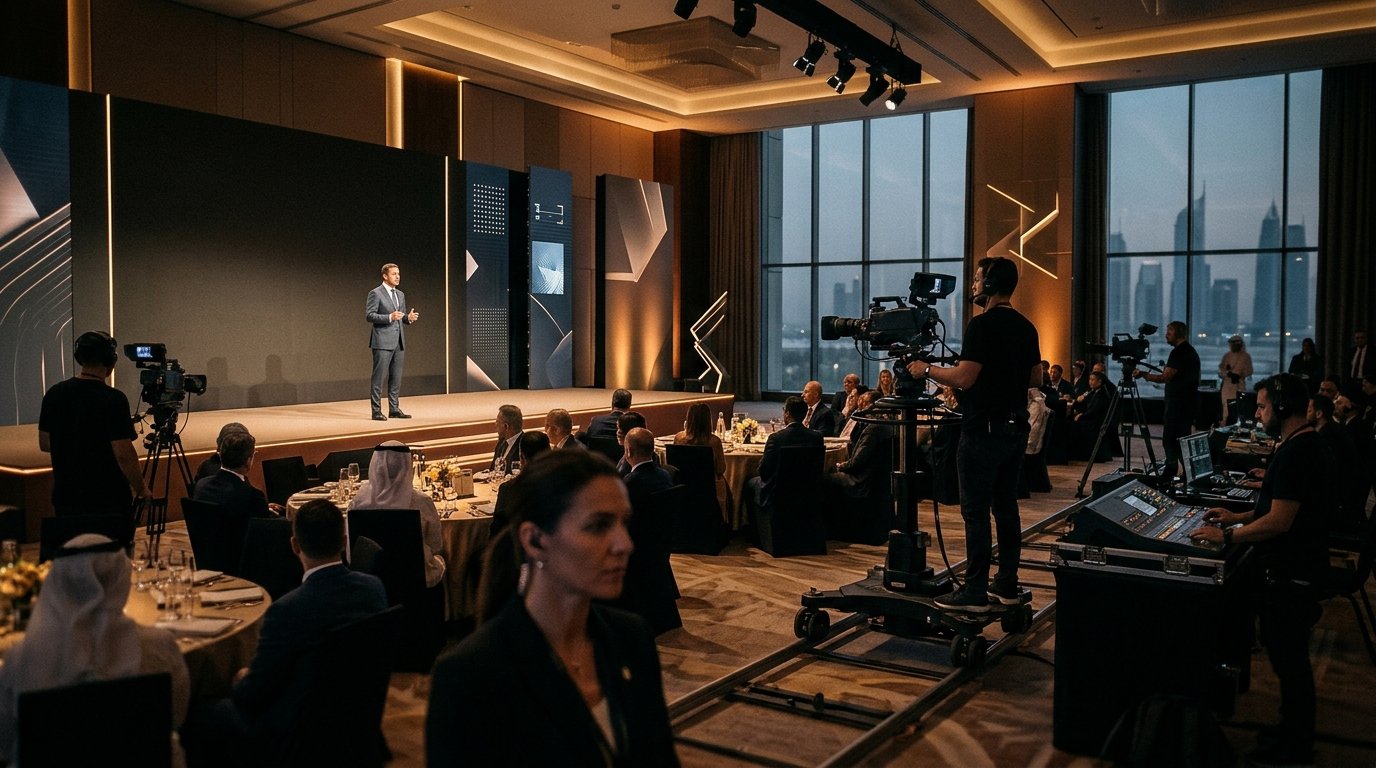
For those still proceeding with Corporate Events Dubai, the emphasis has shifted from mere attendance numbers to the creation of a 'digital fortress' of content. High-end photography and multi-camera broadcasts are no longer just 'nice-to-haves'; they are the only way to ensure the event’s message survives even if the physical gathering is disrupted. This 'capture-first' strategy involves pre-recording keynotes and creating high-fidelity digital assets weeks before the event starts. If the physical event is cancelled due to an uninsurable event, the brand can pivot to a high-production-value virtual broadcast immediately. This mitigates the 'total loss' scenario by ensuring that the intellectual property and the marketing momentum are not wasted. Furthermore, the lack of insurance is forcing a renegotiation of force majeure clauses. Vendors are being asked to share the risk, leading to friction in the supply chain. Standard contracts that once cited 'acts of God' are now being scrutinized by legal teams to determine if 'acts of war' without insurance coverage still qualify for deposit refunds.
This uncertainty is detailed in the Latest event planning trends and risk analysis, which suggests that the 'risk-on' approach of the early 2020s has been replaced by a cautious, content-first strategy. As a premium media partner for global B2B events, Alesia RSVP understands that when regional stability wavers, the choice of location and the quality of event documentation become even more critical for brand continuity and risk mitigation. We are seeing clients invest more in on-site podcast studios and magazine-quality editorial teams to ensure that every insight generated during the event is codified. This creates a tangible asset that exists independently of the venue. In a world where you cannot insure the building, you must insure the message. This means moving away from low-quality social media clips and toward cinema-grade documentation that can be used for months or years, providing a long-term ROI that justifies the initial risk of hosting in a volatile region.
What are the best alternative locations for secure corporate events in 2026?
As the Gulf becomes a high-risk zone for insurers, global corporate planners are aggressively pivoting back to Tier 1 hubs with established stability and robust insurance markets. The flight to safety is real, and it is benefiting cities that can offer both world-class AV infrastructure and a predictable geopolitical environment. For European and North American enterprises, Corporate Events Paris and London have seen a significant uptick in inquiries for late 2026 and 2027. These cities offer a density of vendors and a maturity of insurance products that the Gulf currently cannot match. In these markets, WTPV coverage remains readily available and affordable, allowing planners to secure their budgets 12 to 18 months in advance—a luxury that has vanished in the Middle East.
Singapore remains the primary beneficiary in Asia, acting as the stable alternative for fintech and tech summits that previously looked at Dubai or Doha. The city-state’s ability to provide a neutral, secure, and fully insurable environment makes it the default choice for events with a global attendee base. The decision to relocate is rarely about the quality of the venue—Riyadh’s new facilities are objectively superior to many aging European halls—but about the certainty of the 'show going on.' Corporate boards are prioritizing 'continuity of operations' over the novelty of a new destination. In this environment, the role of an agency like Alesia RSVP becomes pivotal. Whether a brand stays in a high-risk zone or pivots to a safer harbor, the need for a unified production partner who can manage the transition is paramount. We provide the technical continuity that brands need when their physical plans are in flux.
The bridge between a physical event in a volatile region and a global audience is built on professional live streaming and magazine-quality editorial coverage. If you cannot insure the building, you must at least insure the message. By prioritizing high-fidelity video production and on-site podcasting, brands can ensure that their intellectual property is captured and distributed regardless of the regional political climate. Relocating an event to Paris or London doesn't just solve the insurance problem; it also provides access to a different tier of media professionals and technical infrastructure that can elevate the brand's narrative. The future of B2B events in 2026 is not about avoiding risk entirely, but about choosing the risks you can manage and documenting the outcomes with clinical precision. Planners are now looking for 'plug-and-play' cities where the legal and financial frameworks are as reliable as the high-speed internet. This shift marks a return to traditional power centers, at least until the insurance markets find a way to model and price the new reality of Gulf geopolitics. For now, the 'Certainty Premium' is the most valuable commodity in the event industry, and cities that can provide it are seeing their calendars fill up years in advance.
FAQ
Can I still host a corporate event in the Gulf without war insurance?
Yes, but you must be prepared to self-insure or assume full financial liability for a cancellation due to political violence. This means having the liquidity to cover venue deposits, vendor contracts, and travel costs if the event is cancelled. Most standard policies still cover weather, fire, and technical failures, but the specific exclusion of war and terrorism means a total loss of production costs if a conflict escalates. Many organizations are now requiring a 'contingency fund' equal to 50% of the event budget before approving Gulf-based projects.
How does geopolitical instability affect event photography and media planning?
Instability necessitates a 'capture-first' mentality where every keynote and session is recorded with the highest possible quality to serve as evergreen content. If future events are postponed or relocated, the media assets from the current event become the primary tool for maintaining brand presence and community engagement. High-end documentation acts as a hedge; even if the physical event is disrupted, the digital assets ensure the brand's message reaches its audience. This includes pre-recording 'safety' versions of key presentations and investing in redundant live-streaming setups.
What are the insurance requirements for premium B2B events in 2026?
Beyond standard public liability, premium events now require specific riders for cyber disruption, infectious disease (where available), and political risk. In high-volatility regions, planners should seek 'abandonment' coverage that includes a wider range of triggers, though war exclusions remain the industry standard in the Gulf following the late February 2026 conflict. It is essential to work with specialized brokers like Marsh or Aon who can navigate the 'Notice of Cancellation' clauses and negotiate the longest possible window of coverage before the event date.
Frequently Asked Questions
Can I still host a corporate event in the Gulf without war insurance?
Yes, but you must be prepared to self-insure or assume full financial liability for a cancellation due to political violence. This means having the liquidity to cover venue deposits, vendor contracts, and travel costs if the event is cancelled. Most standard policies still cover weather, fire, and technical failures, but the specific exclusion of war and terrorism means a total loss of production costs if a conflict escalates. Many organizations are now requiring a 'contingency fund' equal to 50% of the event budget before approving Gulf-based projects.
How does geopolitical instability affect event photography and media planning?
Instability necessitates a 'capture-first' mentality where every keynote and session is recorded with the highest possible quality to serve as evergreen content. If future events are postponed or relocated, the media assets from the current event become the primary tool for maintaining brand presence and community engagement. High-end documentation acts as a hedge; even if the physical event is disrupted, the digital assets ensure the brand's message reaches its audience. This includes pre-recording 'safety' versions of key presentations and investing in redundant live-streaming setups.
What are the insurance requirements for premium B2B events in 2026?
Beyond standard public liability, premium events now require specific riders for cyber disruption, infectious disease (where available), and political risk. In high-volatility regions, planners should seek 'abandonment' coverage that includes a wider range of triggers, though war exclusions remain the industry standard in the Gulf following the late February 2026 conflict. It is essential to work with specialized brokers like Marsh or Aon who can navigate the 'Notice of Cancellation' clauses and negotiate the longest possible window of coverage before the event date.