
Havas AI-First Identity: Impact on B2B Event Production
Havas AI-First Identity: Impact on B2B Event Production
The recent financial performance of Havas, particularly its 6.9% organic growth in North America during the first half of 2026, signals a tectonic shift in the B2B landscape. As the agency pivots to an 'AI-First' identity through its 'Converged' strategy, the implications for corporate event marketing are profound. This transition highlights a growing demand for authentic, high-end visual assets that ground AI-driven strategies in real-world credibility.
How is an AI-first identity driving growth for global B2B agencies?
When a global powerhouse like Havas pivots to an 'AI-First' identity and subsequently reports record growth, it signals a massive shift in how B2B brands must present themselves to the world. Havas reported a 6.9% organic net revenue growth for North America in the first half of 2026, reaching €1.36 billion in total net revenue. This isn't just a financial recovery; it is a validation of a strategic bet on artificial intelligence as the primary driver of agency value. For corporate decision-makers, this move highlights a critical reality: the market no longer rewards those who wait and see regarding AI integration. The 6.4% organic growth in North America during Q2—significantly outpacing the global average of 2.5%—demonstrates that clients are gravitating toward agencies that can articulate a clear AI strategy and execute it at scale.
In the B2B sector, AI is being used to compress the distance between data and creative execution. Havas’ 'Converged' platform is a prime example of this, integrating data, technology, and creative talent into a single operating system. However, as the industry discussion on Havas' AI pivot suggests, the shift toward AI-first models creates a new demand for authenticity. When every brand can generate synthetic content, the premium on real-world proof-of-presence at major summits increases. This is where the intersection of corporate events and AI-first marketing becomes the new battleground for brand authority. Agencies that lean into AI are not replacing human creativity; they are using it to amplify the impact of human-led initiatives. For B2B brands, this means that every physical touchpoint—from a keynote in New York to a private roundtable in London—must be captured with a level of precision that allows it to feed into an AI-driven content ecosystem without losing its soul.
The growth observed in the North American market is particularly telling. It suggests that enterprise clients are increasingly comfortable with AI-integrated workflows, provided those workflows deliver measurable efficiency and superior creative output. The 'AI-First' identity adopted by Havas is a response to this demand, positioning the agency as a partner capable of navigating the complexities of the modern digital landscape. For event planners and marketing directors, the takeaway is clear: the integration of AI into your brand identity is not just about internal efficiency; it is about external perception. To be seen as a leader in 2026, a brand must demonstrate that it is leveraging the most advanced tools available to communicate its message, while simultaneously doubling down on the high-fidelity, real-world content that proves its claims are grounded in reality.
Why is high-fidelity visual content essential for AI-integrated marketing strategies?
As AI generates more synthetic media, the value of 'proof of presence' becomes the ultimate currency. An AI-first identity is only as strong as the data and visual assets that ground it in reality. High-end photography and video from flagship events like SXSW provide the raw, authentic material that AI cannot fabricate without losing the brand's soul. B2B brands need a comprehensive gallery of real-world interactions, executive keynotes, and high-stakes networking to train their custom models and ground their digital presence in reality. Without this high-quality input, AI-driven marketing becomes generic and loses its competitive edge. The goal is to use AI to scale the reach of human-centric events, not to replace the human element itself.
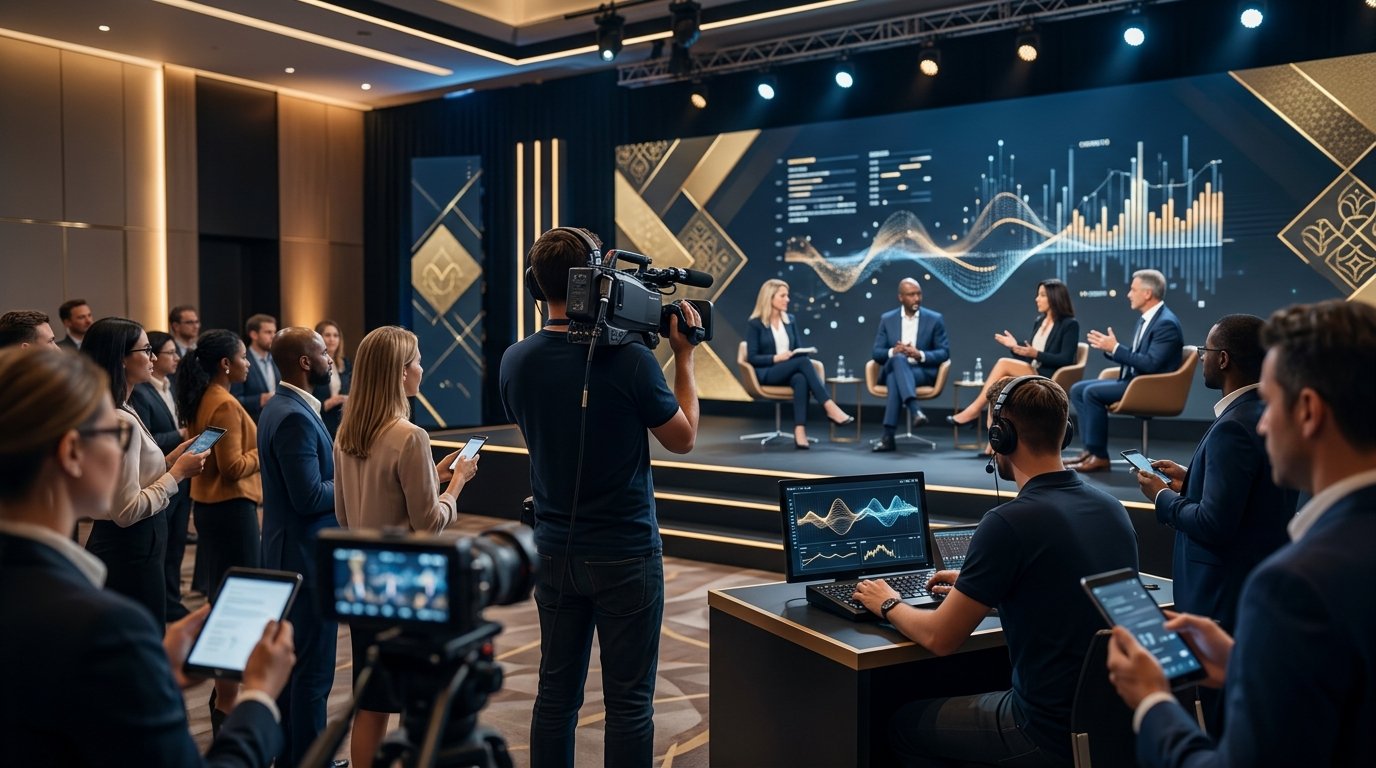
Professional AV production serves as the bedrock for this strategy. For instance, a multi-camera live stream of a corporate summit doesn't just broadcast a message; it creates a massive library of high-fidelity video data that can be repurposed by AI tools for months. This is what we call 'Visual Intellectual Property.' When an AI engine is fed low-resolution or generic imagery, the resulting output is often uncanny or disconnected from the brand's actual aesthetic. Conversely, when an AI is trained on high-bitrate, professionally lit, and expertly composed visual data from a live event, the synthetic extensions of that content remain indistinguishable from the original in terms of quality and brand alignment. This requires a shift in how marketing directors view event production—it is no longer just a line item for logistics, but a primary source of intellectual property for the company's AI engine.
Furthermore, the technical requirements for 'AI-ready' content are more stringent than traditional event coverage. To effectively use event footage for generative AI or automated social clipping, the source material must be captured with specific metadata and high dynamic range. This allows AI tools to isolate subjects, understand lighting environments, and generate new assets that maintain the integrity of the original event. In an era where 'deepfakes' and low-quality AI content are rampant, B2B brands must use their physical events as a 'source of truth.' By capturing every nuance of a C-suite panel or a product launch with professional-grade equipment, brands create a digital moat that protects their identity from being diluted by the sea of generic AI-generated noise.
How can corporate events in North America leverage the AI-first trend for better ROI?
North America is leading the charge with nearly 7% growth in the Havas ecosystem, largely because the region's corporate culture is the fastest to adopt integrated tech models. Events in New York and other major hubs are becoming the primary source of original content. According to the latest event marketing trends, the most successful B2B conferences are those that treat every session as a content production studio. This approach maximizes the Return on Investment (ROI) by transforming a three-day physical event into a year-long digital campaign. The data captured on-site becomes the fuel for automated marketing engines, personalized attendee follow-ups, and AI-generated thought leadership pieces.
As Havas proves that AI-driven identities are winning the market, Alesia RSVP bridges the gap by providing the high-end, human-centric visual assets that these tech-forward brands need to maintain their premium edge at global summits. We ensure that while your strategy is AI-first, your brand remains human-led. Whether it is capturing the nuance of a C-suite panel or producing a same-day highlight reel that feeds into an automated social distribution engine, the quality of the capture determines the quality of the AI output. To maximize ROI, planners must ensure their AV partner understands the downstream value of every frame captured on-site. The future of B2B events lies in this integration: high-stakes physical presence amplified by high-speed digital intelligence.
By adopting an 'Event-as-a-Studio' mindset, brands can justify the higher costs of premium production. The value is no longer just in the experience of the 500 people in the room, but in the millions of impressions generated by the AI-enhanced content derived from that room. This creates a virtuous cycle: better production leads to better AI training data, which leads to more effective marketing, which ultimately drives the kind of organic growth seen by Havas. In the North American market, where competition for attention is fierce, the ability to rapidly turn a live keynote into a suite of high-quality, AI-optimized digital assets is a significant competitive advantage. It allows brands to be 'first to market' with insights from their own events, ensuring they lead the conversation rather than just participating in it. The alignment of high-end production and AI intelligence is the new standard for B2B excellence.
FAQ
What does an 'AI-First' identity mean for B2B event marketing?
An AI-first identity means prioritizing artificial intelligence as the core driver of strategy, content creation, and attendee engagement. For B2B events, this involves using AI to personalize attendee journeys and using professional event content as the primary data source for automated marketing workflows. It shifts the event from a static experience to a dynamic data-gathering and content-generation hub.
How does professional event photography support AI-driven brand growth?
Professional photography provides high-fidelity, authentic visual data that AI tools use to maintain brand consistency. High-quality imagery ensures that AI-generated marketing materials are grounded in real-world corporate events, preventing the brand from appearing generic or synthetic. It provides the 'ground truth' that AI needs to generate realistic and brand-aligned extensions.
Why are North American markets leading the shift toward AI-integrated agency models?
North American markets have a high concentration of enterprise tech firms and a corporate culture that prioritizes rapid technological adoption. This environment drives higher investment in AI-driven marketing strategies, resulting in significant revenue growth for agencies like Havas that lean into AI-first identities. The 6.4% organic growth in Q2 for Havas North America is a direct reflection of this regional appetite for innovation.
How can brands ensure their event content is 'AI-ready'?
To be AI-ready, content must be captured in high resolution (4K or higher) with clean audio and consistent lighting. This allows AI algorithms to better process the data for tasks like automated editing, transcription, and generative expansion. Working with a specialized production partner like Alesia RSVP ensures that the technical specifications of the capture meet the requirements of modern AI marketing stacks.
Questions Fréquentes
What does an 'AI-First' identity mean for B2B event marketing?
An AI-first identity means prioritizing artificial intelligence as the core driver of strategy, content creation, and attendee engagement. For B2B events, this involves using AI to personalize attendee journeys and using professional event content as the primary data source for automated marketing workflows. It shifts the event from a static experience to a dynamic data-gathering and content-generation hub.
How does professional event photography support AI-driven brand growth?
Professional photography provides high-fidelity, authentic visual data that AI tools use to maintain brand consistency. High-quality imagery ensures that AI-generated marketing materials are grounded in real-world corporate events, preventing the brand from appearing generic or synthetic. It provides the 'ground truth' that AI needs to generate realistic and brand-aligned extensions.
Why are North American markets leading the shift toward AI-integrated agency models?
North American markets have a high concentration of enterprise tech firms and a corporate culture that prioritizes rapid technological adoption. This environment drives higher investment in AI-driven marketing strategies, resulting in significant revenue growth for agencies like Havas that lean into AI-first identities. The 6.4% organic growth in Q2 for Havas North America is a direct reflection of this regional appetite for innovation.
How can brands ensure their event content is 'AI-ready'?
To be AI-ready, content must be captured in high resolution (4K or higher) with clean audio and consistent lighting. This allows AI algorithms to better process the data for tasks like automated editing, transcription, and generative expansion. Working with a specialized production partner like Alesia RSVP ensures that the technical specifications of the capture meet the requirements of modern AI marketing stacks.