
How to Plan a Corporate Summit in Davos: 2026 Guide
How to Plan a Corporate Summit in Davos: 2026 Guide
Mastering the world's most prestigious stage requires more than just a plan; it demands a vision that captures the pulse of global influence. As Davos 2026 approaches, corporate decision-makers must recognize that the Swiss Alps present a logistical challenge unlike any other urban environment.
How do you navigate the unique logistics of planning a corporate event in Davos?
Mastering the world's most prestigious stage requires more than just a plan; it demands a vision that captures the pulse of global influence. As Davos 2026 approaches, corporate decision-makers must recognize that the Swiss Alps present a logistical challenge unlike any other urban environment. The village of Davos, while quaint, transforms into a high-security fortress where the 'Promenade' becomes the most expensive real estate on earth for five days. Navigating this environment requires an eighteen-month lead time. You are not just booking a venue; you are securing a foothold in a zone where every square meter is contested by global NGOs, sovereign states, and Fortune 500 giants. The density of high-level delegates requires a level of precision that leaves no room for error.
Logistics in Davos are defined by the 'Zones.' If your summit is held outside the high-security 'White Zone,' you must account for the transit times that can triple due to snow or security checkpoints. Successful planners prioritize proximity over aesthetics, though the two often go hand-in-hand in the Graubünden region. Securing lodging for your production team and executives is the first hurdle; the second is the physical transport of equipment. The narrow mountain roads and strict delivery windows mean that your AV partner must be seasoned in alpine logistics. This is not the place for a generalist agency; it is a theater for specialists who understand that a five-minute delay at a checkpoint can derail a keynote session involving a G7 head of state.
The geography of Davos is deceptive. While the town is linear, the verticality of the landscape and the restricted access routes during the Annual Meeting create bottlenecks that can paralyze a production schedule. Planning for 2026 must account for the 'Last Mile' problem—where equipment may need to be hand-carried or moved via small electric vehicles because heavy trucks are banned from the Promenade after a certain hour. Furthermore, the weather is a volatile variable. A sudden heavy snowfall doesn't just make travel difficult; it can trigger immediate changes in security protocols, closing off entire streets for snow removal or motorcade passage. Your logistical plan must include a 'Plan B' for every single movement of people and hardware. This involves local scouting missions at least twelve months in advance to understand the specific limitations of your chosen venue, whether it is a hotel ballroom, a temporary pavilion, or a repurposed storefront on the main strip.
What are the essential AV and vendor requirements for a high-stakes summit?
The technical requirements for a Davos summit are dictated by the expectation of zero-latency and absolute redundancy. When your speakers are shaping global policy, a flickering screen or a dropped audio feed is a reputational catastrophe. You need dedicated fiber lines for live streaming, as the local infrastructure often reaches peak capacity during the high-traffic hours of the Annual Meeting. Relying on standard hotel Wi-Fi is a risk that seasoned planners never take.
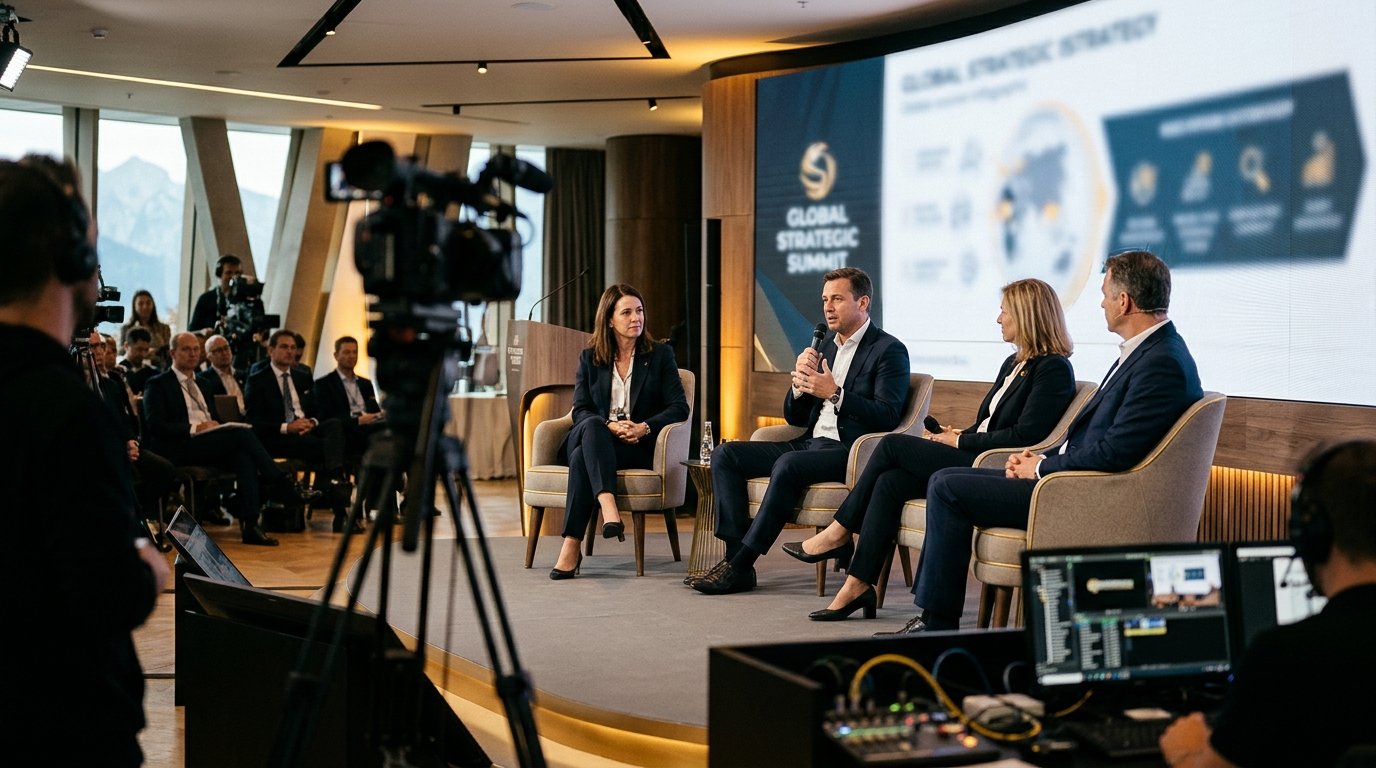
Beyond basic connectivity, the acoustic environment of temporary pavilions—a staple of Davos summits—requires sophisticated sound engineering. These glass-and-steel structures are beautiful but acoustically hostile, often featuring hard surfaces that cause significant echo and reverberation. High-end audio production must include noise-canceling microphone arrays and localized sound reinforcement to ensure that every word of a panel discussion is captured for both the live audience and the digital broadcast. Furthermore, lighting must be calibrated for both the human eye and the camera lens. Davos sessions are frequently picked up by global news syndicates, meaning your lighting rig must meet broadcast standards. This level of technical complexity is why we emphasize the importance of a unified AV strategy. Managing multiple vendors in a high-security environment is a recipe for communication breakdown.
Redundancy is the watchword for Davos. This means dual-redundant power supplies for critical AV racks and secondary internet uplinks via satellite or dedicated microwave links if fiber is compromised. The hardware must be selected for its reliability in cold environments; equipment stored in unheated trucks overnight can suffer from condensation issues once moved into a warm venue. A professional AV partner will factor in 'acclimatization time' for sensitive electronics. Additionally, the technical crew must be as high-caliber as the equipment. In a Davos environment, technicians must be capable of troubleshooting under extreme pressure while maintaining a discreet, professional presence in the room. The goal is a 'silent' production—one where the technology is invisible, and the focus remains entirely on the high-level dialogue taking place. This requires a level of rehearsal and system-checking that far exceeds standard corporate event protocols.
How can premium photo and video production elevate your brand presence in Davos?
Davos is a content factory. The true ROI of a summit in the Alps is not just the handshakes in the lounge, but the digital legacy created during the event. Premium photo and video production are the only ways to export the prestige of your presence to a global audience. We move away from standard event snapshots toward an editorial style that mirrors the quality of high-end business journalism. In Davos, your photography should look like it belongs on the cover of the Financial Times, not a corporate newsletter. This requires photographers who understand lighting in complex, mixed-light environments—balancing the blue light of the alpine snow with the warm interior lighting of a mountain lodge.
Video production must be equally ambitious. A standard aftermovie is insufficient for a Davos summit. Instead, brands should focus on 'Executive Storytelling'—capturing short, sharp insights from speakers that can be distributed across LinkedIn and internal channels within hours of the session. This requires an on-site editing suite capable of high-speed rendering and immediate delivery. By treating your summit as a broadcast event rather than a static meeting, you amplify your brand's voice far beyond the mountains. This approach ensures that your investment in Davos 2026 continues to pay dividends long after the snow has melted and the delegates have returned home.
To achieve this, the production team must be integrated into the event's editorial flow. It is not enough to simply 'film the panel.' The crew must identify key moments of consensus or controversy and package them for immediate social media impact. This is where the distinction between a 'videographer' and a 'content producer' becomes clear. In Davos, you need the latter—someone who understands the nuances of global business and can identify which soundbite will resonate with a global audience. Furthermore, the visual aesthetic must be consistent. Whether it is a portrait of a CEO or a wide shot of a crowded pavilion, the imagery must convey a sense of gravity and importance. This is achieved through the use of cinema-grade cameras, prime lenses, and a sophisticated color grading process that gives the footage a polished, high-production-value look that stands out in a crowded digital feed.
What are the key steps to coordinating international vendors for a Swiss event?
Coordinating international vendors for a Swiss event requires a deep understanding of local labor laws, customs (carnets) for equipment, and the specific security protocols of the World Economic Forum. Switzerland is not part of the EU's customs union, which means that every piece of equipment brought across the border must be documented via an ATA Carnet to avoid significant taxes and delays at the border. Alesia RSVP bridges the gap between complex logistical planning and premium brand storytelling, providing on-the-ground AV coordination and high-end visual production that meets the rigorous standards of Davos summits.
As you look toward Davos 2026, the strategy should be one of consolidation. By choosing a partner that manages the entire visual and technical stack—from live streaming and podcasting to multi-photographer coverage—you eliminate the friction of vendor hand-offs. In a high-pressure environment like Davos, every additional vendor is a potential point of failure. A single, accountable partner for photo, video, and streaming ensures that the technical execution remains invisible, allowing the content to take center stage.
Furthermore, labor laws in Switzerland (specifically the LSE - Loi sur le service de l'emploi) are strict regarding foreign workers. Ensuring that your production team has the correct work permits and is compliant with local wage regulations is essential to avoid legal complications or on-site shutdowns. Alesia RSVP's experience in the region ensures that all administrative hurdles are cleared long before the first flight lands in Zurich. We also manage the complex accreditation process for the 'White' and 'Green' security zones, ensuring that our crews have the necessary clearances to move between venues during the height of the event. This level of foresight is what separates a successful summit from a logistical nightmare. The race for Davos 2026 has already begun; the winners will be those who secure their production partners today and begin the rigorous process of mapping out their technical and creative requirements.
FAQ
What is the best time to start planning a corporate summit for Davos 2026?
Planning should ideally begin 18 to 24 months in advance. This lead time is necessary to secure premium venues near the Promenade and to navigate the complex security accreditation process for both staff and equipment.
How does Alesia RSVP handle security protocols and access for visual production in Davos?
We manage the entire accreditation process for our production teams, ensuring all staff have the necessary background checks and badges for the White and Green zones. We also coordinate equipment vetting with local security to prevent delays during load-in.
Can Alesia RSVP manage both AV coordination and content creation for international summits?
Yes, our dual positioning as an event management agency and an AV production house allows us to handle technical logistics while simultaneously producing high-end photo, video, and live stream content for a unified brand experience.
Frequently Asked Questions
What is the best time to start planning a corporate summit for Davos 2026?
Planning should ideally begin 18 to 24 months in advance. This lead time is necessary to secure premium venues near the Promenade and to navigate the complex security accreditation process for both staff and equipment.
How does Alesia RSVP handle security protocols and access for visual production in Davos?
We manage the entire accreditation process for our production teams, ensuring all staff have the necessary background checks and badges for the White and Green zones. We also coordinate equipment vetting with local security to prevent delays during load-in.
Can Alesia RSVP manage both AV coordination and content creation for international summits?
Yes, our dual positioning as an event management agency and an AV production house allows us to handle technical logistics while simultaneously producing high-end photo, video, and live stream content for a unified brand experience.