
AI & B2B Events: Is Traditional Production Over?
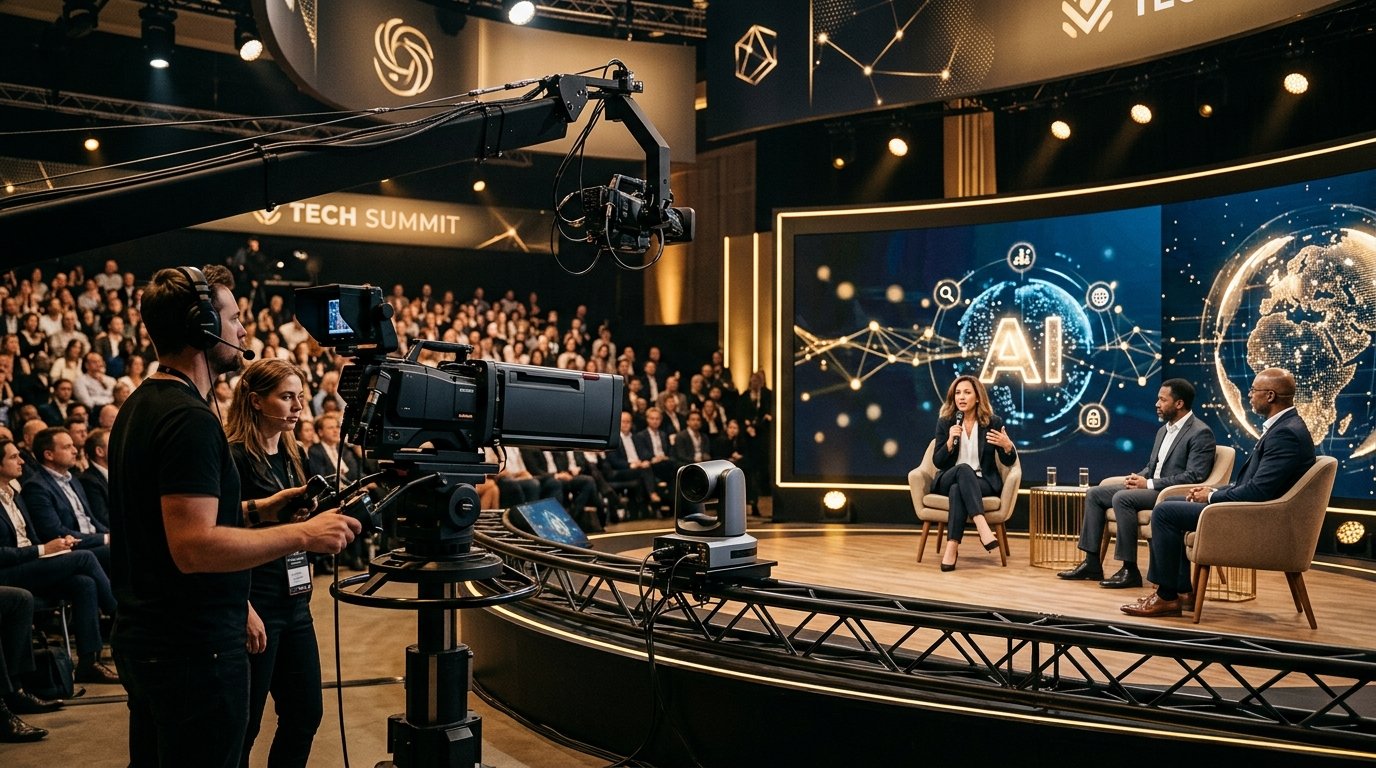
AI & B2B Events: Is Traditional Production Over?
Generative AI has evolved from a tech novelty into a massive creative lever. Is it ready to power the production of your most prestigious B2B events and corporate brand stories?
How is Generative AI Redefining Storytelling for Brand Events?
AI in event marketing is no longer a mere gimmick; it has become a massive creative lever. The question on every CMO's mind is simple: is it ready to transform the capture and coverage of high-stakes B2B events? At the recent Brandweek 2026, the Higgsfield AI creative suite demonstrated that video generation tools are no longer toys for early adopters but productivity engines capable of breaking traditional physical boundaries. For a brand hosting a global summit, this means storytelling is no longer limited to what the camera caught on the keynote stage. AI allows for narrative expansion, creating conceptual visuals that illustrate a speaker's points in real-time and turning a standard presentation into an immersive visual journey.
This evolution marks a turning point in post-event content strategy. Traditionally, event storytelling was constrained by budgets, camera counts, and physical locations. Today, as seen in this discussion on AI's impact in the event industry, creators are using AI to manifest what is in their minds without the usual material limitations. For corporate events, this enables the generation of high-end motion graphics or recontextualizing interviews within sophisticated virtual environments, significantly increasing the perceived value of every produced minute. The narrative becomes fluid, less dependent on live-action variables, and more focused on the brand’s core message.
For B2B decision-makers in the US and EU, the key is understanding that AI doesn't replace the story; it facilitates its expression. In an attention economy where engagement is the rarest resource, the ability to produce visually stunning content from real-world captures is a major competitive advantage. Companies adopting these tools for their conference recaps or product launches aren't just documenting a moment; they are building a coherent, powerful brand universe that resonates long after the convention center doors have closed.
Can AI Replace the Physical Capture of Authentic Event Moments?
Despite the spectacular breakthroughs of Higgsfield AI, one truth remains: you cannot generate the authenticity of a handshake between two CEOs or the palpable energy of a room after a major announcement. AI excels at creating content from scratch, but B2B events thrive on social proof and the reality of human interaction. Physical capture—editorial photography and on-site videography—remains the indispensable foundation of any event communication strategy. An algorithm can simulate a backdrop, but it cannot capture the raw emotion of successful networking or the spark in a passionate speaker's eyes.
This is where a hybrid strategy becomes essential. AI is used to enhance, clean, and accelerate, but the base material must be real. In our photo and video gallery, we see every day that what captures the attention of investors and partners is the human element. An AI-generated image, however perfect, lacks the organic imperfection that makes an event credible. The role of modern production is to marry the surgical precision of human capture with the expansion power of generative AI. Replacing one with the other would be a strategic error, stripping the event of its primary purpose: the encounter.
For global brands, the goal is to use physical capture as a source of authentic data that AI then magnifies. Imagine a raw interview conducted on a busy trade show floor: AI cleans the background noise and stylizes the environment to match the corporate identity perfectly, while preserving the interviewee's sincere, real-time expression. This synergy defines high-end production today. Authenticity is the fuel, and AI is the engine that propels content to new heights of quality and distribution.
What are the Benefits of AI-Native Tools in B2B Video Post-Production?
Time is the most expensive variable in event production. Historically, delivering a high-quality aftermovie took weeks of editing, color grading, and sound mixing. The integration of AI-native tools radically changes this equation. As highlighted by tech trends on BizBash, AI now allows for the processing of massive amounts of footage in a fraction of the usual time. Automated culling of the best takes, instant multi-cam synchronization, and precise multi-language subtitle generation are just the tip of the iceberg. For an event organizer, this translates to unprecedented reactivity.
The ability to deliver social-media-optimized video clips just hours after a session ends has become a standard requirement for large-scale events like SXSW 2026. AI allows for the repurposing of a single long-form piece of content into dozens of vertical, square, or horizontal capsules tailored for each platform (LinkedIn, X, Instagram) without repetitive human intervention. This operational efficiency not only reduces costs but maximizes the ROI of the event by dominating the media space while the topic is still trending. AI doesn't just work faster; it allows you to do more with the same resources.
In post-production, AI acts as a superpowered assistant. It can remove distracting elements from a shot, adjust lighting on an underexposed face, or stabilize handheld footage shot in a crowded hall. These corrections, once time-consuming and expensive, are now automated, allowing editors to focus on what matters most: rhythm and emotion. For marketing departments, this ensures consistent production quality regardless of the often chaotic shooting environments of major trade shows or international summits.
Why Human Expertise Remains the Essential 'Pilot' for AI Creative Tools?
Mahi de Silva, co-founder of Higgsfield, describes AI as a 'booster seat' for creators. This metaphor is particularly relevant for the B2B sector. AI is an expression tool, not a decision-maker. Without clear artistic direction, a deep understanding of brand guidelines, and ground-level event knowledge, AI produces generic results often disconnected from business objectives. The true skill lies in the ability to pilot these tools so they serve a precise strategic vision. AI doesn't replace the director's eye or the communicator's sensitivity; it multiplies their ability to transform raw capture into a memorable and coherent brand narrative. In both the US and EU markets, where data privacy and GDPR compliance are also key factors in how content is processed, the human 'pilot' ensures that AI usage remains ethical, strategic, and impactful.
FAQ
Will AI replace videographers at B2B events?
No. AI enhances the production process but cannot capture the authentic human interactions and emotions that form the core of B2B social proof.
How does AI improve event ROI?
By enabling rapid content turnaround and multi-platform repurposing, allowing brands to stay relevant in the digital conversation while the event is still happening.
Frequently Asked Questions
Will AI replace videographers at B2B events?
No. AI enhances the production process but cannot capture the authentic human interactions and emotions that form the core of B2B social proof.
How does AI improve event ROI?
By enabling rapid content turnaround and multi-platform repurposing, allowing brands to stay relevant in the digital conversation while the event is still happening.