
Riyadh Travel Freeze: Impact on Global B2B Events
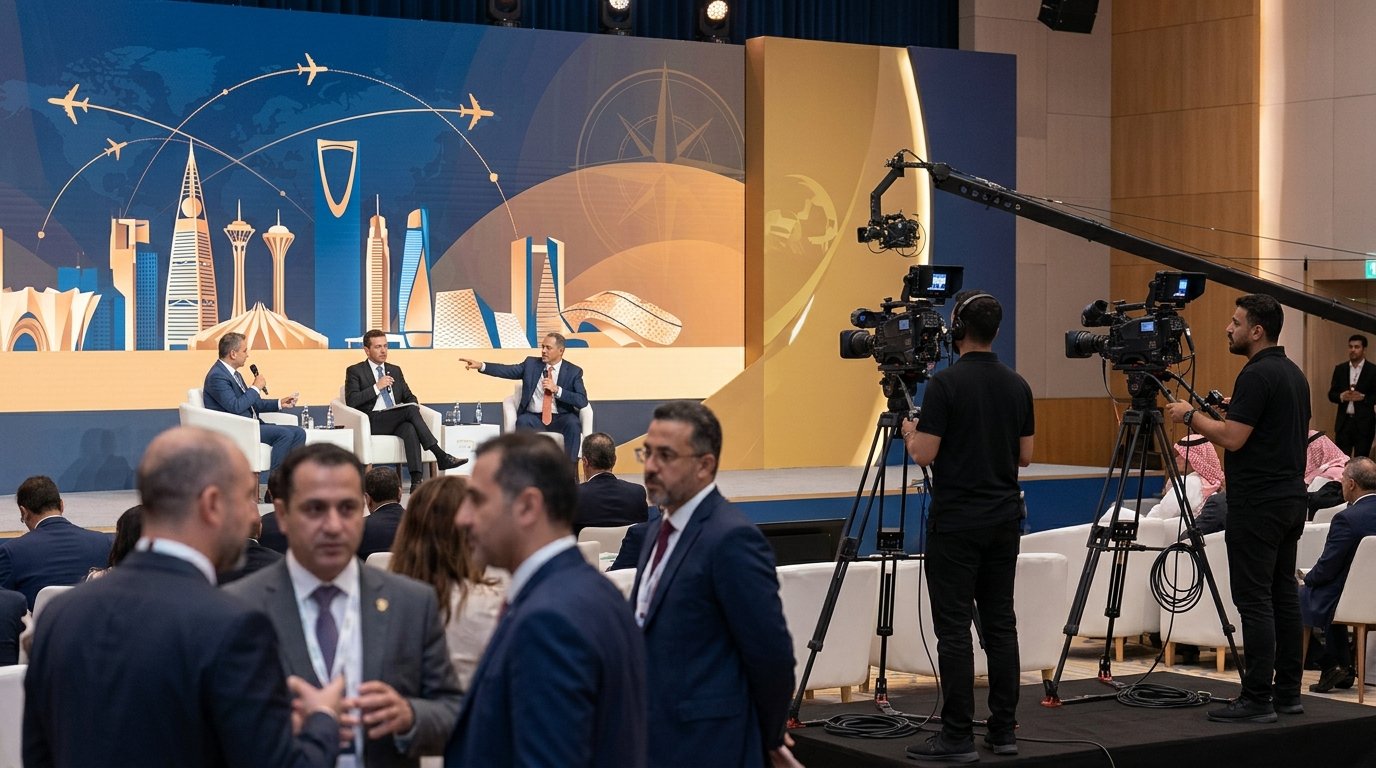
Riyadh Travel Freeze: Impact on Global B2B Events
Logistical instability in Saudi Arabia is forcing B2B summit organizers to rethink their calendars, prioritizing secure hubs to ensure operational continuity and duty of care.
How does the Riyadh airport lockdown impact the B2B events industry?
The announcement of a near-total freeze on business travel to Saudi Arabia is more than just an isolated logistical hiccup; it is a seismic shift for the corporate events value chain. As Riyadh aimed to become the epicenter of international summits under its Vision 2030 initiative, the prolonged restriction of its primary airport to scheduled flights has fundamentally changed the risk assessment for global brands. For a Marketing Director or VP of Events, reliability isn't a luxury—it’s the bedrock of brand strategy. An event where attendees cannot guarantee their arrival simply does not exist. Geopolitical tensions have transformed a promising destination into a zone of high operational uncertainty, making event cancellation insurance for large-scale summits either prohibitively expensive or impossible to secure. This freeze triggers a domino effect: budgets allocated for Saudi summits are being locked, and organizers are moving aggressively to protect their investments. The reality is stark: in the B2B world, an event season doesn't just slide by a few weeks; it gets pushed to 2027, creating a massive void in the Middle Eastern conference calendar. This travel freeze forces decision-makers to analyze geopolitical risk with newfound rigor. It is no longer just about choosing a prestigious venue, but about guaranteeing the physical and logistical integrity of hundreds of C-suite executives whose schedules allow for zero downtime. The local supply chain, already under pressure, falters when technical experts and international speakers cannot land. You can follow this Discussion on the impact of corporate travel in Saudi Arabia to gauge the current level of concern among industry professionals. Relying on land transfers via Bahrain or Dammam is a precarious workaround that fails to meet the standards of high-level conferences. Multi-hour desert transits do not align with the security and comfort requirements of global delegations. Furthermore, congestion at alternative ports of entry creates bottlenecks for AV equipment and staging structures, exponentially increasing labor costs and delaying builds. For global brands, Riyadh was a land of opportunity; in just months, it has become a case study in the fragility of emerging hubs. The impact is also felt in networking: without the physical presence of Saudi decision-makers, the core value proposition of these summits evaporates, leading sponsors to demand refunds or massive deferrals. This situation redefines the 'Plan B' in the industry: it’s no longer a minor adjustment, but a total overhaul of Middle Eastern presence strategies for the next five years.
What are the strategic alternatives for organizers facing Saudi instability?
In the face of the Riyadh paralysis, the B2B event market isn't stopping—it's migrating. The geography of prestige is shifting toward proven infrastructures where aerial logistics are infallible. Dubai has naturally emerged as the primary strategic haven. With unparalleled hotel capacity and a robust aviation hub via Emirates and FlyDubai, the city is absorbing the flow of fintech, energy, and tech summits originally slated for the Kingdom. Dubai offers an operational maturity that Riyadh had yet to solidify, particularly regarding visa flexibility and rapid customs clearance for production gear. Beyond the Middle East, Europe is also seeing a resurgence. Cities like Paris and London are once again top-tier options for boards that cannot afford a 2027 delay. Choosing an alternative rests on three pillars: immediate accessibility, participant safety, and local AV production capacity. Relocating an event at the last minute requires local partners capable of mobilizing technical resources without notice—a guarantee provided by the mature ecosystems of Paris or Geneva. Organizers are moving away from the promise of 'new hubs' to return to 'safe bets.' This trend is echoed in the Event Industry Trends on BizBash, which highlights that logistical resilience has surpassed cost or tourism appeal as the number one site selection criterion. For global brands, the goal is to maintain thought leadership continuity regardless of regional context. Pivoting to hubs like Dubai or London allows brands to save the event while benefiting from a vendor ecosystem already attuned to the demands of Fortune 500 companies. Abu Dhabi is also emerging as a serious contender, offering a more institutional and serene environment ideal for government summits or strategic think tanks. However, this forced migration is saturating the calendars of European and Emirati convention centers, leading to spiked rental rates and a scarcity of available dates. Organizers must now demonstrate unprecedented contractual agility, negotiating much more precise force majeure clauses to protect against future regional disruptions. The market is witnessing an accelerated professionalization of risk management, where destination choices are now vetted by compliance and security departments as much as by marketing teams.
Why is premium visual documentation crucial during a venue pivot?
When an event must be relocated or when a portion of the audience is grounded by travel restrictions, high-end audiovisual production ceases to be a luxury—it becomes the only bridge between the brand and its stakeholders. If your VIPs cannot fly to Riyadh, the event must come to them with absolute fidelity. Broadcast-quality multi-camera streaming and editorial-grade photography become the guardians of the summit’s credibility. In this crisis context, Alesia RSVP acts as a trusted partner to secure the perceived value of your corporate gatherings. Whether capturing the essence of a pivot summit in Dubai or orchestrating a live broadcast from Paris, our AV production expertise ensures your message isn't diluted by logistical hurdles. We are accustomed to supporting our clients through our events where complexity and agility are the norms. Premium visual documentation transforms a physically restricted event into a powerful digital experience capable of generating content long after the sessions close. This is where ROI is won: in the ability to produce aftermovies, high-level interviews, and social snippets that prove your organization remains in control despite geopolitical turbulence. Documentation is no longer just a souvenir; it is a strategic asset that justifies keeping the event on a disrupted calendar. By investing in world-class production, you turn a travel constraint into a global reach opportunity, independent of closed borders or restricted airports. The technology must be invisible to let the discourse shine: using cinema-grade cameras for keynotes, integrating real-time graphics, and impeccable sound management are what differentiate an amateur webinar from a de-materialized international summit. In the event of a relocation, visual consistency between the originally planned event and its new iteration is paramount to reassure partners. AV production thus becomes the storytelling tool that narrates the brand's resilience. At Alesia RSVP, we understand that every frame captured must serve a specific business objective, whether to reassure investors or engage a global community. Technical flexibility also allows for adaptation to the time zones of remote participants, offering optimized replays and short-form content that maintains engagement regardless of the physical venue.
FAQ
Why are events being moved away from Riyadh?
Current travel restrictions and airport limitations in Riyadh have created significant logistical uncertainty, making it difficult for international attendees and speakers to guarantee their presence, thus forcing organizers to seek more stable hubs.
What are the best alternative cities for B2B summits in the region?
Dubai and Abu Dhabi are the primary regional alternatives due to their mature aviation infrastructure and hospitality capacity. Internationally, London, Paris, and Geneva are being prioritized for their logistical reliability.
How can I protect my event budget against geopolitical risks?
Organizers are increasingly using more robust force majeure clauses and investing in premium AV production to ensure that if physical attendance is limited, the event can still deliver high ROI through digital broadcast and content distribution.
Frequently Asked Questions
Why are events being moved away from Riyadh?
Current travel restrictions and airport limitations in Riyadh have created significant logistical uncertainty, making it difficult for international attendees and speakers to guarantee their presence, thus forcing organizers to seek more stable hubs.
What are the best alternative cities for B2B summits in the region?
Dubai and Abu Dhabi are the primary regional alternatives due to their mature aviation infrastructure and hospitality capacity. Internationally, London, Paris, and Geneva are being prioritized for their logistical reliability.
How can I protect my event budget against geopolitical risks?
Organizers are increasingly using more robust force majeure clauses and investing in premium AV production to ensure that if physical attendance is limited, the event can still deliver high ROI through digital broadcast and content distribution.