
India's MICE Ambitions: Scaling Corporate Event Production
India's MICE Ambitions: Scaling Corporate Event Production
India is rapidly scaling its infrastructure to become a global MICE powerhouse, but the real challenge lies in bridging the gap between massive venues and world-class event execution.
Is India truly ready to compete with established global MICE destinations?
The numbers surrounding India’s event sector are staggering and reflect a clear national priority. The market generated $49.4 billion in 2023, with projections to double to $103.7 billion by 2030. This growth is anchored by massive state-led investments in venues like the Bharat Mandapam and Yashobhoomi (India International Convention and Expo Centre) in Delhi. These facilities are not merely buildings; they are geopolitical statements designed to position India as a central node in the global trade and diplomatic circuit. However, global readiness isn't measured in square footage alone. Established hubs like Dubai or Singapore have spent decades refining the 'soft' infrastructure—logistics, streamlined visa processes, and a specialized workforce that understands the nuances of B2B corporate culture. India is currently in a transition phase where the physical hardware is ahead of the service software. While the G20 Summit served as a massive proof-of-concept for high-security, high-profile government gatherings, the everyday corporate conference requires a different kind of consistency. It requires a seamless integration of hospitality, technology, and local expertise that doesn't just meet the brief but anticipates the needs of C-suite attendees. According to industry discussions on India's MICE aspirations, the focus is shifting from 'can we host it?' to 'how well can we host it?' For international planners, the question isn't whether the building exists, but whether the local ecosystem can support the high-pressure demands of a Fortune 500 product launch or a global investor summit. This requires a shift from a hospitality-centric mindset to a production-centric one, where technical precision and timing are as important as the venue's aesthetic. The 'National Strategy and Roadmap for MICE Industry' released by the Ministry of Tourism highlights this, but the implementation at the ground level—specifically regarding last-mile connectivity and specialized event labor—remains a work in progress. To truly compete with the likes of Singapore’s Marina Bay Sands or Dubai’s DWTC, India must ensure that the 'human software'—the technicians, the project managers, and the logistics experts—is as world-class as the marble and glass of its new convention centers.
How does world-class infrastructure impact the visual documentation of B2B events?
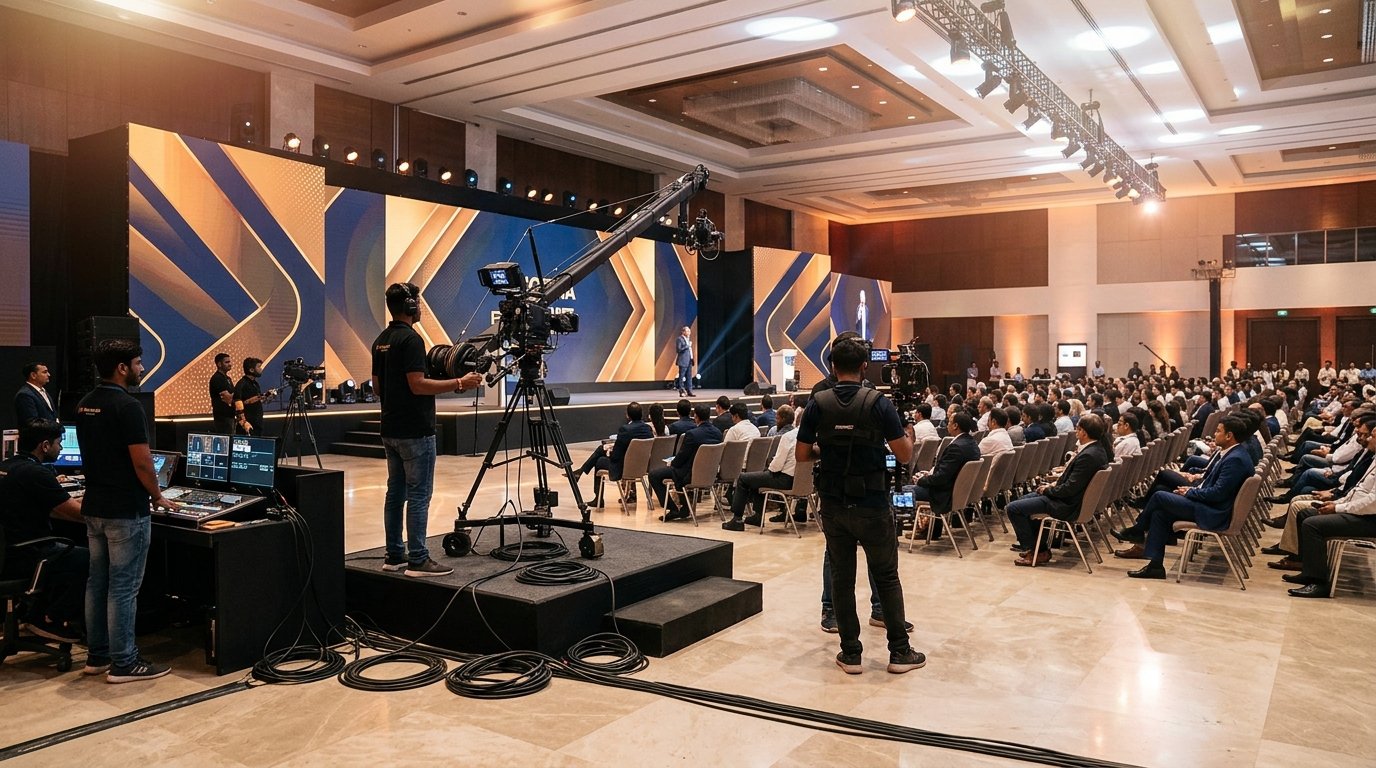
When a venue is designed with modern production in mind, the quality of the output—photography, video, and live streaming—improves exponentially. High ceilings, integrated fiber-optic networks, and strategically placed rigging points aren't just technical specs; they are the canvas for brand storytelling. In the context of India's new convention centers, the sheer scale offers a dramatic backdrop for event photography and video. However, scale can be a double-edged sword. A massive, half-empty hall looks disastrous on camera. Professional documentation in these new Indian 'mega-venues' requires a strategic approach to framing and lighting. It is about capturing the energy of a 5,000-person keynote while also documenting the intimate networking moments that happen in the shadows of these giants. As India markets these spaces, the visual proof of successful, high-density events will be its most valuable currency. For a marketing director sitting in London or New York, seeing a cinematic aftermovie of a successful summit in Delhi is the ultimate de-risking tool. It proves that the lighting works, the audio is crisp, and the atmosphere is conducive to high-level business. Without this editorial-grade documentation, these billion-dollar centers remain just empty shells in the eyes of the global market. The infrastructure provides the stage, but the visual content provides the credibility. Modern production demands more than just a camera crew; it requires an understanding of how architectural lighting interacts with digital sensors in vast spaces. In venues like Yashobhoomi, where the ceiling heights allow for massive LED installations, the challenge for the production team is to manage the exposure and color balance so the brand's visual identity remains consistent across all platforms. Furthermore, the availability of high-speed, dedicated data lines within these venues allows for seamless 4K streaming, which is now a non-negotiable requirement for hybrid global summits. If the infrastructure fails to support these technical needs, the visual documentation suffers, and by extension, the venue's global reputation is compromised. High-end visual storytelling is the bridge that connects a physical location to a global audience, transforming a local event into a worldwide brand statement.
What are the main challenges for event organizers entering the Indian market?
The primary hurdle remains the fragmentation of the supply chain. In established markets, an organizer can rely on a handful of tier-one partners for everything from AV to catering. In India, despite the rise of world-class venues in cities like Kochi and Varanasi, the vendor ecosystem is still maturing. Organizers often find themselves managing a dozen different local suppliers to achieve a single result. Furthermore, there is the issue of standardization. A 'premium' service in one city might not match the 'premium' service in another. For international brands, this lack of predictability is a significant risk. This is why many are looking for partners who can bridge the local-global divide—agencies that understand the Indian landscape but operate with the precision of a European or North American production house. Global event trends and venue marketing suggest that the successful entry into emerging markets depends heavily on the quality of the local production partner. Beyond the logistics, the cultural nuances of business in India—from timing to communication styles—require a level of local fluency that cannot be ignored. The challenge is not finding a venue; it is finding a partner who can manage the intricate layers of the Indian market while maintaining the rigorous standards of a global corporate brand. Regulatory hurdles, such as customs clearances for specialized technical equipment (ATA Carnets), can also be a bottleneck for international production crews. While the government has made strides in ease of doing business, the 'on-the-ground' reality often involves a labyrinth of local permits and municipal regulations that vary from state to state. For instance, hosting an event in Bangalore, the tech hub, involves different logistical considerations than hosting in the heritage-rich environment of Rajasthan. The maturity of the local labor market also varies; while technical skills are abundant, the specific 'soft skills' required for high-stakes corporate hospitality are still being standardized. Organizers must therefore invest more time in pre-event vetting and on-site rehearsals to ensure that the execution matches the global brand's expectations. Success in India is not about overcoming the environment, but about integrating with it through a partner who speaks both the language of the local vendor and the language of the global CMO.
Why is high-end photography and video essential for marketing new convention spaces?
India is currently in a marketing phase for its MICE infrastructure. To move from a 'new' destination to a 'preferred' one, it needs to showcase more than just architectural renders. It needs to show the human element of the event: the handshake between CEOs, the vibrant energy of a tech showcase, and the flawless delivery of a hybrid broadcast. High-end visual content serves as the bridge between a venue's potential and its proven capability. At Alesia RSVP, we have spent years documenting the world's most prestigious summits in established hubs. We understand that as the geography of B2B events shifts toward emerging powerhouses like India, the demand for world-class visual storytelling only intensifies. Whether it’s a fintech summit in Singapore or a corporate conference in a brand-new Indian convention center, our mission remains the same: to capture the prestige and scale of your event with uncompromising quality. The infrastructure is ready; now it is time to ensure the execution—and the documentation—is equally world-class. The investment in concrete must be matched by an investment in content. If the world cannot see the success of your event, did it really happen? For the Indian MICE sector to truly arrive on the global stage, it must prioritize the production of magazine-quality editorial content that speaks the language of international decision-makers. This content serves a dual purpose: it acts as a post-event report for stakeholders and as a high-impact marketing asset for future editions. In an era where digital presence is as important as physical attendance, the quality of the video highlights, the social media clips, and the keynote photography determines the event's 'long tail' ROI. High-quality documentation de-risks the destination for future organizers by providing visual evidence of technical reliability and operational excellence. It transforms a 3-day conference into a year-round marketing tool, ensuring that the prestige of the event resonates long after the final delegate has left. As India continues to scale its physical presence in the MICE world, the role of premium visual production will be the deciding factor in whether these venues become global icons or remain local landmarks. The transition from a developing market to a global leader is paved with high-resolution proof of success.
FAQ
What does MICE stand for in the global travel and event industry?
MICE is an acronym for Meetings, Incentives, Conferences, and Exhibitions. It represents the specialized niche of group tourism dedicated to planning, booking, and facilitating conferences, seminars, and other professional events that drive business growth and international collaboration.
How can international brands ensure consistent media quality when hosting events in emerging markets?
Brands should partner with global AV production agencies that have a proven track record in international hubs. This ensures that regardless of the local venue, the photography, video, and streaming standards meet the brand's global guidelines, executive expectations, and technical requirements for high-stakes B2B communication.
What are the fastest-growing MICE cities in India for 2025?
While Delhi and Mumbai remain the primary hubs due to their massive new convention centers, cities like Kochi, Varanasi, and Khajuraho are seeing significant infrastructure growth. These cities are being positioned as specialized destinations for corporate summits and incentives, supported by new convention centers, improved air connectivity, and a focus on 'bleisure'—combining business with local cultural experiences.
Frequently Asked Questions
What does MICE stand for in the global travel and event industry?
MICE is an acronym for Meetings, Incentives, Conferences, and Exhibitions. It represents the specialized niche of group tourism dedicated to planning, booking, and facilitating conferences, seminars, and other professional events that drive business growth and international collaboration.
How can international brands ensure consistent media quality when hosting events in emerging markets?
Brands should partner with global AV production agencies that have a proven track record in international hubs. This ensures that regardless of the local venue, the photography, video, and streaming standards meet the brand's global guidelines, executive expectations, and technical requirements for high-stakes B2B communication.
What are the fastest-growing MICE cities in India for 2025?
While Delhi and Mumbai remain the primary hubs due to their massive new convention centers, cities like Kochi, Varanasi, and Khajuraho are seeing significant infrastructure growth. These cities are being positioned as specialized destinations for corporate summits and incentives, supported by new convention centers, improved air connectivity, and a focus on 'bleisure'—combining business with local cultural experiences.