
India MICE Strategy: Beyond New Delhi Convention Centers
India MICE Strategy: Beyond New Delhi Convention Centers
India is scaling its infrastructure to become a global MICE powerhouse, but hardware alone won't attract the world's most prestigious B2B events.
Is India ready to compete with established global MICE hubs in 2025?
India is no longer content with being a secondary destination for international delegations. Following the high-visibility success of the G20 Summit, the Indian government has pivoted toward an aggressive expansion of its Meetings, Incentives, Conferences, and Exhibitions (MICE) sector. The numbers are staggering: the market generated $49.4 billion in revenue last year and is projected to reach $103.7 billion by 2030. This growth is anchored by massive investments in 'hardware'—the physical venues like the Yashobhoomi (IICC) in New Delhi. However, building a venue is not the same as building a reputation. For a corporate decision-maker, a venue is merely a shell; the true value lies in the ease of execution and the prestige associated with the location.
When we look at established hubs like the Middle East, specifically Corporate Events Dubai, the comparison becomes clear. Dubai didn't just build the World Trade Centre; it built a seamless ecosystem of luxury hospitality, streamlined visa processes, and a world-class service layer. India’s current challenge is replicating this 'software' layer across its vast geography. While New Delhi and Mumbai have the foundation, the government's push into cities like Varanasi and Kochi requires a monumental shift in local service standards. According to Industry insights on India's MICE aspirations, the focus must shift from square footage to the attendee experience. For international organizers, the risk of logistical friction in emerging Indian markets often outweighs the novelty of the location. To compete, India must prove it can handle the high-stakes pressure of a 5,000-delegate corporate summit without the growing pains typically associated with developing markets.
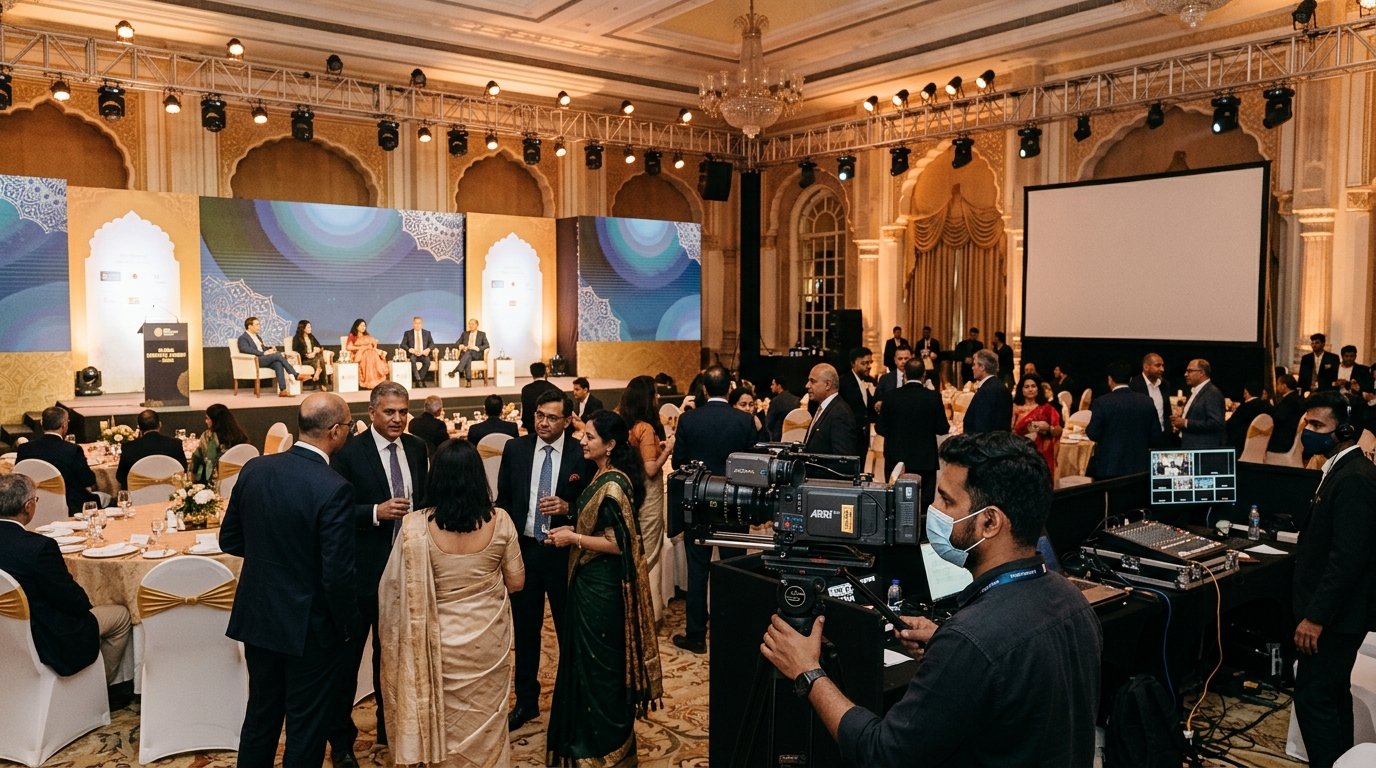
The G20 was a proof of concept, demonstrating that India can host the world’s most powerful leaders with precision. But a government-backed summit is a different beast than a privately funded B2B conference. Private organizers demand ROI, and that ROI is increasingly tied to how the event is perceived globally through digital channels. If the local infrastructure lacks the specialized AV, lighting, and production support required for a modern broadcast-quality event, the venue’s size becomes irrelevant. India’s aspirations are valid, but the path to $103 billion requires more than concrete; it requires a sophisticated service economy that speaks the language of global enterprise.
What defines a holistic ecosystem for high-end corporate events?
A successful MICE destination is a machine with many moving parts. It isn't enough to have a 100,000-square-meter exhibition hall if the surrounding transport links are congested or if the local vendor pool cannot meet international technical riders. Industry experts argue that a holistic ecosystem includes everything from high-speed connectivity to specialized event insurance and, perhaps most importantly, a skilled workforce. In many emerging Indian MICE hubs, there is a visible gap between the ambition of the venue and the reality of on-site technical support. High-end corporate events require a level of precision where a five-minute delay in a live stream or a failure in simultaneous interpretation equipment is catastrophic.
Organizers are looking for 'plug-and-play' environments. When a VP of Events chooses a city, they are buying into a network of trusted partners. This is why cities like Singapore and London remain dominant; the friction of planning is minimized by the density of expert providers. India's strategy of developing 'MICE-ready' destinations in Tier 2 cities like Khajuraho is bold, but it places the burden of logistics on the organizer. This is where the narrative of Global event trends and venue marketing becomes relevant. Marketing a destination requires showing, not just telling. If a venue cannot demonstrate a track record of hosting complex, multi-track corporate programs with seamless technical execution, it will struggle to attract the Fortune 500.
Furthermore, the ecosystem must extend to post-event value. Corporate events are content engines. A summit in 2025 is as much about the 2,000 people in the room as it is about the 200,000 people watching the highlights online. If the destination doesn't offer the production infrastructure to capture and broadcast that content at a premium level, the event's impact is halved. India’s investment must therefore include the digital 'plumbing' of these venues—ensuring that fiber-optic backbones and broadcast-ready power grids are standard, not optional upgrades. The goal is to move from being a 'cost-effective' choice to a 'world-class' choice.
How does premium photography and video elevate the prestige of new event venues?
Prestige is a manufactured asset. For new venues like Yashobhoomi to enter the global consciousness, they need to be framed correctly. This is not about simple snapshots; it is about editorial-grade visual storytelling that positions the venue as a peer to the Javits Center or the Palais des Festivals. When an international brand hosts an event in a new market, they are taking a brand risk. High-quality visual documentation mitigates this risk by proving the event's success to stakeholders, sponsors, and future attendees. Alesia RSVP has long maintained that the quality of your event's aftermovie is the ceiling for your event's perceived success. If the production looks amateur, the event—and by extension, the venue—is judged as amateur.
In the context of India’s MICE expansion, premium visual content serves as the bridge between local execution and global standards. By utilizing a Galerie Photo & Video approach that prioritizes magazine-quality output and same-day delivery, organizers can broadcast the scale and sophistication of their Indian events in real-time. This creates a feedback loop: high-quality content attracts better sponsors, which leads to higher budgets, which allows for even better production. For a venue, being the backdrop of a viral, high-production-value keynote is the best marketing money can't buy. It validates the infrastructure and signals to the rest of the industry that the destination is ready for prime time.
At Alesia RSVP, we see the transition from 'event coverage' to 'brand storytelling' as the defining trend of the decade. As India builds these massive convention centers, the demand for sophisticated AV production will skyrocket. Organizers will no longer be satisfied with local generalists; they will seek out agencies that understand the nuances of corporate branding and executive presence. The ability to produce a 60-second highlight reel that feels like a cinematic trailer is what differentiates a standard conference from a global summit. As India scales its physical footprint, the visual narrative will be the primary tool for convincing the global C-suite that India is not just a destination for the future, but a destination for right now.
What are the emerging Indian cities leading the MICE revolution?
While New Delhi remains the gateway, the real story of India's MICE growth is happening in the periphery. Cities like Kochi, with its unique blend of coastal appeal and modern infrastructure, are positioning themselves as 'bleisure' (business + leisure) destinations. This is a strategic move to capture the 'Incentives' part of the MICE acronym. Similarly, Varanasi is leveraging its cultural heritage to offer a backdrop that no Western convention center can replicate. This 'cultural ROI' is a powerful draw for international associations looking to provide their members with an experience that transcends the four walls of a ballroom.
However, the move to Tier 2 cities introduces a specialized set of challenges. Logistics, local transport, and the availability of high-end technical equipment become more volatile. For a corporate planner, the appeal of a 'unique' location is often tempered by the fear of a technical failure in a remote area. This is why the government's role in creating 'MICE-ready' zones is so critical. These zones must act as international enclaves where the standards of service, connectivity, and security are guaranteed. If India can successfully bridge the gap between its ancient cultural appeal and the rigorous demands of modern corporate production, it will create a MICE product that is truly unique in the global market. The potential is there, the investment is there, and the ambition is undeniable. The final hurdle is the consistent execution of the 'software'—the human and technical services that turn a large building into a world-class event.
FAQ
What is the projected growth of the Indian MICE market by 2030?
The Indian MICE market is expected to grow from $49.4 billion in 2023 to approximately $103.7 billion by 2030. This growth is driven by government investment in massive convention centers and a strategic push to market India as a global hub for international conferences and exhibitions.
Why is a holistic ecosystem more important than just a convention center?
A holistic ecosystem includes hospitality, transport, technical expertise, and streamlined administrative processes. Without these, even the most advanced convention center fails to attract international organizers who require a friction-less environment for high-stakes corporate events and summits.
How can event organizers ensure high-quality visual coverage in emerging markets?
Organizers should partner with global AV production agencies that have experience navigating emerging markets. By bringing in a lead production team that understands international corporate standards for photography and video, brands can ensure their event's global image remains premium regardless of local venue limitations.
Frequently Asked Questions
What is the projected growth of the Indian MICE market by 2030?
The Indian MICE market is expected to grow from $49.4 billion in 2023 to approximately $103.7 billion by 2030. This growth is driven by government investment in massive convention centers and a strategic push to market India as a global hub for international conferences and exhibitions.
Why is a holistic ecosystem more important than just a convention center?
A holistic ecosystem includes hospitality, transport, technical expertise, and streamlined administrative processes. Without these, even the most advanced convention center fails to attract international organizers who require a friction-less environment for high-stakes corporate events and summits.
How can event organizers ensure high-quality visual coverage in emerging markets?
Organizers should partner with global AV production agencies that have experience navigating emerging markets. By bringing in a lead production team that understands international corporate standards for photography and video, brands can ensure their event's global image remains premium regardless of local venue limitations.