
2026 Las Vegas Corporate Event Budgeting & AV Rates
2026 Las Vegas Corporate Event Budgeting & AV Rates
A strategic guide for corporate decision-makers planning high-stakes events in Las Vegas for 2026, focusing on logistics, AV, and budget optimization.
How much should you budget for premium corporate venues in Las Vegas for 2026?
Navigating the high-stakes world of Las Vegas corporate events in 2026 requires more than just a spreadsheet—it demands a strategic vision for premium execution. As rates evolve, securing top-tier production and logistics early is the difference between a standard meeting and a brand-defining experience. For 2026, the Las Vegas market is shifting away from the 'volume-first' model toward high-value, experiential summits. Based on current hospitality labor contracts and inflationary trends in the Nevada service sector, planners should anticipate a baseline increase of 12% to 15% in venue rental and food and beverage (F&B) costs compared to 2024 levels. Premium properties like the Wynn, Encore, and the newer Fontainebleau are commanding significant premiums for their pillar-less ballrooms and integrated tech stacks, which reduce the need for expensive structural rigging but increase the base square-footage cost.
Budgeting for a 500-person summit now requires a minimum allocation of $450 to $600 per attendee per day just for venue and catering. This figure covers the basics: a general session room, breakout spaces, and standard high-end catering. However, it does not include the essential visual storytelling components that justify the travel spend for your C-suite and international delegates. When reviewing contracts, pay close attention to the service charge and sales tax—often exceeding 30% combined in Clark County. For instance, a $100,000 F&B minimum quickly becomes $130,000 once the 24% service charge and 8.375% sales tax are applied. To visualize how these budgets translate into physical space, reviewing a portfolio of past high-end productions can provide a benchmark for the level of finish expected by modern B2B audiences.
The 2026 landscape rewards those who lock in multi-year master service agreements (MSAs) with venues, providing a hedge against the inevitable price surges during peak convention months like January (CES) and October (IMEX). Furthermore, the 'resort fee' culture has expanded into the corporate block. Negotiating these fees out of the contract—or ensuring they include high-speed symmetrical Wi-Fi for all attendees—is a critical cost-saving measure. In 2026, bandwidth is not a luxury; it is a utility. If your event involves heavy app usage or live polling, the venue's standard 'meeting room Wi-Fi' will likely fail. Budgeting an additional $10,000 to $20,000 for dedicated bandwidth is now a standard requirement for tech-forward summits. Ultimately, the goal is to move from a 'cost-center' mindset to an 'investment' mindset, where the venue serves as a high-performance backdrop for corporate messaging.
What are the essential AV and content production costs for high-impact events?
In 2026, the 'AV' line item is no longer just about microphones and projectors; it is about content capture and global broadcast. For a major conference like Consensus 2026, the production value is what separates a localized meeting from a global industry moment. You must budget for a multi-camera live streaming setup and on-site editorial teams if you want your event to have a shelf life beyond the closing keynote. High-end video production, including same-day highlight reels and social-first vertical content, should account for approximately 20% to 25% of your total event budget. This shift reflects the reality that the audience 'in the room' is only a fraction of the total reach potential.
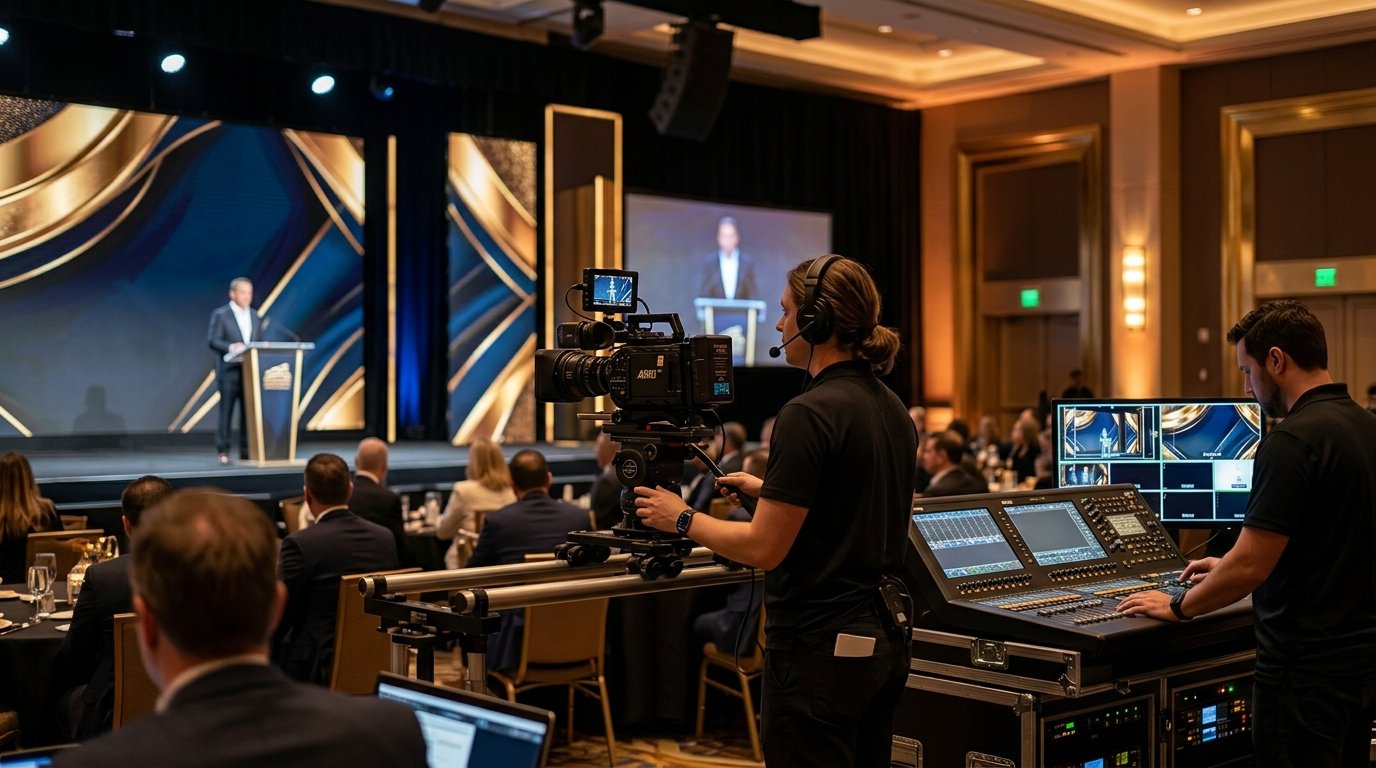
Market observations indicate that labor rates for specialized technicians—specifically LED wall engineers, V1 vision mixers, and broadcast directors—are rising by approximately 8% annually due to the scarcity of high-level talent in the Vegas valley. A professional 3-camera live stream setup for a main stage in Las Vegas now starts at $15,000 per day. This includes a dedicated technical director, camera operators, a broadcast-grade switcher (such as a Ross Carbonite or Blackmagic Constellation), and hardware encoding for redundant streams. If you are planning a podcast activation or an executive interview suite, expect to allocate an additional $5,000 to $8,000 for a turnkey mobile studio with soundproofing and professional lighting.
The ROI on these items is found in the post-event content cycle. One hour of keynote footage can be repurposed into three months of LinkedIn leadership content, effectively lowering your cost-per-lead over the long term. However, many planners fall into the trap of using the in-house AV provider. While convenient, in-house packages are often marked up by 40% to 60% to cover the venue's commission, often utilizing equipment that is two or three generations behind. Bringing in an external specialized production partner allows for a bespoke equipment list—such as 1.9mm pixel pitch LED walls instead of standard 3.5mm—ensuring magazine-quality output that looks as good on a 4K monitor as it does in person. For 2026, the focus is on 'cinematic' corporate production: using shallow depth-of-field lenses, dynamic lighting plots, and spatial audio to create an immersive environment that justifies the premium ticket price.
How can you optimize vendor coordination and logistics for a seamless Vegas experience?
Logistics in Las Vegas are notoriously complex due to union regulations and the sheer scale of the properties. The 'Vegas Tax'—hidden costs like drayage (the fee for moving freight from the loading dock to your booth) and rigging points—can derail a budget if not accounted for in the RFP stage. Drayage alone can cost between $90 and $150 per hundredweight (CWT), meaning a heavy LED wall or custom stage set can incur thousands of dollars in fees before it is even uncrated. Successful event directors in 2026 are moving toward a 'single-source' model to mitigate these risks. Instead of managing six different vendors for photography, video, streaming, and event management, they are partnering with agencies that provide an integrated layer of oversight.
This consolidation reduces the risk of communication breakdowns and eliminates the 'finger-pointing' that occurs when technical issues arise on-site. For example, when the lighting designer and the video director work for the same agency, the color temperature of the stage lights is perfectly synced with the camera sensors long before the first rehearsal. This level of technical harmony is difficult to achieve with a fragmented vendor list. Furthermore, navigating the IATSE (International Alliance of Theatrical Stage Employees) and Teamster requirements in Las Vegas requires a partner who understands 'dark time' rules, meal break penalties, and jurisdictional boundaries. Mismanaging a crew break can result in thousands of dollars in overtime penalties in a single afternoon.
Alesia RSVP bridges the gap between complex Las Vegas logistics and world-class visual storytelling, ensuring your 2026 budget accounts for the high-end AV and content capture necessary to stand out in the Neon Capital. Our dual expertise as both a corporate event management agency and a premium AV production house allows us to navigate the intricacies of Las Vegas venues while maintaining a focus on the final creative output. Whether it is managing the load-in for a 40-foot LED wall or coordinating a team of five editorial photographers for a multi-day summit, the goal is a seamless execution that reflects the brand’s prestige. The conclusion for 2026 is clear: budget for quality, consolidate your vendors, and treat your event content as your most valuable marketing asset. By centralizing your production and logistics, you not only protect your budget from hidden fees but also ensure that the visual legacy of your event is captured with the precision it deserves.
FAQ
What is the average increase in Las Vegas vendor rates for 2026?
Corporate event planners should expect an 8% to 15% increase in vendor rates for 2026. This is driven by high demand for specialized technical labor, rising union labor rates (IATSE), and the increased costs of logistical operations within major Las Vegas Strip properties. Securing contracts 12-18 months in advance is recommended to lock in current pricing.
Why is high-end video production a critical budget line item for B2B events?
Professional video production transforms a one-time event into a long-term marketing asset. High-quality aftermovies, keynote captures, and social media cuts provide the necessary ROI by extending the event's reach to a global audience. In 2026, the 'digital twin' of your event is just as important as the physical experience for brand authority.
How does Alesia RSVP manage local vendor coordination in Las Vegas?
Alesia RSVP utilizes a dedicated project management layer to oversee all local sub-contractors and union labor. By acting as a single point of contact for AV, photography, and logistics, we eliminate the 'Vegas Tax' of mismanaged drayage and labor overlaps, ensuring brand consistency and technical reliability across the entire event lifecycle.
Frequently Asked Questions
What is the average increase in Las Vegas vendor rates for 2026?
Corporate event planners should expect an 8% to 15% increase in vendor rates for 2026. This is driven by high demand for specialized technical labor, rising union labor rates (IATSE), and the increased costs of logistical operations within major Las Vegas Strip properties. Securing contracts 12-18 months in advance is recommended to lock in current pricing.
Why is high-end video production a critical budget line item for B2B events?
Professional video production transforms a one-time event into a long-term marketing asset. High-quality aftermovies, keynote captures, and social media cuts provide the necessary ROI by extending the event's reach to a global audience. In 2026, the 'digital twin' of your event is just as important as the physical experience for brand authority.
How does Alesia RSVP manage local vendor coordination in Las Vegas?
Alesia RSVP utilizes a dedicated project management layer to oversee all local sub-contractors and union labor. By acting as a single point of contact for AV, photography, and logistics, we eliminate the 'Vegas Tax' of mismanaged drayage and labor overlaps, ensuring brand consistency and technical reliability across the entire event lifecycle.