
LEAP East 2026: Hong Kong Corporate Event Production Guide
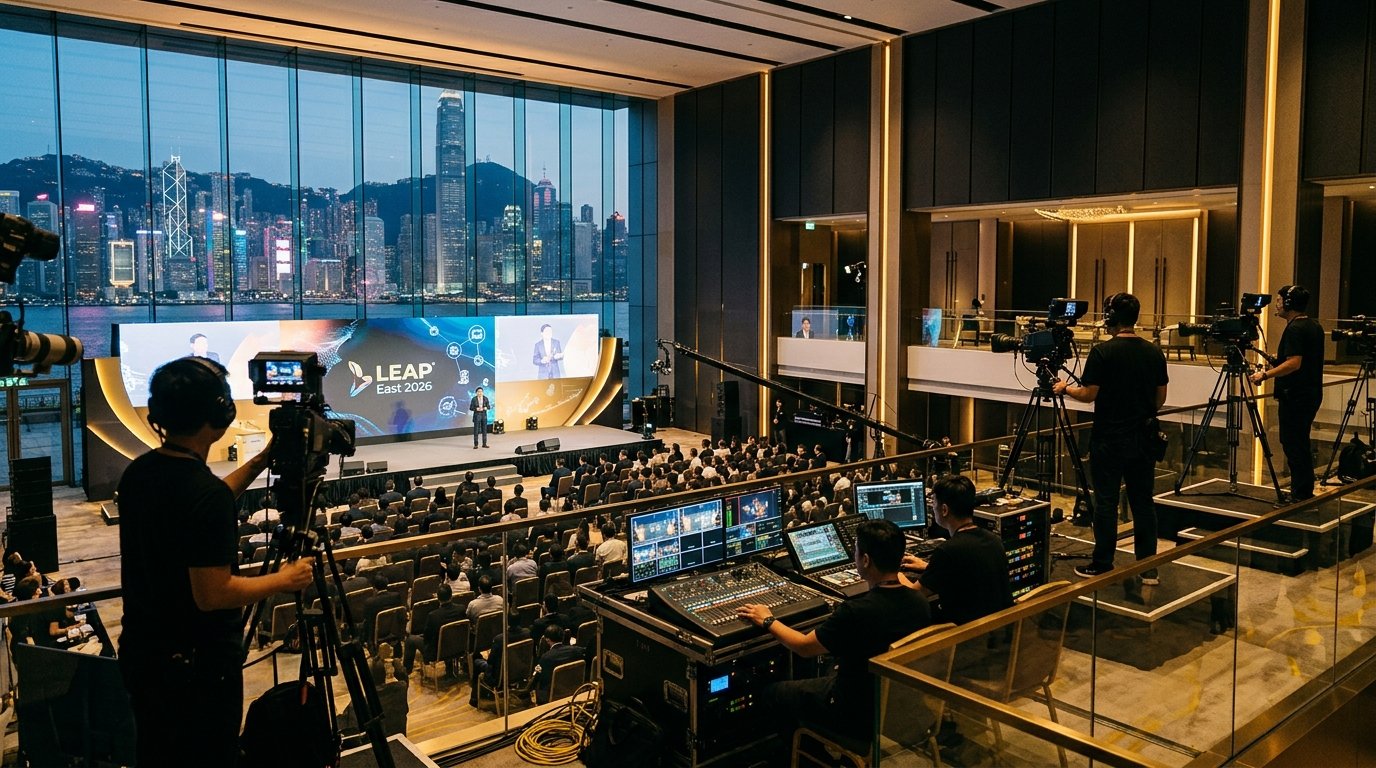
LEAP East 2026: Hong Kong Corporate Event Production Guide
From Riyadh to Hong Kong, the inaugural LEAP East 2026 has officially redefined the scale of global tech summits, attracting over 35,000 visionaries to the heart of Asia. This landmark event represents more than just a conference; it is a strategic bridge between the Middle East’s digital transformation and the Greater Bay Area’s technological prowess. For corporate planners and marketing directors, the scale of LEAP East presents a unique set of challenges and opportunities. Success in this environment requires a move away from traditional event logistics toward a sophisticated production model that treats every keynote, every handshake, and every product launch as a high-value media asset. As the first international expansion of the LEAP brand, the Hong Kong edition set a new benchmark for how regional summits can facilitate global capital flow through meticulously curated environments and world-class technical execution.
Why did LEAP East 2026 choose Hong Kong as its first international expansion?
The selection of the Hong Kong Convention and Exhibition Centre (HKCEC) for the first LEAP summit outside Saudi Arabia was a calculated move by organizers and the Saudi Ministry of Communications and Information Technology. Hong Kong serves as a unique dual-conduit, offering seamless access to Mainland China while maintaining a Western-aligned common law system. This legal and geographic positioning is vital for a summit that attracted 340 speakers and over 400 investors from 30 different regions. For corporate decision-makers, this move signals Hong Kong's enduring status as a primary hub for high-stakes intellectual property and capital flow. While corporate events in Singapore continue to dominate the fintech sector, LEAP East has staked a massive claim in the deep tech and AI sectors by leveraging Hong Kong’s simple, low tax regime and robust infrastructure.
From a production standpoint, the sheer scale of the event—gathering more than 35,000 technology professionals—demands a level of logistical coordination rarely seen outside of Davos or the World Economic Forum. The presence of financial heavyweights like Paul Chan and Abdullah Alswaha highlights that this was not merely a trade show, but a diplomatic and economic milestone. For brands participating in such a high-profile environment, the challenge is standing out among 450 exhibitors. Static booths are no longer sufficient; the requirement is for immersive, high-fidelity brand storytelling that reflects the sophistication of the attendees. This scale dictates that event management must move beyond simple coordination into the realm of strategic asset production. You can see similar high-stakes execution in our past event coverage.
Furthermore, the choice of HKCEC in Wan Chai provides a backdrop of urban density and professional efficiency that is hard to replicate. The venue’s ability to handle massive power loads for AI demonstrations and complex AV setups is a prerequisite for an event of this magnitude. For international delegations, the proximity to the city’s financial heart means that the summit doesn't end at the exhibition doors; it continues into the boardrooms of Central and the private dining rooms of Kowloon. This continuity of business is exactly why the Saudi-HK partnership chose this specific geography. The production must therefore extend its reach, capturing the essence of these satellite events with the same rigor as the main stage keynotes. When 400+ investors are moving through a space, every visual cue must reinforce the message of stability, innovation, and opportunity. The integration of the Greater Bay Area (GBA) into the event’s narrative further complicates the production needs, as content must often be tailored for both international audiences and regional stakeholders who have different aesthetic and linguistic expectations.
How can brands maximize their visual impact at massive tech summits like LEAP East?
At an event with 450 exhibitors and 400 investors, the competition for attention is absolute. Brands that rely on generic event snapshots or low-quality video recaps lose the opportunity to influence the 35,000 professionals in attendance. To maximize visual impact, firms must shift from a 'documentation' mindset to an 'editorial' mindset. This means employing multi-photographer teams that understand corporate hierarchy and investor relations. Capturing a handshake between a CEO and a Tier-1 investor requires more than just being in the room; it requires the technical foresight to manage lighting and framing in the chaotic environment of the HKCEC. High-end video production is equally vital. Aftermovies should not just be montages of people walking; they must be documentary-style assets that capture the substance of the keynotes and the urgency of the deal-making occurring on the floor.
Professional AV production serves as a delivery mechanism for brand credibility. When an organization invests in a summit of this magnitude, the content generated on-site becomes its primary marketing collateral for the following quarter. This is why immediate turnaround—same-day highlight reels and real-time social media delivery—is non-negotiable. For a deep dive into how these visual strategies are evolving, you should follow the latest event trends on BizBash which highlight the shift toward high-fidelity production values in the B2B space. Capturing the effective alignment between 400+ investors and 450+ exhibitors requires more than just a camera—it requires a strategic eye for the moments that define industry leadership.
To achieve this, production teams must utilize cinema-grade equipment—think Sony FX9 or Arri Alexa Mini LF—even for 'run-and-gun' event coverage. The difference in dynamic range and color science is what separates a professional corporate asset from a hobbyist video. Lighting is another critical factor; the flat, fluorescent overheads of large exhibition halls are notoriously unflattering. Expert crews will bring portable, high-output LED kits to create 'pockets' of cinematic light during interviews and booth tours. This attention to detail ensures that the brand looks as premium as its price point suggests. Moreover, the post-production workflow must be optimized for speed without sacrificing quality. This involves on-site DITs (Digital Imaging Technicians) who can offload, backup, and begin the initial color grade while the event is still in progress. By the time the closing keynote finishes, the primary marketing assets should be 90% complete, allowing the brand to own the news cycle the following morning. This level of technical readiness is what defines a successful presence at LEAP East.
What are the key networking trends emerging from the 2026 tech event circuit?
The 2026 circuit, led by LEAP East, demonstrates a significant pivot toward 'high-trust' networking environments. With 400 investors present, the focus has moved away from broad-spectrum lead generation toward curated, executive-level interactions. This shift is reflected in the demand for on-site podcast studios and private broadcast suites within the exhibition hall. Executives are looking for controlled environments where they can share insights that reach beyond the 35,000 people on-site to a global digital audience. This mirrors industry discussions on LEAP East that emphasize the convergence of physical presence and digital reach.
As a premium agency specializing in high-stakes B2B events, Alesia RSVP understands that the production value of these interactions directly impacts the perceived value of the brand. Whether it is a multi-camera live stream of a keynote or a magazine-quality photo gallery of a private investor dinner, the quality of the execution must match the caliber of the participants. Alesia RSVP provides the technical backbone for these summits, ensuring that the visual output is as professional as the deal-making it documents. The inaugural LEAP East has set a new benchmark for what a regional tech summit can achieve. For corporate planners, the message is clear: if you are not producing content that matches the scale of the venue and the seniority of the audience, you are leaving ROI on the table. The future of B2B events lies in the intersection of flawless logistics and premium visual storytelling.
Another emerging trend is the 'content-first' booth design. Instead of traditional counters and brochure racks, forward-thinking companies are building their exhibition spaces as mini-broadcast centers. These spaces are designed with acoustics and lighting in mind, allowing for high-quality live interviews and social media 'lives' to be conducted directly from the floor. This approach treats the physical booth as a stage for digital amplification. Furthermore, the use of data-driven photography—where AI-assisted tagging helps identify key stakeholders in a library of thousands of images—is becoming standard for large-scale summits. This allows marketing teams to quickly find and share photos with specific VIPs, reinforcing the networking connection made during the event. Finally, the 'After-Action' visual report is replacing the traditional PDF summary. These are high-impact, short-form video series that break down the key takeaways of the summit for internal and external stakeholders. By investing in these high-trust, high-fidelity production methods, brands ensure that their participation in LEAP East 2026 resonates long after the HKCEC halls have been cleared.
FAQ
How does LEAP East compare to other major tech summits like SXSW or Consensus?
LEAP East distinguishes itself through a heavy focus on institutional investment and government-backed innovation, whereas SXSW is more consumer-facing and Consensus is crypto-centric. With over 400 investors and 35,000 professionals, LEAP East acts as a high-level bridge between the Middle East and Asian tech ecosystems, making it a more transactional and diplomatic environment than its peers. The production requirements are consequently more formal and focused on corporate credibility.
What are the best practices for capturing high-end video content at international B2B conferences?
The most effective approach is to deploy a dedicated production team that utilizes cinema-grade cameras and professional audio recording to create documentary-style recaps rather than generic montages. Priority should be given to same-day delivery of highlight reels to leverage the event's social media momentum. Additionally, ensuring that the crew understands the nuances of corporate protocol and can navigate high-security VIP areas is essential for capturing the most impactful moments.
What is the importance of on-site editing for events like LEAP East?
On-site editing is critical for maintaining relevance in a fast-paced digital landscape. By having editors working in real-time at the HKCEC, brands can release high-quality content while the event is still trending. This 'Content Factory' approach ensures that the brand's narrative is the dominant one in social media feeds and news cycles, maximizing the return on the significant investment required to participate in such a large-scale summit.
Frequently Asked Questions
How does LEAP East compare to other major tech summits like SXSW or Consensus?
LEAP East distinguishes itself through a heavy focus on institutional investment and government-backed innovation, whereas SXSW is more consumer-facing and Consensus is crypto-centric. With over 400 investors and 35,000 professionals, LEAP East acts as a high-level bridge between the Middle East and Asian tech ecosystems, making it a more transactional and diplomatic environment than its peers. The production requirements are consequently more formal and focused on corporate credibility.
What are the best practices for capturing high-end video content at international B2B conferences?
The most effective approach is to deploy a dedicated production team that utilizes cinema-grade cameras and professional audio recording to create documentary-style recaps rather than generic montages. Priority should be given to same-day delivery of highlight reels to leverage the event's social media momentum. Additionally, ensuring that the crew understands the nuances of corporate protocol and can navigate high-security VIP areas is essential for capturing the most impactful moments.
What is the importance of on-site editing for events like LEAP East?
On-site editing is critical for maintaining relevance in a fast-paced digital landscape. By having editors working in real-time at the HKCEC, brands can release high-quality content while the event is still trending. This 'Content Factory' approach ensures that the brand's narrative is the dominant one in social media feeds and news cycles, maximizing the return on the significant investment required to participate in such a large-scale summit.