
Live Streaming Web Summit 2026: Multi-Camera Setup Guide
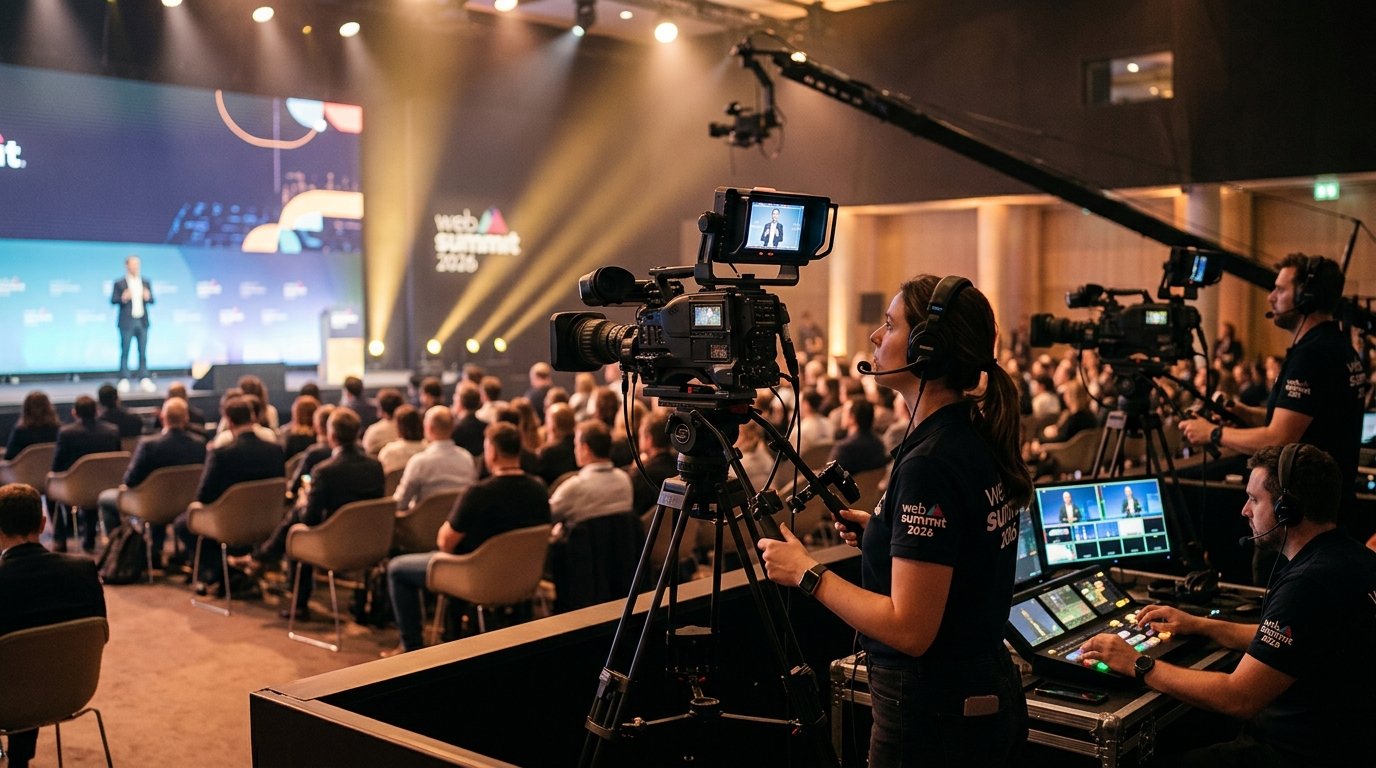
Live Streaming Web Summit 2026: Multi-Camera Setup Guide
With a massive international audience in Lisbon, a multi-camera setup is non-negotiable for brands wanting to cut through the noise at Web Summit 2026.
How do you design a multi-camera live streaming workflow for a Web Summit keynote?
With a global audience descending on Lisbon, the primary challenge for any brand at Web Summit 2026 is ensuring their message cuts through the noise. A physical presence at the Altice Arena is a significant investment, but without a high-end multi-camera setup, your keynote remains a localized event rather than a global digital phenomenon. Corporate decision-makers are shifting away from static, single-camera 'documentation' toward cinematic, broadcast-quality storytelling. Designing a workflow for such a high-density environment requires more than just hardware; it requires an editorial eye that understands the rhythm of a B2B presentation. At a massive scale like Web Summit, your production team must account for signal interference, immense crowd noise, and the specific lighting challenges of a cavernous arena.
A professional multi-camera workflow typically utilizes a minimum of three perspectives: a wide 'master' shot to capture the scale of the stage and audience, a medium shot for the speaker's body language, and a dedicated ISO camera for tight shots and slide integration. This variety is what keeps a remote audience engaged. When you look at our past events, the common thread is the removal of the 'virtual' barrier. If the remote viewer feels like they are in Lisbon, the production has succeeded. This involves real-time vision mixing where a director selects angles that correspond to the speaker's energy. If a speaker is moving across the stage, a static camera fails. You need tracking shots that maintain the momentum of the delivery.
Technical redundancy is the second pillar of a successful Web Summit stream. You are operating in one of the most congested wireless environments on the planet. Relying on standard venue Wi-Fi is a recipe for catastrophic failure. A professional setup employs bonded cellular solutions alongside a dedicated hardline connection. We have seen too many corporate brands lose their global audience in the first five minutes because their stream flickered or dropped frame rates. To avoid this, your AV partner must implement a failover system where a secondary encoder is running in parallel, ready to take over the broadcast instantly without the viewer noticing a single glitch. This level of technical security is what separates amateur setups from corporate-grade production.
Why is on-site podcasting becoming the ultimate engagement tool for B2B sponsors in Lisbon?
The evolution of B2B marketing has moved toward intimacy and authority. While big stages provide reach, on-site podcasting provides depth. For sponsors at Web Summit 2026, building a glass-walled podcast studio on the exhibition floor serves two purposes: it creates an physical attraction for passersby and generates a library of high-value content. We saw this trend accelerate significantly during previous major industry events, where brands transitioned from traditional booths to 'content hubs.' A podcast studio allows you to invite C-suite executives, industry influencers, and key partners for 15-minute high-impact conversations. These sessions are easier to schedule than a full panel and provide a more authentic connection with the audience.
From a production standpoint, on-site podcasting requires specialized acoustic management. The floor of the Altice Arena is loud. Using broadcast-grade dynamic microphones and real-time noise suppression is non-negotiable. The goal is to capture the 'hum' of the event to provide atmosphere without sacrificing the clarity of the dialogue. Furthermore, these sessions should never be audio-only. In 2026, a podcast is a visual medium. Multi-camera video recording of these interviews allows for the creation of 'micro-content'—short, 60-second clips that can be pushed to LinkedIn and X within an hour of the recording. This rapid-fire content delivery keeps your brand at the center of the conversation for the duration of the four-day event.
The strategic advantage of the on-site podcast is the 'afterlife' of the content. While a live stream is about the moment, a podcast series recorded in Lisbon can be dripped out over the following three months. This extends the ROI of the event well into the next quarter. You aren't just paying for four days of visibility; you are investing in a season of thought leadership. By capturing high-quality video and audio simultaneously, you provide your marketing team with a repository of insights that can be repurposed into blog posts, white papers, and social campaigns.
How can premium event photography and recap videos extend your brand's ROI post-Web Summit?
Photography is often treated as a commodity, yet in a high-stakes environment like Web Summit, it is your most versatile marketing asset. Generic event snapshots are useless for premium brands. You need editorial-grade photography that captures the intensity of the networking, the scale of the production, and the prestige of your speakers. These images are the primary assets for your PR outreach and internal reporting. A multi-photographer team allows for comprehensive coverage: one focusing on the 'hero' shots of the stage, another capturing the candid interactions at the booth, and a third focusing on the high-level VIP networking that happens in the lounges.
Similarly, the aftermovie or recap video has evolved. The era of the three-minute montage set to generic upbeat music is over. Decision-makers now demand narrative-driven recaps. A 60-second high-energy cut for social media is necessary for immediate impact, but a three-minute 'documentary-style' recap that features interviews, key insights, and a clear narrative arc is what actually influences B2B buyers. This content should be delivered with extreme speed. At Alesia RSVP, we prioritize same-day delivery for social highlights because the relevance of an event drops by 50% every 24 hours after it concludes. If you are posting your Web Summit highlights a week after the closing ceremony, you have already lost the momentum.
Integrating your photography and video strategy with your live streaming ensures a unified brand voice. The visual language should be consistent across all mediums. If your live stream looks like a million-dollar broadcast but your social media photos look like they were taken on an old smartphone, the brand experience is fractured. Professional AV teams coordinate these efforts, ensuring that the color grading, lighting, and framing across photo and video all align with your corporate identity. This level of detail is what signals to your clients that your organization operates at a premium level.
What are the technical requirements for seamless 4K broadcasting at the Altice Arena?
Broadcasting in 4K from a venue with tens of thousands of active devices is a feat of engineering. The bandwidth requirements for a stable 4K stream are substantial, often requiring a dedicated 20-30 Mbps upload speed that is completely isolated from the general attendee network. But bandwidth is only half the battle. You must also consider the processing power of your encoders and the capabilities of your streaming platform. Most B2B audiences will watch on 1080p screens, but capturing in 4K allows for 'punch-ins' during the editing process without losing quality, which is vital for creating high-end recap videos later.
Frequently Asked Questions
Pourquoi choisir le multi-caméra plutôt qu'un plan fixe pour une keynote ?
Le multi-caméra brise la monotonie visuelle et permet de souligner les moments clés du discours, augmentant le temps de rétention des spectateurs en ligne de plus de 40%.
Le matériel utilisé est-il conforme aux normes européennes ?
Oui, toutes nos installations respectent les normes de sécurité électrique européennes et les protocoles de transmission de données conformes au RGPD.