
B2B Event Marketing: Scaling at the Speed of Sports
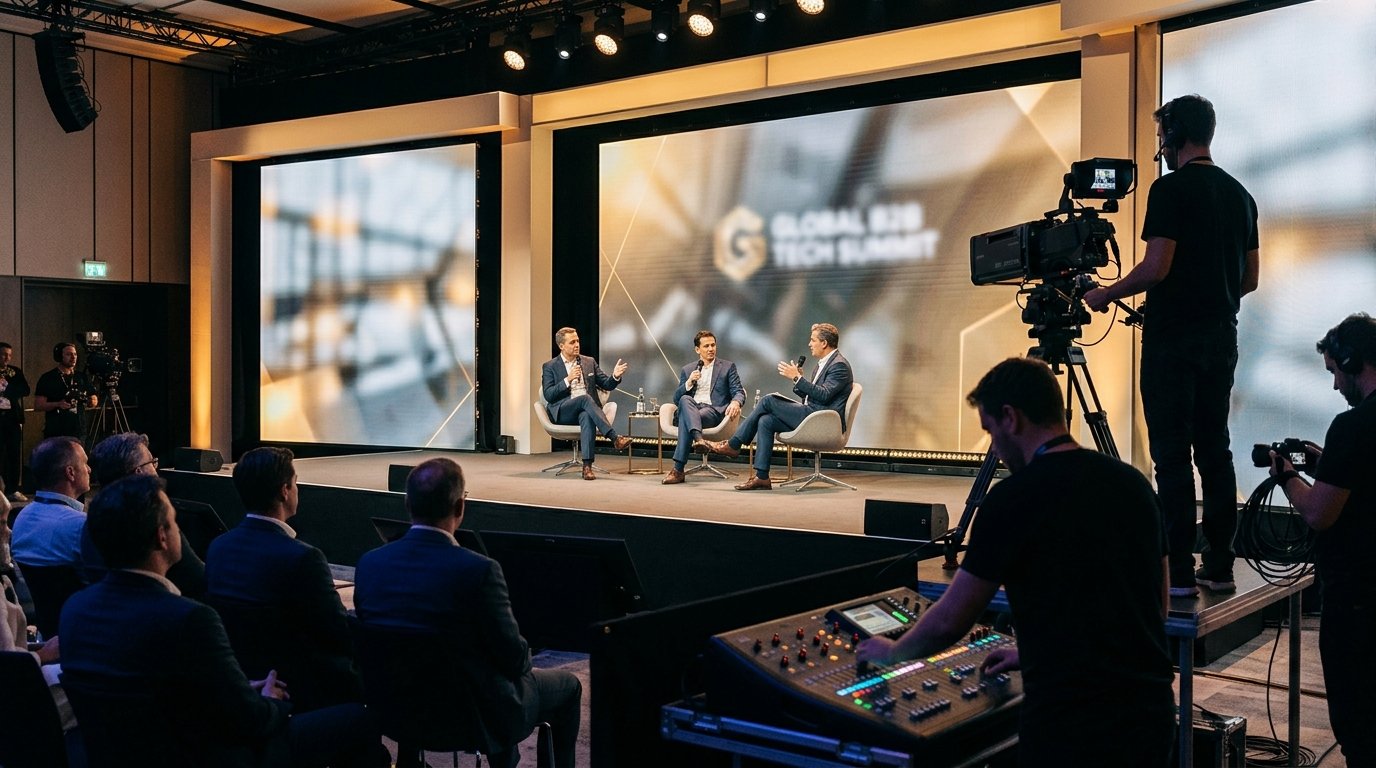
B2B Event Marketing: Scaling at the Speed of Sports
Why wait a week for your event photos? Adopt the lightning-fast pace of sports marketing to dominate real-time social conversations and transform every highlight into an immediate digital asset.
How can B2B event marketing learn from the reactivity of sports?
In the B2B arena, waiting a week to publish your event photos is like broadcasting a championship game on a tape delay: the emotion has faded, and the audience has moved on. Speed has become the new standard for premium engagement. During a recent summit hosted by ADWEEK in partnership with Viral Nation, industry leaders emphasized that to stay relevant, brands must now adopt the frantic pace of sports by leveraging social media and content creators. While this discussion focused on global brand partnerships, the lesson for corporate events is crystal clear: the latency between action and distribution is the primary killer of brand impact. The lifecycle of information at a high-stakes tech conference like EthCC is measured in minutes. If your major announcement isn't relayed with impeccable visual quality the moment the speaker leaves the stage, you're ceding ground to ambient noise rather than leading the narrative.
Sports marketing excels at capturing dynamic action and fleeting moments of grace, instantly transforming them into social assets. For a corporate event, the 'big play' isn't a touchdown—it’s a strategic announcement, a handshake between two CEOs, or a spontaneous reaction from an expert panel. Taking inspiration from sports means implementing a production infrastructure capable of treating these moments as live feeds. The goal is to move from passive documentation—simply archiving what happened—to dynamic activation that fuels the global conversation. Successful brands today treat their annual summits with the same logistical rigor as a league final, where every second of content produced has exponential value if shared immediately. This approach requires a break from traditional production methods that often prioritize slow perfectionism over immediate impact. To see how this visual approach translates in the field, visit our photo and video gallery for real-world examples of high-velocity delivery.
This transition toward sports-level velocity also requires rethinking the role of on-site creators. In sports, a sideline photographer knows their image must be on the feed before the quarter ends. In B2B, photographers must adopt this same 'brand journalism' mindset. It’s no longer about taking 2,000 photos to pick 50 the following Monday; it’s about identifying the 5 iconic shots of the morning and delivering them fully edited during the coffee break. This agility allows you to capitalize on the peak attention of attendees who, armed with their smartphones, are looking for high-quality content to resharing to boost their own professional presence. By providing these premium assets in real-time, the organizer isn't just communicating; they are equipping an army of ambassadors with professional-grade visual ammunition.
Why is real-time visual content the ultimate driver for social engagement?
The LinkedIn algorithm—the primary engine of B2B—rewards relevance, freshness, and initial 'dwell time.' A post featuring a high-definition photo of a keynote published 30 minutes after the session ends generates a radically higher engagement rate than a full album posted three days later. Why? Because the conversation is active, organic, and geo-located. Attendees are still on-site, remote observers are frantically following the event hashtag, and global attention is at its zenith. Real-time content doesn't just inform; it validates the event's importance to the outside world and creates a sense of immediacy that delayed content can never replicate.
As noted in this discussion on the impact of real-time marketing in the industry, a brand's ability to insert itself into the social flow with studio-quality visuals changes the perception of its authority. This is no longer just User-Generated Content (UGC), which is often blurry or poorly framed; it is brand-owned content produced at the speed of UGC. This hybridization is the Holy Grail of modern event marketing. By delivering high-fidelity visual assets in real-time, companies allow their executives and partners to become instant ambassadors. We are no longer talking about 'covering' an event, but massively amplifying it.
This strategy transforms every participant into a potential broadcast node. When a speaker steps off stage and finds a perfectly lit, edited photo of themselves in action already in their inbox or on a dedicated platform, their propensity to share it on their own networks is 100%. ROI is no longer calculated solely by leads generated on-site, but by the digital share of voice conquered during the critical 48 hours of the event. By occupying the visual space with superior quality, you saturate your targets' feeds, creating an impression of omnipresence and sector dominance. This is where social psychology comes into play: seeing a constant stream of professional content creates the FOMO (Fear Of Missing Out) effect for those who couldn't attend and reinforces a sense of pride for those who did.
How to guarantee premium quality while producing content at live speed?
The major challenge lies in the precarious balance between execution speed and aesthetic standards. Producing fast must never mean producing poorly, especially in sectors like luxury, tech, or finance where brand image is a critical asset. A mediocre image, even if published instantly, can damage a company's credibility. The solution lies not in the raw talent of the photographer alone, but in the sophisticated engineering of the workflow. At Alesia RSVP, we transform sports marketing reactivity into the standard for luxury corporate events. We don't just capture the moment; we deploy direct wireless transmission systems (via FTP protocols or proprietary cloud solutions) from the photographers' cameras to dedicated on-site editing stations.
This methodology allows for the delivery of curated, retouched assets optimized for each platform in under 15 minutes. This level of technical excellence separates traditional production agencies from next-generation strategic partners. As highlighted by the latest event trends and execution speed, technological infrastructure is now as vital as the creative eye. Achieving a cinematic look with same-day delivery requires anticipating every lighting scenario, every key script moment, and having a post-production team capable of 'editing-while-shooting.'
In practice, this involves using DIT (Digital Imaging Technician) workflows on the ground, capable of culling, color grading, and exporting video clips or photos while the event is still in progress. Furthermore, in an era of strict GDPR compliance in the EU and evolving data privacy laws in the US, these workflows must ensure secure, encrypted delivery of assets to authorized stakeholders only. By integrating event management and audiovisual production under one roof, we eliminate the communication friction that usually slows down delivery between different vendors. The result is a dominant social presence, a reinforced brand image, and a resonance that lasts long after the lights go down. Ultimately, speed is not a marketing gimmick; it is a fundamental component of your event's perceived value. In a world saturated with information, being the first to tell the story with the best imagery is the only viable strategy for capturing lasting attention.
FAQ
What is the ideal delivery time for B2B event photos to maximize social impact?
To maximize engagement on LinkedIn and X (Twitter), key moments like keynotes, contract signings, or product launches should be delivered within 15 to 30 minutes. A carefully edited 'highlights' gallery should be available the same evening to allow attendees to share their overall experience before the day ends. Any delay beyond 24 hours significantly reduces the organic reach of the content.
How do you maintain high visual quality with such fast turnaround times?
Quality is maintained through a 'live-editing' workflow. This includes using professional DITs on-site who receive photos wirelessly from the photographers. They apply pre-set brand color grading and cropping immediately, ensuring that the speed of delivery never compromises the premium aesthetic required for B2B branding.
Questions Fréquentes
What is the ideal delivery time for B2B event photos to maximize social impact?
To maximize engagement on LinkedIn and X (Twitter), key moments like keynotes, contract signings, or product launches should be delivered within 15 to 30 minutes. A carefully edited 'highlights' gallery should be available the same evening to allow attendees to share their overall experience before the day ends. Any delay beyond 24 hours significantly reduces the organic reach of the content.
How do you maintain high visual quality with such fast turnaround times?
Quality is maintained through a 'live-editing' workflow. This includes using professional DITs on-site who receive photos wirelessly from the photographers. They apply pre-set brand color grading and cropping immediately, ensuring that the speed of delivery never compromises the premium aesthetic required for B2B branding.