
India's MICE Market: Reaching $103B by 2030
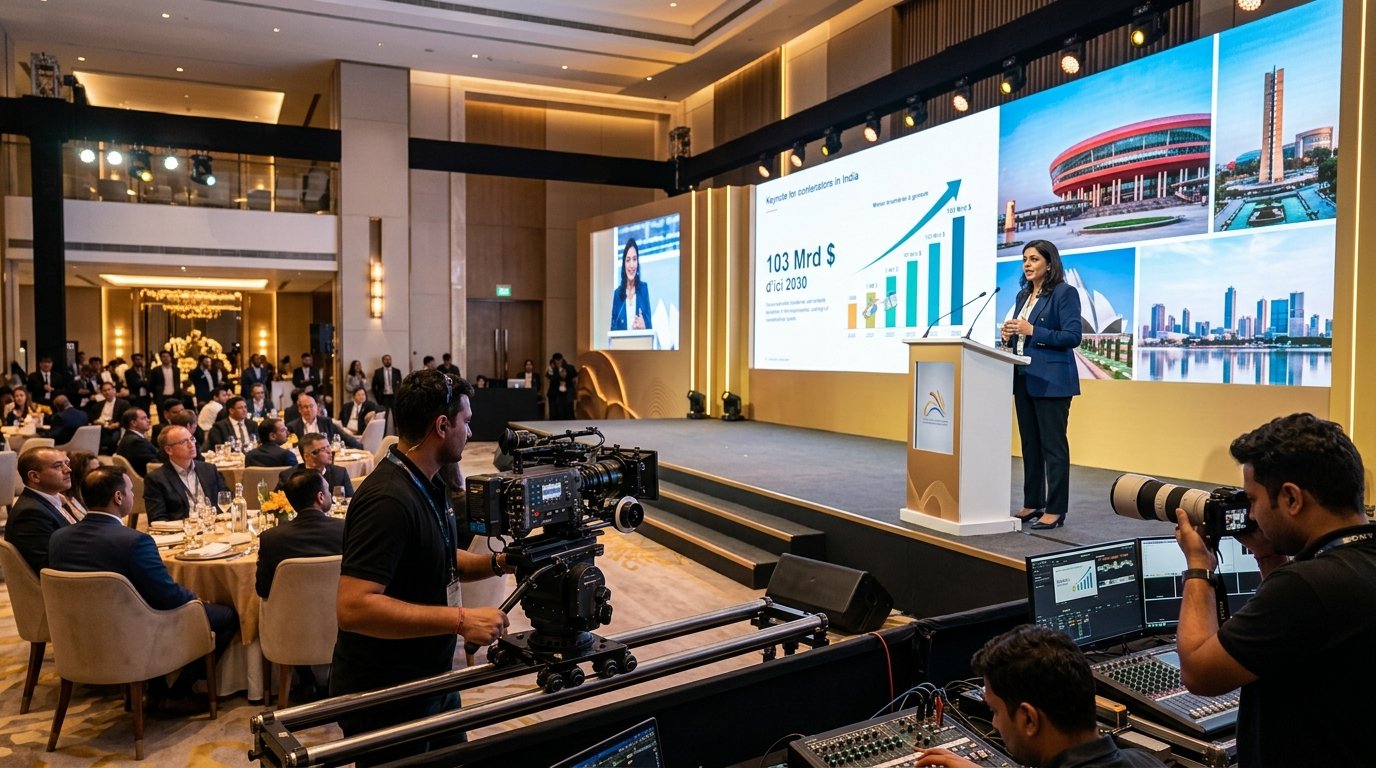
India's MICE Market: Reaching $103B by 2030
India is emerging as the new titan of the B2B event industry. Beyond massive infrastructure projects, the real challenge lies in capturing the essence of these events and meeting international production standards. Here is an analysis of a market in full transformation.
Why is India Becoming a Strategic Hub for the Global MICE Sector?
With a MICE (Meetings, Incentives, Conferences, and Exhibitions) market that generated $49.4 billion last year and is projected to reach $103.7 billion by 2030, India is no longer a secondary player. The Indian government, led by Tourism Minister Gajendra Singh Shekhawat, has identified this segment as a primary engine for economic growth, aiming to place the country in the global top 10 for MICE destinations. This ambition is rooted in the logistical and diplomatic success of last year's G20 summit, which served as an unprecedented technological and organizational showcase. Corporate decision-makers now view India as a crossroads where tech innovation, financial power, and sophisticated venues—such as Bharat Mandapam and the Yashobhoomi complex in Dwarka—converge.
The rise of cities like Varanasi, Khajuraho, and Kochi as 'MICE-ready' hubs demonstrates a clear strategy to decentralize events beyond traditional hubs like Delhi or Mumbai. For a CMO or VP of Events, India offers a price-to-quality ratio and a scale of deployment that is increasingly difficult to match in Europe or North America. The 'Meet in India' initiative, designed to promote the country as a global conference destination, highlights this push for professionalization. However, this exponential growth requires a deep dive into quality standardization. Organizing a summit in Kochi demands local expertise coupled with international production expectations. The Indian market is no longer just a cost-saving alternative; it is a strategic destination to capture emerging markets and tech talent.
The region's appeal also lies in its ability to offer immersive experiences that Western convention centers often struggle to replicate. Brands no longer come to India just for a hotel ballroom, but for venues that integrate cultural heritage with radical modernity. This duality creates a unique playground for brand storytelling. For Fortune 500 companies, India's MICE sector represents an opportunity to demonstrate commitment to a market that will soon house the world's largest middle class. Rapid investments in transport infrastructure, including airport expansions and high-speed rail, now provide access to regions once deemed too complex, opening the door for luxury incentives and large-scale product launches.
What are the Major Challenges for Hosting World-Class B2B Events in India?
Despite government optimism, the reality on the ground presents structural challenges that event organizers must anticipate with military-grade precision. The success of a MICE destination depends not just on the square footage of its centers, but on the entire logistical ecosystem and the reliability of vendors. Recent airport infrastructure incidents serve as a reminder that connectivity and security remain critical areas of vigilance. For global brands, logistical uncertainty is the primary barrier to investment. A 5,000-person event requires absolute fluidity, from delegate transport to the reliability of live-streaming networks, in a country where urban traffic can paralyze a poorly planned organization.
Another major challenge lies in managing expectations for Audiovisual (AV) services and technical management. While India possesses undeniable technical talent and increasingly modern equipment, high-end B2B event production requires specific rigor in terms of timing and finishing. It is not just about installing the latest LED screens; it is about designing a scenography that scrupulously respects international brand codes and HSE (Health, Safety, and Environment) standards. Coordinating multiple local vendors—often fragmented—can be complex without centralized supervision capable of speaking the language of international excellence. Organizers must navigate between brand-new infrastructure and persistent operational constraints, such as customs management for specialized equipment or complex local permits.
Sustainability is also becoming central. As ESG (Environmental, Social, and Governance) standards become mandatory for global corporations, India's MICE sector must accelerate its transition toward 'zero-waste' events. Energy management, the reduction of single-use plastics, and the carbon footprint of domestic travel are subjects on which organizers are increasingly audited. The choice of production partners becomes crucial: efficiency is no longer enough; responsibility is required. To guarantee the ROI of an international summit in India, the pre-production phase should be twice as long as in Europe to secure every link in the chain, from dedicated internet bandwidth to mass catering that meets the strictest hygiene standards.
How Visual Content Bridges the Gap Between Infrastructure and Brand Experience
This is where content strategy transforms a simple meeting into a powerful marketing asset. To turn a physical infrastructure into a desirable and credible destination, premium visual production is the most effective tool. A conference held in a new center in Varanasi only exists for the rest of the world through the quality of the images and videos it produces. Photo and video coverage should not be seen as an auxiliary expense, but as the strategic bridge connecting the physical event to its global audience. By producing cinematic-quality aftermovies and flawless streaming feeds, brands validate their choice of location and reinforce their authority in the market.
Visual content helps reassure future sponsors and participants who may still hold prejudices about India's capacity for high-stakes events. If the imagery shows world-class production—precise lighting, dynamic multi-camera capture, and polished scenography—doubts about infrastructure vanish. In this regard, looking at established regional benchmarks, such as /corporate-events-singapore, is essential for India. It is about documenting every success to build a long-term reputation for reliability. A well-executed content strategy allows every highlight of the summit to be repurposed for social media, PR, and annual reports for months, maximizing the initial investment.
Beyond simple capture, using immersive technologies like on-stage Augmented Reality (AR) or video mapping can compensate for certain architectural limits and create the 'wow' effect essential for product launches. Visual production must also include a narrative dimension: telling the story of the brand's footprint in India, showing interaction with the local ecosystem, and capturing the unique energy of these events. To explore what high-level visual coverage looks like, it is useful to consult /international-realizations that set the bar for color grading, editing, and pacing. The goal is simple: ensure that anyone watching the video regrets not being there.
What Lessons Can Event Organizers Learn from the G20 Summit?
The G20 summit was a major turning point, proving that India can handle extreme security, health, and logistical protocols under the global spotlight. The primary lesson for organizers is the vital importance of public-private collaboration. While the Indian government invests heavily in 'hardware' (the buildings), it is the agility and expertise of production and event management agencies that transform these spaces into memorable experiences. Organizers must now demand total service integration: space management, AV technology, cybersecurity, and real-time crisis management. The G20 proved that when local hospitality meets global technical standards, India is capable of competing with the world's most established business hubs.
FAQ
What is the projected size of India's MICE market by 2030?
The market is projected to reach approximately $103.7 billion, driven by government initiatives and new infrastructure.
Which cities are emerging as MICE hubs in India beyond Delhi and Mumbai?
Kochi, Varanasi, and Khajuraho are becoming key destinations for international B2B events.
What are the main logistical challenges for international organizers in India?
Key challenges include urban traffic management, vendor fragmentation, and ensuring international HSE and sustainability standards.
Questions Fréquentes
What is the projected size of India's MICE market by 2030?
The market is projected to reach approximately $103.7 billion, driven by government initiatives and new infrastructure.
Which cities are emerging as MICE hubs in India beyond Delhi and Mumbai?
Kochi, Varanasi, and Khajuraho are becoming key destinations for international B2B events.
What are the main logistical challenges for international organizers in India?
Key challenges include urban traffic management, vendor fragmentation, and ensuring international HSE and sustainability standards.