
Retail Media: Turning Physical Events into Ad Content Hubs
Retail Media: Turning Physical Events into Ad Content Hubs
The emergence of retail media leaders at giants like Home Depot marks a decisive turning point in the industry: retail spaces are no longer just points of transaction; they are becoming strategic broadcast platforms. This shift is radically transforming how brands must design their physical activations. Today, every square foot of commercial space is a potential advertising opportunity, and every event serves as the launchpad for an omnichannel campaign. For CMOs and marketing directors, the challenge is recognizing that the physical store has become the most powerful medium in the buyer's journey, offering a qualified, captive audience at the exact moment of decision-making. This convergence of retail and content production requires high-level technical expertise to capture the essence of the physical experience and translate it into high-performing digital assets.
How the Retail Media Boom is Redefining In-Store Event Experiences
The recent appointment of Christine Foster at Home Depot to lead Orange Apron Media isn't just an HR announcement; it is a signal of a profound industry mutation. Retail media is no longer confined to digital banners on e-commerce sites or sponsored search results. It is now claiming physical space, transforming every store and shopping mall into a powerful owned media channel. For marketing directors and event managers, this means every product launch and brand activation must be envisioned as a television production ready for broadcast across these new networks.
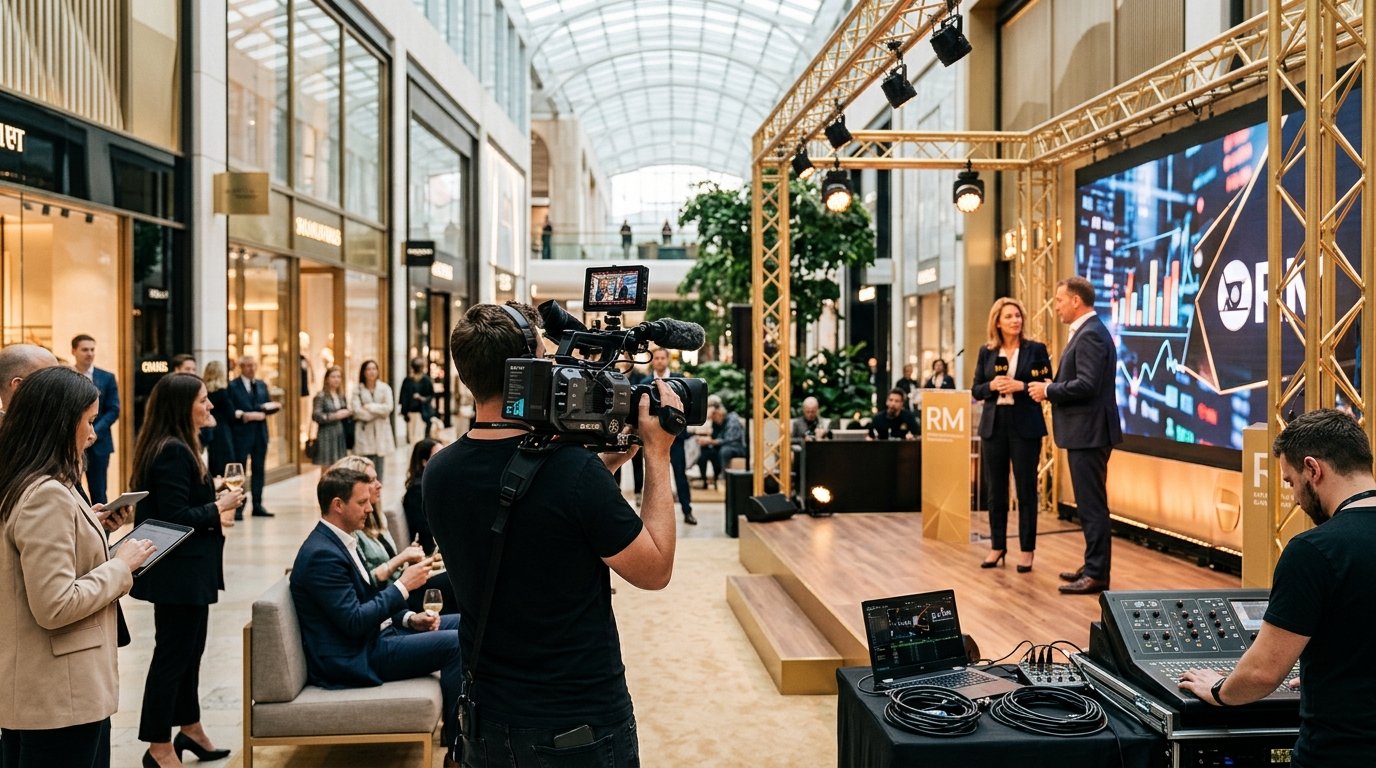
The goal is no longer just to attract the local shopper passing the booth, but to generate a high-quality content stream capable of fueling thousands of points of sale or giant screens across a national mall network. This approach turns the physical event into a 'content hub.' Imagine a live product demonstration in London or Paris: through retail media, this demo can be captured, edited in real-time, and broadcast across an entire network, multiplying the impact of the initial investment a thousandfold.
This convergence of commerce and media demands unprecedented production rigor. Brands can no longer settle for amateur atmosphere shots or smartphone videos. They must produce visual assets that meet broadcast standards. Looking at the latest Retail Media trends on BizBash, it’s clear that event scenography is becoming the natural backdrop for omnichannel ad campaigns. The success of a corporate event in a retail environment now depends on its ability to be documented with surgical precision to feed internal advertising algorithms.
Furthermore, the integration of first-party data is a game-changer. While the US leads in Retail Media Networks (RMNs), EU markets are rapidly adapting with GDPR-compliant strategies that leverage deep shopper insights. Events must now align with these audience segments. If an activation targets expert DIYers, the video content produced on-site must reflect that technical expertise. Physical retail media closes the loop between brand experience and immediate conversion, turning events into a measurable and scalable performance lever.
Why High-End Video Production is the Backbone of Mall Activations
In an environment saturated with visual stimuli like a shopping mall, mediocrity is invisible. The massive influx of advertising into 'Third Spaces'—those vital social environments between work and home, as defined by sociologist Ray Oldenburg—demands a cinematic aesthetic to capture a volatile and demanding audience. Video production must move beyond simple post-event recaps to become premium storytelling that rivals streaming platform content.
A successful brand activation in any global metropolis must be captured with clear editorial intent: transforming a physical experience into digital desire. This requires high-performance gear (full-frame sensors, cinema lenses), lighting management worthy of a film set, and dynamic editing tailored for both short-form social media (TikTok, Reels) and 4K giant screens in shopping centers.
The technical challenges in malls are significant: unflattering mixed lighting, complex acoustics with constant background noise, and unpredictable foot traffic. 'Haute couture' production anticipates these constraints. Using high-precision directional microphones and discrete but powerful auxiliary lighting creates an aesthetic bubble around the activation.
Companies investing in these spaces spend colossal budgets on floor space and logistics. Neglecting the quality of visual capture is a waste of capital. Video becomes the indispensable bridge between the ephemeral in-store experience and the longevity of the campaign on retail media platforms. It’s about creating assets that showcase not just the product, but the brand’s expertise in physical execution. The content must be 'DOOH' (Digital Out Of Home) ready, with such clarity that it catches the eye even without sound, while remaining rich enough for a VIP newsletter or an annual report.
Documenting B2B Events for Integration into Third Space Ad Networks
Integrating event content into retailer ad networks requires a specific technical and organizational approach. It’s not just about filming the event as a whole, but about producing modular, ready-to-use segments for different channels. Alesia RSVP acts as the strategic partner capable of transforming a complex activation into a library of assets immediately exploitable by marketing teams and ad networks.
This methodology relies on creating an on-site 'Content Factory.' Whether it’s expert interviews, detailed product demos, or real-time customer reactions (vox-pops), every sequence must be calibrated for the 'Retail Media' format. This involves respecting specific aspect ratios (vertical for mobile, horizontal for in-store screens) and precise durations (6, 15, or 30 seconds) tailored to retailer ad inventories.
This approach maximizes event ROI by extending its life long after the physical activation ends. By documenting every step with premium quality, the brand builds a visual heritage reusable for future campaigns. As noted in this discussion on the evolution of retail and events, while data is king, content is the indispensable vehicle for that data. Without strong imagery, the advertising message gets lost in the noise.
As a premium audiovisual production agency, we understand that image quality is the primary lever of credibility for a brand exposing itself in these new advertising spaces. One must think 'modular' from pre-production: planning B-roll shots, ensuring color grading consistent with brand guidelines, and preparing versions with and without subtitles for silent in-store playback. In conclusion, physical retail media is a historic opportunity for B2B events to prove their value as creators of high-performance content. Don’t let average visual execution limit the impact of your strategic investments in the shopping centers of tomorrow.
FAQ
What is physical Retail Media and how does it impact events?
Physical Retail Media refers to using retail spaces, aisles, and shopping malls as advertising platforms via digital screens (DOOH), audio systems, and live activations. For the event industry, this means in-store animations are no longer just local activities; they become sources of premium content designed to feed the distributor's digital broadcast networks, reaching a much wider audience than just the visitors on-site.
Why hire a premium photo/video agency for a mall activation?
Shopping malls present unique challenges such as poor lighting and complex acoustics. A premium agency uses cinema-grade equipment and specialized techniques to ensure the content meets broadcast standards, cutting through the visual noise and preserving the brand's prestige across all digital touchpoints.
Frequently Asked Questions
What is physical Retail Media and how does it impact events?
Physical Retail Media refers to using retail spaces, aisles, and shopping malls as advertising platforms via digital screens (DOOH), audio systems, and live activations. For the event industry, this means in-store animations are no longer just local activities; they become sources of premium content designed to feed the distributor's digital broadcast networks, reaching a much wider audience than just the visitors on-site.
Why hire a premium photo/video agency for a mall activation?
Shopping malls present unique challenges such as poor lighting and complex acoustics. A premium agency uses cinema-grade equipment and specialized techniques to ensure the content meets broadcast standards, cutting through the visual noise and preserving the brand's prestige across all digital touchpoints.