
Riyadh Event Freeze: Navigating Saudi Arabia Travel Risks
Riyadh Event Freeze: Navigating Saudi Arabia Travel Risks
As Riyadh's event season shifts to 2027 due to geopolitical instability and logistical bottlenecks, brands must rethink their regional strategy and visual presence in stable hubs like Dubai and London.
How is the Saudi Arabia travel freeze affecting the 2026-2027 event calendar?
When geopolitical instability freezes a major business hub, the corporate world doesn't stop—it pivots. The recent restriction of Riyadh’s airspace and the subsequent freeze on scheduled flights have sent shockwaves through the MICE (Meetings, Incentives, Conferences, and Exhibitions) industry. What was supposed to be a flagship year for the Kingdom’s 'Vision 2030' momentum has been abruptly pushed into 2027. For VP Events and Marketing Directors, this isn't just a scheduling conflict; it is a fundamental disruption of regional market entry strategies. According to recent reports, regional tensions and the resulting airspace closures have forced a total reassessment of Saudi Arabia’s reliability as a host. When attendees are forced to drive four hours to Dammam or seven hours to Bahrain just to catch a connecting flight, the 'premium' experience of a corporate summit evaporates. The friction of travel has become a deterrent that outweighs the potential of the Saudi market in the immediate term.
This freeze is not a temporary glitch. The travel industry is seeing a total pause on new bookings for large-scale delegations. Industry executives confirm that no new corporate travel is being initiated to the Kingdom for the upcoming fiscal quarters. This creates a massive vacuum in the 2026-2027 calendar. Large-scale summits that require months of technical lead time, complex AV setups, and international speaker coordination cannot operate under the shadow of indefinite airport closures. The risk profile has simply become too high for enterprise-level compliance departments to approve. Insurance premiums for events in the region have spiked, and 'Force Majeure' clauses are being triggered across the board. This shift is discussed extensively in recent LinkedIn discussion on Saudi corporate travel impact, where professionals are debating the long-term viability of the region's current event infrastructure and the logistical nightmare of rerouting thousands of delegates through secondary land borders.
For those who had already committed significant budgets to Riyadh, the focus now shifts to salvage and relocation. The 2027 timeline is a lifetime away in the fast-moving sectors of fintech, AI, and renewable energy. Brands that wait until the Kingdom reopens its skies will find themselves two years behind their competitors who choose to relocate their flagship gatherings to more stable environments. The narrative of Saudi Arabia as the 'new frontier' for business tourism is currently being tested by the hard reality of logistics and physical security. Furthermore, the delay in the launch of Riyadh Air and the congestion at King Khalid International Airport (RUH) have compounded the issue, making it nearly impossible to guarantee the seamless 'VIP' arrival experience that high-net-worth attendees expect. The 'Vision 2030' goals remain ambitious, but the operational reality of 2026 is one of caution and strategic withdrawal. Companies are now looking at their 24-month roadmaps and realizing that the 'Saudi stop' needs to be replaced with a more reliable anchor point in the Middle East or Europe to ensure that their annual growth targets are not held hostage by regional volatility.
What are the best alternative locations for Middle East corporate events?
As Riyadh recedes from the immediate calendar, the corporate gaze is turning back to proven hubs with established track records. The most obvious beneficiary is Dubai. With its world-class infrastructure and unshakeable logistics, Dubai remains the primary alternative for any brand that needs to maintain a Middle Eastern presence without the operational risk currently associated with Saudi Arabia. The city’s ability to absorb large-scale conference overflows is unmatched, offering a 'plug-and-play' environment for event planners who need to move a 2,000-person summit with only a few months' notice. When a summit in Riyadh is postponed, the first question a Marketing Director asks is whether the same dates are available at the Dubai World Trade Centre or the Madinat Jumeirah. The UAE's 'Open Skies' policy and the sheer density of flight connections via Emirates and FlyDubai provide the reliability that Saudi Arabia currently lacks.
However, the pivot isn't just regional. Many enterprise brands are looking at London or Singapore as safe-haven alternatives for their global summits. The decision to move an event is often driven by the need for 'guaranteed delivery.' In the high-stakes world of B2B conferences, a 90% chance of success is a failure. Decision-makers are looking for 100% certainty that their speakers can land, their AV equipment can be cleared through customs without delay, and their attendees can depart on schedule. This trend toward 'flight-to-quality' locations is highlighted in BizBash trends in global event planning, where the emphasis has shifted from 'novelty destinations' back to established corporate hubs that offer legal and logistical predictability. Abu Dhabi is also emerging as a strong contender, with its quieter but equally sophisticated ADNEC facilities providing a more exclusive feel for C-suite retreats that might have previously been slated for AlUla or Diriyah.
Choosing an alternative location requires more than just booking a hotel ballroom; it requires a partner who understands the local production nuances and the technical requirements of a high-end broadcast. Whether it is navigating the specific permit requirements in the UAE or the technical broadcast standards in the UK, the relocation of a major event is a complex AV and management feat. At Alesia RSVP, we have seen this shift firsthand. Our clients are no longer asking 'where is the newest venue?' but rather 'where can we guarantee a flawless execution?' This shift back to stability is a direct reaction to the volatility seen in the Riyadh corridor. Relocating to a hub like London or Dubai also allows brands to tap into a more diverse local talent pool for technical support, live translation, and event management, reducing the cost of flying in entire crews from abroad. The focus has moved from the 'prestige of the new' to the 'prestige of the professional,' where the success of the event is measured by its seamless execution rather than its zip code.
How can brands maintain visual storytelling and ROI when major events are postponed?
The postponement of an event to 2027 doesn't mean your brand's story should go dark for two years. In fact, the absence of a physical gathering makes high-quality digital content even more vital. If you cannot bring your audience to Riyadh, you must bring the expertise of your executives to the audience through other means. This is where professional AV production becomes a strategic asset rather than a line-item expense. High-end video production and on-site podcasting at alternative locations allow brands to maintain their thought leadership momentum even when their primary event location is compromised. The goal is to create a 'digital twin' of the event experience—one that delivers the same level of insight and networking value through a screen as it would in a ballroom.
Visual storytelling is the bridge that connects a postponed event to a future success. By capturing high-quality editorial photography and cinematic video at smaller, more frequent regional gatherings in cities like Dubai, Paris, or London, brands can build a content library that sustains their marketing efforts throughout the hiatus. The ROI of an event is increasingly measured by the 'long tail' of the content produced. If a summit is moved from a 5,000-person hall in Riyadh to a 500-person executive retreat in London, the quality of the broadcast and the aftermovie must be even higher to compensate for the smaller physical footprint. This 'quality over quantity' approach ensures that the brand's authority remains intact. A well-produced 4K live stream or a series of high-impact executive interviews can reach a global audience of tens of thousands, far exceeding the reach of the original physical event.
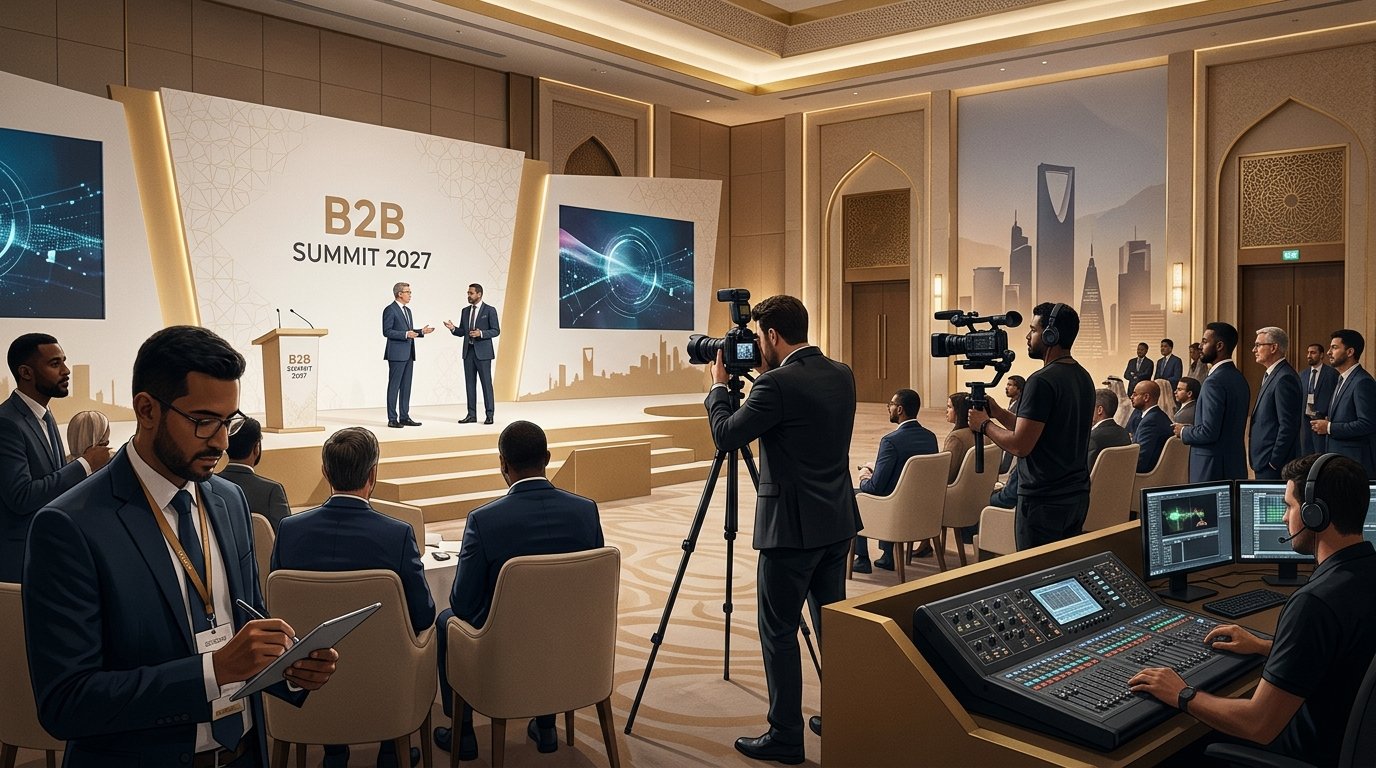
At Alesia RSVP, we specialize in documenting these high-stakes transitions. We understand that when a location pivots, the brand's visual identity must remain consistent. Whether we are providing multi-camera live streaming for a hybrid town hall or magazine-quality photography for a private C-suite summit, our goal is to ensure that the disruption in travel does not lead to a disruption in brand authority. As Saudi Arabia faces these logistical challenges, we help premium brands maintain their momentum by capturing their flagship gatherings in stable, world-class hubs. This involves more than just pointing a camera; it involves understanding the narrative of the brand and ensuring that every frame reflects the company's stature. The brands that will win in 2027 are those that didn't stop talking in 2026. They are the ones who invested in high-fidelity content, maintained their presence through digital channels, and used the 'freeze' as an opportunity to refine their message and reach their audience in more targeted, visually compelling ways. The event may move, but the impact of the content must remain absolute.
FAQ
Are corporate events in Saudi Arabia being cancelled or postponed?
Most major corporate events in Riyadh are being postponed to 2027 due to ongoing airport restrictions, airspace closures, and regional instability. Brands are currently freezing new travel plans to the Kingdom as airlines suspend flights, leading to a strategic shift toward more stable regional hubs like Dubai and Abu Dhabi to ensure event continuity.
Where is business tourism being redirected in the Gulf region?
Business tourism and large-scale B2B conferences are primarily being redirected to Dubai and Abu Dhabi. These cities offer the necessary infrastructure, safety protocols, and global flight connectivity that are currently restricted in Saudi Arabia. Additionally, European hubs like London and Paris are seeing an uptick in Middle East-focused corporate gatherings.
How does the Riyadh travel freeze impact event insurance and compliance?
The travel freeze has led to a significant increase in insurance premiums for events in Saudi Arabia, with many providers excluding coverage for geopolitical risks. Corporate compliance departments are often refusing to approve travel to the region, forcing organizers to relocate events to 'low-risk' jurisdictions to meet duty-of-care obligations for their employees and speakers.
What are the technical challenges of relocating a large-scale event from Saudi Arabia?
Relocating an event requires managing complex logistics, including the transfer of specialized AV equipment, securing new local permits, and finding available technical crews. Established hubs like Dubai offer more 'plug-and-play' technical infrastructure, which simplifies the transition compared to the emerging but currently restricted infrastructure in Riyadh.
How can brands maintain their presence in the Saudi market during the freeze?
Brands can maintain their presence by hosting smaller, high-impact hybrid events in nearby stable cities and using professional video production to broadcast content specifically to their Saudi stakeholders. Investing in high-quality digital storytelling and executive interviews ensures the brand remains top-of-mind until the physical event market in the Kingdom stabilizes in 2027.
Frequently Asked Questions
Are corporate events in Saudi Arabia being cancelled or postponed?
Most major corporate events in Riyadh are being postponed to 2027 due to ongoing airport restrictions, airspace closures, and regional instability. Brands are currently freezing new travel plans to the Kingdom as airlines suspend flights, leading to a strategic shift toward more stable regional hubs like Dubai and Abu Dhabi to ensure event continuity.
Where is business tourism being redirected in the Gulf region?
Business tourism and large-scale B2B conferences are primarily being redirected to Dubai and Abu Dhabi. These cities offer the necessary infrastructure, safety protocols, and global flight connectivity that are currently restricted in Saudi Arabia. Additionally, European hubs like London and Paris are seeing an uptick in Middle East-focused corporate gatherings.
How does the Riyadh travel freeze impact event insurance and compliance?
The travel freeze has led to a significant increase in insurance premiums for events in Saudi Arabia, with many providers excluding coverage for geopolitical risks. Corporate compliance departments are often refusing to approve travel to the region, forcing organizers to relocate events to 'low-risk' jurisdictions to meet duty-of-care obligations for their employees and speakers.
What are the technical challenges of relocating a large-scale event from Saudi Arabia?
Relocating an event requires managing complex logistics, including the transfer of specialized AV equipment, securing new local permits, and finding available technical crews. Established hubs like Dubai offer more 'plug-and-play' technical infrastructure, which simplifies the transition compared to the emerging but currently restricted infrastructure in Riyadh.
How can brands maintain their presence in the Saudi market during the freeze?
Brands can maintain their presence by hosting smaller, high-impact hybrid events in nearby stable cities and using professional video production to broadcast content specifically to their Saudi stakeholders. Investing in high-quality digital storytelling and executive interviews ensures the brand remains top-of-mind until the physical event market in the Kingdom stabilizes in 2027.