
Post-Quantum Security: AI Redefines Blockchain & Tech Summits
Post-Quantum Security: AI Redefines Blockchain & Tech Summits
AI has broken a post-quantum algorithm in record time, radically changing the landscape for future global Web3 events and institutional trust.
How Is AI Truly Threatening Post-Quantum Blockchain Security?
The recent announcement regarding Anthropic’s analytical capabilities has sent shockwaves far beyond the quiet hallways of cryptography research labs. Their model, Claude Mythos Preview, achieved the unthinkable: identifying a major structural flaw in the HAWK digital signature scheme. This protocol, based on lattice-based cryptography, was previously considered one of the most promising bastions against the brute force of future quantum computers. What was supposed to withstand decades of hacking attempts was compromised in just 60 hours, at a negligible computational cost of approximately $100,000. For CTOs, protocol researchers, and security leads attending elite international circles, this is no longer a theoretical demonstration; it is an immediate operational crisis that challenges the entire industry's roadmap.
The AI-driven attack reduced the algorithm's theoretical resistance from 2^64 to 2^38 operations. In cryptographer speak, this isn't just a crack; it's a structural collapse. This drastic reduction renders HAWK’s shorter keys obsolete before they could even be deployed at scale on mainnets. This vulnerability highlights a cruel technical paradox: while we build decentralized infrastructures meant to guarantee immutability for decades, AI is advancing at an exponential rate that makes traditional human peer-review cycles dangerously slow. HAWK had undergone two years of intensive review without such a flaw being detected. The AI didn't just calculate faster; it 'understood' a geometric weakness in the lattice structure that human experts had overlooked.
This accelerated threat is forcing Web3 firms to completely rethink their technical debt management. Since trust is the fundamental currency of blockchain, the fragility of mathematical foundations could stall institutional adoption if a coordinated response isn't mounted. Central banks and hedge funds, already navigating complex regulatory frameworks like GDPR or MiCA, are now demanding audits that include generative AI stress tests. The arms race between protocol developers (like those for Bitcoin or Ethereum) and the offensive capabilities of Large Language Models (LLMs) is officially on. The ripples of this breach will be felt far beyond crypto, potentially impacting every digital signature system used in global finance. Security trends analysis in the event industry on BizBash.
The risk is structural. If protocols protecting billions in assets can be weakened by commercially available AI, the entire Decentralized Finance (DeFi) stack must be audited through a new lens. B2B decision-makers must now integrate 'accelerated algorithmic risk' into their strategy. It’s no longer about whether quantum computing arrives in ten years; it’s about how AI makes classical attacks infinitely more sophisticated today. This new reality demands constant vigilance and a level of technological agility that few current projects possess.
Why Summits Like EthCC and Consensus Have Become Cryptography’s War Rooms
As threats become more ethereal and digital certainties more volatile, physical events like /ethcc in Paris or /consensus in Austin are emerging as vital anchors for the industry. These gatherings are no longer just networking platforms or marketing showcases; they are transforming into genuine crisis and decision centers. This is where tomorrow’s hard forks are negotiated and migrations to more resilient cryptographic standards are decided. At upcoming editions, agendas won't be driven by retail adoption curves, but by the raw technical survival of networks facing the AI-Quantum hybrid threat. The era of promotional fluff is over, replaced by real-time collaborative defense engineering.
Global summits act as catalysts for normalizing these new protection technologies. It is in the hallways, away from the main stages, that strategic alliances are forged between core developers and infrastructure providers. The visibility of these technical debates is crucial for reassuring institutional investors who are closely monitoring the ecosystem's reaction speed. A strong presence at these events allows foundations and protocols to demonstrate their resilience. It’s about proving that despite AI-discovered flaws, the community has the agility to patch vulnerabilities before malicious actors exploit them. LinkedIn discussion on AI and Quantum impact.
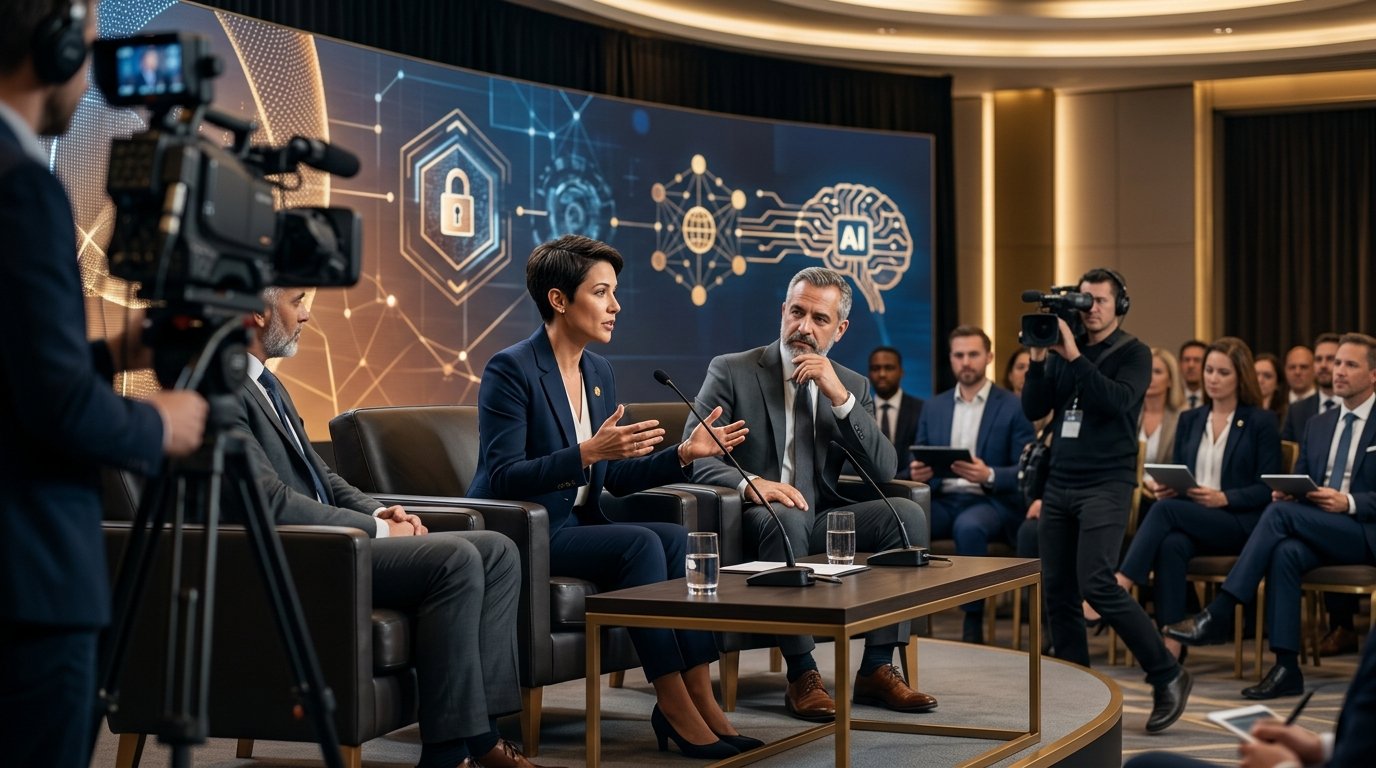
As specialized observers of these high-level gatherings, we are noticing a radical shift in atmosphere. The speculative hype of previous years has given way to a studious gravity. Capturing these 'moments of truth' through rigorous visual and editorial documentation has become an indispensable strategic communication tool. For a Web3 brand, showing its engineers in deep discussion with the world's top cryptographers on a technical panel is now the most effective way to validate credibility. Imagery no longer just illustrates commercial success; it documents technical expertise in the face of algorithmic uncertainty. Content produced at these events must reflect this depth: less glitter, more mathematical substance, and long-term vision.
This transition toward 'war room' events reinforces the importance of logistics and content production. When critical decisions are made in just a few days during a summit, the ability to disseminate that information accurately and professionally becomes a security issue in itself. The players who dominate these physical spaces also dominate the technological narrative. Human coordination, facilitated by physical proximity, remains the only effective barrier against the execution speed of offensive AI. This is where the longevity of decentralized networks is decided: in the ability of humans to align faster than machines can crack their secrets.
The Impact of Algorithmic Vulnerability on Investor Confidence at B2B Events
Trust is the most valuable and volatile asset in the tech sector. When an AI can weaken years of fundamental research in less than a week, investors and corporate partners no longer settle for whitepaper promises. They demand tangible guarantees, physical presence, and total transparency. In an age where digital authenticity is challenged by AI manipulation, direct human interaction at corporate events becomes the new pillar of B2B trust. We are no longer just betting on the robustness of source code, but on the strength of a team, the clarity of a vision, and the responsiveness of an organization to the unforeseen.
Audiovisual production and media coverage of these events must now reflect this demand for seriousness and technical mastery. Alesia RSVP operates precisely at this strategic intersection. By providing prestige coverage for these critical summits, we help tech leaders project an image of stability and competence. Whether through capturing high-level technical debates or producing interviews with executives capable of explaining the stakes of post-quantum security, our role is to translate raw expertise into a powerful and reassuring brand narrative. The clarity of the message and the quality of the physical presentation are now essential components of a project's market resilience.
FAQ
What is the HAWK algorithm and why does its vulnerability matter?
HAWK is a lattice-based digital signature scheme intended for post-quantum security. Its vulnerability to AI analysis suggests that even 'quantum-secure' math may be susceptible to advanced AI-driven cryptanalysis today.
How are B2B tech events changing in response to AI threats?
Events like EthCC and Consensus are shifting from marketing-heavy schedules to 'war room' environments where developers and stakeholders coordinate immediate technical defenses and protocol migrations.
Why is physical presence at summits important for Web3 trust?
As digital assets become more vulnerable to automated attacks, the human element—transparency, direct communication, and collaborative engineering—becomes the primary way to maintain institutional investor confidence.
Frequently Asked Questions
What is the HAWK algorithm and why does its vulnerability matter?
HAWK is a lattice-based digital signature scheme intended for post-quantum security. Its vulnerability to AI analysis suggests that even 'quantum-secure' math may be susceptible to advanced AI-driven cryptanalysis today.
How are B2B tech events changing in response to AI threats?
Events like EthCC and Consensus are shifting from marketing-heavy schedules to 'war room' environments where developers and stakeholders coordinate immediate technical defenses and protocol migrations.
Why is physical presence at summits important for Web3 trust?
As digital assets become more vulnerable to automated attacks, the human element—transparency, direct communication, and collaborative engineering—becomes the primary way to maintain institutional investor confidence.