
Solana Alpenglow: The Speed Revolution for Web3 Events
Solana Alpenglow: The Speed Revolution for Web3 Events
Solana’s Alpenglow upgrade aims to slash settlement times to 150ms, transforming how high-stakes corporate events handle ticketing and activations. This technical shift moves blockchain from a background process to an invisible, real-time infrastructure capable of supporting the world's most demanding professional gatherings.
How will Solana’s 150ms settlement impact the attendee experience at major tech conferences?
What if your event transactions were as fast as a camera shutter? Solana's Alpenglow upgrade is bringing 150-millisecond finality, promising a future where Web3 event experiences are truly instantaneous. For the corporate event professional, the current 12.8-second wait for transaction finality is a relic of an era that the modern summit has outgrown. In a high-pressure environment like EthCC or Consensus, a twelve-second delay at a registration kiosk or a VIP lounge entry point isn't just a technical metric; it is a bottleneck that degrades the premium feel of the brand. Alpenglow, currently active on the devnet and testnet, fundamentally changes how validators reach agreement. By removing validator votes from blocks, the network streamlines the path to finality. This shift is not merely about technical efficiency; it is about psychological flow. When an attendee taps a wallet to access a restricted session, the response must be as immediate as a physical key in a lock.
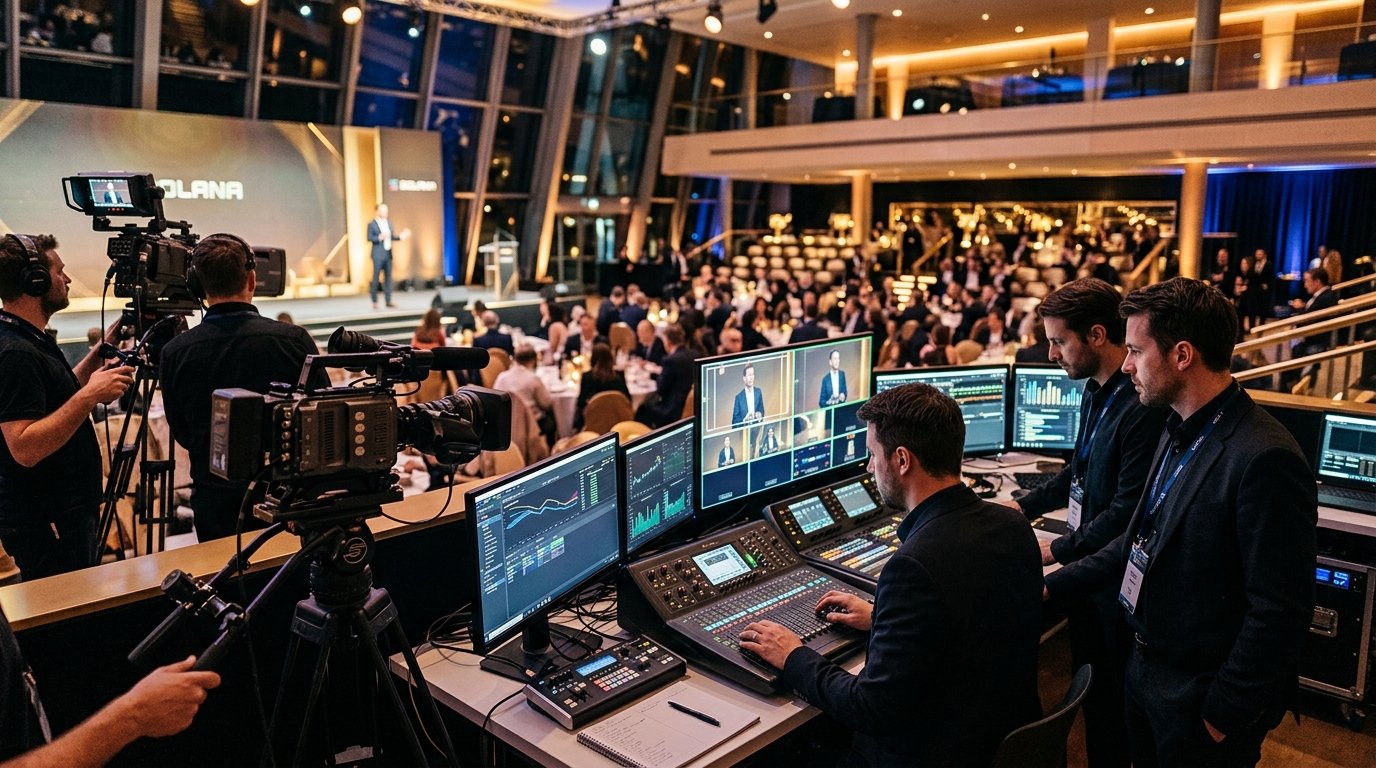
Industry veterans know that friction is the enemy of engagement. If a transaction takes more than a second, the attendee's attention drifts to their phone or their surroundings. At a scale of 5,000 to 10,000 attendees, these micro-delays aggregate into significant logistical hurdles. This Industry discussion on Solana's impact highlights that the move toward sub-second settlement is the baseline requirement for the next generation of event tech. For production houses like Alesia RSVP, this speed allows us to document seamless interactions rather than capturing shots of attendees staring at loading screens. We are moving toward an era where the blockchain backend is truly invisible, which is the ultimate goal of any sophisticated event technology implementation. The technical reality of Alpenglow means that as application teams stress-test these new protocols, the potential for 'instant' digital collectibles and real-time governance voting during keynotes becomes a viable strategy for corporate marketers.
Beyond the immediate gates, Alpenglow addresses the 'confirmation anxiety' often felt by users of decentralized applications. In a professional setting, certainty is the primary currency. When a validator confirms a block in 150ms, the 'irreversible' state of the transaction is reached before the user can even register a delay. This allows for complex, multi-layered activations. Imagine a scenario where an attendee scans a QR code at a booth, and a smart contract instantly triggers a physical dispenser while simultaneously updating a global leaderboard and minting a commemorative NFT. On legacy systems, this sequence would be disjointed and awkward. With Alpenglow, the physical and digital actions are perfectly synchronized. This level of responsiveness is what separates a gimmick from a professional-grade tool. For the technical directors of major summits, this upgrade reduces the overhead required for 'optimistic UI'—the practice of pretending a transaction is finished before it actually is. With Alpenglow, the UI doesn't need to lie; the network is finally as fast as the interface.
Why is near-instant transaction finality essential for high-end NFT ticketing and event commerce?
The luxury B2B event market operates on a standard of zero-friction. High-net-worth attendees and C-suite executives do not tolerate 'pending' states. When implementing NFT-gated experiences or on-site commerce, the speed of the underlying chain dictates the perceived quality of the event. Solana's move to 150ms finality aligns blockchain performance with the expectations of the traditional fintech world. Consider the implications for sponsor activations. A brand hosting a high-end activation at a major tech summit wants every touchpoint to feel premium. If an attendee wins a digital asset or purchases exclusive merchandise, the handover should be immediate.
According to Latest event technology trends on BizBash, the integration of real-time digital assets is a primary growth driver for event ROI. When the settlement is instantaneous, the digital asset becomes a tangible part of the physical experience. Alesia RSVP has observed that the most successful Web3 integrations are those that don't feel like 'Web3'—they feel like magic. Speed is the primary ingredient of that magic. As the visual storytellers for the world's most prestigious Web3 summits, Alesia RSVP sees Solana's speed upgrade as a pivotal shift for the frictionless, premium attendee experiences we document—from instant NFT-gated VIP access to real-time digital memorabilia. We aren't just filming an event; we are documenting the integration of high-speed technology into corporate culture. The Alpenglow upgrade ensures that the digital trail of an event is as fast and dynamic as the event itself. This is not a marginal improvement; it is the difference between a clunky experiment and a professional-grade corporate tool.
Furthermore, the security benefits of 150ms finality cannot be overstated for high-value event commerce. In a 'pop-up' economy like a three-day summit, the window for fraud is small but significant. Fast finality prevents double-spending attacks and ensures that when a vendor provides a luxury item in exchange for a stablecoin payment on Solana, the funds are settled before the customer leaves the booth. This reliability encourages more high-end vendors to participate in the on-chain economy of the event. It also enables 'atomic' event experiences where a single transaction can handle multiple outcomes—such as paying for a session, receiving a digital badge, and unlocking a private networking channel—all in one sub-second interaction. This level of efficiency is what allows event organizers to scale their digital offerings without scaling their support staff. When the technology works this fast and this reliably, the need for 'troubleshooting booths' disappears, allowing the focus to remain on the content and the networking.
How can event organizers in global hubs like Dubai and Singapore leverage Alpenglow for seamless activations?
Global business hubs like Dubai and Singapore have positioned themselves as the frontrunners for blockchain-enabled corporate events. These cities provide the infrastructure and the regulatory clarity that attract the world's largest summits. In these environments, the expectation for technical excellence is absolute. By utilizing Solana’s Alpenglow upgrade, organizers can deploy complex multi-step activations that were previously impossible due to latency. For instance, a multi-stage scavenger hunt across a massive venue like the Dubai World Trade Centre becomes viable when each checkpoint can verify progress in 150 milliseconds.
Alesia RSVP operates as a premium partner in these Tier 1 cities, providing both the event management expertise and the high-end AV production required to match such technical sophistication. When the tech moves this fast, your production partner must move faster. We provide same-day editorial coverage that mirrors the speed of the network. If your event uses Alpenglow to settle 1,000 transactions a second, our team is there to ensure that the visual narrative of that success is distributed across your social channels before the day is over. This cohesion between high-speed blockchain infrastructure and high-speed content production is the new standard for B2B event marketing. Organizers should look at Alpenglow not just as a network upgrade, but as an opportunity to rethink the entire attendee journey. From the moment of arrival in Singapore to the final gala in London, the goal is a unified, instantaneous digital and physical experience.
As Solana moves closer to a mainnet launch of these features, the window for planning 2026 activations is opening now. Forward-thinking VPs of Events will see this as the moment to transition away from legacy systems and toward a stack that can actually keep up with the pace of global business. In cities like Dubai, where 'smart city' initiatives are already integrated into the venue experience, Alpenglow acts as the connective tissue between the city's digital identity and the event's private ecosystem. This allows for seamless transitions from airport transit to hotel check-in to event entry, all powered by a single, high-speed ledger. The logistical implications for large-scale summits are profound. By reducing the time spent on verification, organizers can increase the time spent on high-value networking. This is the ultimate promise of Alpenglow: it removes the digital noise so that the human connection can take center stage. For Alesia RSVP, documenting these moments of frictionless connection is our core mission. We are ready to capture the speed of 2026, where the technology is so fast it becomes invisible, leaving behind only the impact of the experience itself.
FAQ
What is the Solana Alpenglow upgrade and how does it affect event tech?
Alpenglow is a core software upgrade for the Solana network designed to reduce transaction finality from approximately 12.8 seconds to 150 milliseconds. In the context of event technology, this allows for instantaneous NFT ticketing, real-time access control, and frictionless on-site payments that match the speed of traditional credit card processors.
How does transaction speed improve the ROI of B2B networking events?
Faster transaction speeds increase the throughput of on-site activations and reduce physical bottlenecks at registration and VIP entry points. This leads to higher attendee satisfaction, better data accuracy for sponsors, and a more professional brand image, all of which directly contribute to the measurable ROI of high-stakes corporate summits.
Will Alpenglow be ready for major 2026 tech summits?
Alpenglow is currently undergoing rigorous testing on Solana's devnet and testnet. While a specific mainnet launch date is subject to validator consensus, the roadmap indicates that the protocol will be stable and ready for large-scale production environments by the 2026 event cycle. Organizers should begin architecting their digital stacks now to leverage these speeds.
Does 150ms finality require specialized hardware for event organizers?
No, the upgrade is implemented at the protocol level. Event organizers and application developers simply need to update their integration libraries to support the new finality standards. Attendees will experience the benefits through their existing mobile wallets and web-based event apps without needing new hardware.
How does Alpenglow compare to Ethereum Layer 2 solutions for events?
While many Ethereum L2s offer low fees, they often suffer from sequencer latency or bridging complexities that can reach several seconds. Solana’s Alpenglow provides 'L1 finality,' meaning the entire network reaches an irreversible state in 150ms without the need for secondary layers, providing a more robust and unified experience for high-traffic physical events.
Frequently Asked Questions
What is the Solana Alpenglow upgrade and how does it affect event tech?
Alpenglow is a core software upgrade for the Solana network designed to reduce transaction finality from approximately 12.8 seconds to 150 milliseconds. In the context of event technology, this allows for instantaneous NFT ticketing, real-time access control, and frictionless on-site payments that match the speed of traditional credit card processors.
How does transaction speed improve the ROI of B2B networking events?
Faster transaction speeds increase the throughput of on-site activations and reduce physical bottlenecks at registration and VIP entry points. This leads to higher attendee satisfaction, better data accuracy for sponsors, and a more professional brand image, all of which directly contribute to the measurable ROI of high-stakes corporate summits.
Will Alpenglow be ready for major 2026 tech summits?
Alpenglow is currently undergoing rigorous testing on Solana's devnet and testnet. While a specific mainnet launch date is subject to validator consensus, the roadmap indicates that the protocol will be stable and ready for large-scale production environments by the 2026 event cycle. Organizers should begin architecting their digital stacks now to leverage these speeds.
Does 150ms finality require specialized hardware for event organizers?
No, the upgrade is implemented at the protocol level. Event organizers and application developers simply need to update their integration libraries to support the new finality standards. Attendees will experience the benefits through their existing mobile wallets and web-based event apps without needing new hardware.
How does Alpenglow compare to Ethereum Layer 2 solutions for events?
While many Ethereum L2s offer low fees, they often suffer from sequencer latency or bridging complexities that can reach several seconds. Solana’s Alpenglow provides 'L1 finality,' meaning the entire network reaches an irreversible state in 150ms without the need for secondary layers, providing a more robust and unified experience for high-traffic physical events.