
Tokenized Stocks & the 1960s Paper Crisis: Event Insights
Tokenized Stocks & the 1960s Paper Crisis: Event Insights
The financial industry stands at a crossroads where the ghosts of the 1960s 'paper crisis' meet the cutting-edge potential of Real World Asset (RWA) tokenization. As Fairmint’s CEO recently warned, the move toward digital stocks risks repeating historical failures if infrastructure and interoperability are not prioritized. In this high-stakes environment, the way these technical debates are presented to the world is as critical as the code itself. For the institutional sector, visual authority is the primary signal of operational maturity.
How does the 1960s 'paper crisis' relate to modern stock tokenization?
The warning issued by Fairmint’s CEO regarding a modern 'paper crisis' in the tokenized stock market is a sobering reminder that technology alone does not solve systemic friction. To understand the gravity of this comparison, one must look back at the late 1960s, a period known as the 'Paperwork Crunch.' During this time, the New York Stock Exchange was nearly paralyzed by its own success. Trading volumes surged from 5 million to 12 million shares a day, a level that the manual, paper-based processing systems of the era simply could not handle. Stock certificates were physically moved by a literal army of messengers; as the volume grew, the physical movement of these papers became impossible. This led to shortened trading weeks, mandatory Wednesday closures to catch up on backlogs, and eventually, the collapse of several brokerage firms. It was a systemic failure of infrastructure that forced the industry to move toward the centralized, book-entry system we use today via Cede & Co.
Today, as we transition toward Real World Asset (RWA) tokenization, the 'paper' has become digital code, but the underlying risk of fragmented infrastructure and lack of interoperability remains identical. If the industry fails to standardize how these digital assets move between different ledgers and blockchains, we are simply digitizing a bottleneck rather than eliminating it. We risk creating a series of 'digital silos' where assets are trapped on specific platforms, requiring complex, manual-adjacent processes to bridge them to other ecosystems. For corporate event professionals and marketing directors in the fintech space, this historical parallel is more than a technical trivia point. It represents the central tension in current B2B financial marketing: the gap between the promise of instant, T+0 settlement and the reality of legacy institutional requirements and fragmented tech stacks.
When leaders gather at events like the Digital Asset Summit, the primary goal is often to bridge this gap. The discourse is no longer about the novelty of blockchain or the speculative nature of crypto; it is about the grueling, necessary work of building industrial-grade infrastructure that can withstand the rigors of global finance. This shift in narrative requires a parallel shift in how these events are documented and broadcast to the wider financial community. Institutional trust is not built on whitepapers alone; it is built on the visible consensus of industry leaders. As the Fairmint CEO suggests, the risk of a repeat crisis is real if we do not address the 'plumbing' of the tokenized economy. Documenting these high-stakes technical debates requires a level of precision that mirrors the technology itself. Grainy livestreams or amateur photography do not signal the stability that institutional investors require when discussing the future of global stock markets. The visual record of these events serves as a primary source for LPs, GPs, and regulators who are watching for signs of maturity in the RWA sector. They are looking for evidence that the 'digital paper' of today will not lead to the same operational paralysis that nearly destroyed Wall Street fifty years ago.
Why is high-end visual storytelling essential for building trust in RWA infrastructure?
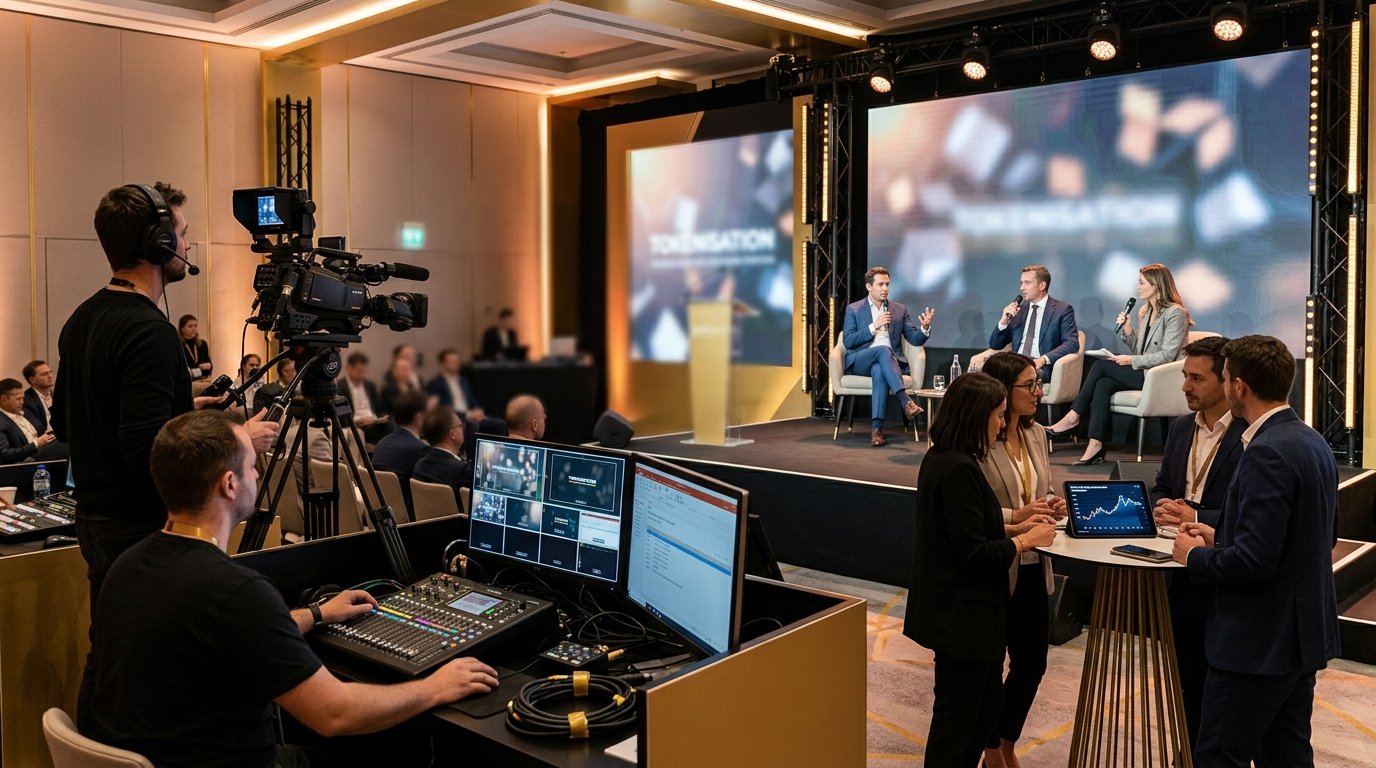
In the high-stakes world of institutional finance, optics are a proxy for operational excellence. When a fintech brand or a consortium of banks discusses the risks of a 'paper crisis' at a major summit, the quality of the content produced from that event becomes a deliverable in its own right. High-end visual storytelling—comprising editorial-grade photography and multi-camera broadcast video—serves to validate the gravity of the discussion. It transforms a technical panel into a moment of industry leadership. This is particularly vital when addressing complex topics like tokenized stock settlement, where the audience includes skeptical C-suite executives, conservative regulatory bodies, and high-net-worth investors who are accustomed to the polished standards of traditional finance.
Alesia RSVP understands that capturing these dialogues is about more than just 'coverage.' It is about executive storytelling. When a CEO addresses infrastructure risks, the visual output must capture the intensity and authority of the moment. This is why we prioritize magazine-quality editorial photography and same-day delivery for highlight reels. In the fast-moving fintech space, a delay in content delivery is a lost opportunity to lead the conversation. If a major announcement regarding interoperability standards is made at 10:00 AM, the professional visual assets should be ready for distribution by 2:00 PM to dominate the news cycle. By providing immediate, professional visual assets, brands can dominate the post-event narrative on platforms like LinkedIn and specialized financial news outlets, ensuring that their perspective on the 'paper crisis' is the one that sticks.
Furthermore, the move toward RWA tokenization is inherently a move toward transparency. Professional event production mirrors this value. A high-definition, multi-angle broadcast of a keynote at Consensus provides a transparent, immutable record of what was promised and what was debated. This level of production quality signals that the organization is not just a startup experimenting with code, but a serious financial player capable of managing the complexities of global markets. We have seen in recent LinkedIn discussions on Tokenized Stocks and the Paper Crisis that the ability to present these arguments clearly and professionally is what separates industry leaders from the noise. When the subject matter is as dry as settlement layers and ledger interoperability, the visual presentation must provide the engagement and prestige that the topic deserves. It is about creating an environment where the viewer, whether in the room or watching remotely, feels the weight of the institutional shift occurring.
What role do major FinTech summits play in solving the tokenization bottleneck?
Major summits act as the physical clearinghouses for the tokenized economy. They are the only venues where regulators, traditional finance (TradFi) executives, and Web3 innovators occupy the same space to hammer out the standards that will prevent a modern 'paper crisis.' These events are the frontline of industry evolution. The networking that happens in the corridors of the Digital Asset Summit or the main stages of Consensus is where the interoperability protocols of the next decade are often born. For an event to be successful in this context, it must function as a high-performance environment for both networking and content creation. It is not enough to simply host a talk; the event must facilitate the 'intellectual property' generation that happens when two disparate sectors of finance collide.
From an event management perspective, the focus must be on facilitating these high-level interactions while simultaneously capturing the intellectual property generated. The 'bottleneck' in tokenization is often a lack of shared understanding between different stakeholders. Professional event coverage solves this by distilling complex multi-day summits into digestible, high-impact content. Whether it is an on-site podcast studio interviewing the Fairmint CEO or a documentary-style recap of a closed-door roundtable, the goal is to extend the life of the event far beyond the closing keynote. This aligns with broader BizBash trends in financial event reporting, which emphasize the shift from passive attendance to active content generation. The event is no longer a static moment in time; it is a content engine that fuels the brand's authority for months.
Alesia RSVP captures these high-stakes dialogues with premium precision, ensuring that the transformative moments where infrastructure risks are addressed are documented to build long-term brand authority. We don't just record events; we manage the visual identity of the brand on-site, ensuring that every frame reflects the premium nature of the institution. This involves meticulous planning of stage lighting to ensure broadcast-quality skin tones, strategic camera placement to capture audience engagement, and a dedicated post-production workflow that treats event footage with the same care as a cinematic production. As the RWA sector matures, the events that define it must also mature. This means moving away from the casual, 'tech-bro' production styles of early-stage crypto and toward the rigorous, high-fidelity standards of global corporate summits. The future of tokenized stocks depends on trust, and trust is built through the professional, transparent, and high-quality documentation of the industry's most important conversations. By solving the visual 'bottleneck,' we help the industry solve the technical one.
FAQ
What is the 'paper crisis' in the context of digital assets?
The 'paper crisis' refers to a potential infrastructure bottleneck where digital asset settlement systems cannot handle high trading volumes due to a lack of standardization and interoperability. It mirrors the 1960s Wall Street crisis where physical paper processing could not keep up with market growth, leading to operational collapse. In the modern context, this means that without unified protocols, tokenized stocks could face similar delays and failures despite being digital.
How does professional event production build institutional trust?
Institutional trust is built through signals of stability and operational maturity. High-end visual storytelling, such as editorial-grade photography and multi-camera broadcasts, demonstrates that a fintech brand is serious and capable. In the RWA space, where the underlying technology is complex and invisible, the professional presentation of leadership debates serves as a visible proxy for the reliability of the infrastructure itself.
Why is same-day content delivery important for fintech events?
The fintech and digital asset markets move at an incredible pace. To lead the industry narrative, brands must be able to share high-quality visual assets immediately after an announcement or panel. Same-day delivery allows organizations to dominate social media platforms like LinkedIn and secure coverage in financial news outlets while the topic is still trending, ensuring their expertise is the primary source of information.
What are the key events for RWA and tokenized stock discussions?
Key events include the Digital Asset Summit (DAS), Consensus, and various institutional-focused summits hosted by major banks and fintech consortiums. These venues are where the 'plumbing' of the tokenized economy is debated and where interoperability standards are established between TradFi and Web3 stakeholders.
How does Alesia RSVP support fintech brands at major summits?
Alesia RSVP provides premium event production services including magazine-quality photography, multi-camera video broadcasting, and rapid-turnaround content editing. We focus on executive storytelling, ensuring that the visual identity of the brand on-site reflects the high standards required by institutional investors and regulatory bodies.
Frequently Asked Questions
What is the 'paper crisis' in the context of digital assets?
The 'paper crisis' refers to a potential infrastructure bottleneck where digital asset settlement systems cannot handle high trading volumes due to a lack of standardization and interoperability. It mirrors the 1960s Wall Street crisis where physical paper processing could not keep up with market growth, leading to operational collapse. In the modern context, this means that without unified protocols, tokenized stocks could face similar delays and failures despite being digital.
How does professional event production build institutional trust?
Institutional trust is built through signals of stability and operational maturity. High-end visual storytelling, such as editorial-grade photography and multi-camera broadcasts, demonstrates that a fintech brand is serious and capable. In the RWA space, where the underlying technology is complex and invisible, the professional presentation of leadership debates serves as a visible proxy for the reliability of the infrastructure itself.
Why is same-day content delivery important for fintech events?
The fintech and digital asset markets move at an incredible pace. To lead the industry narrative, brands must be able to share high-quality visual assets immediately after an announcement or panel. Same-day delivery allows organizations to dominate social media platforms like LinkedIn and secure coverage in financial news outlets while the topic is still trending, ensuring their expertise is the primary source of information.
What are the key events for RWA and tokenized stock discussions?
Key events include the Digital Asset Summit (DAS), Consensus, and various institutional-focused summits hosted by major banks and fintech consortiums. These venues are where the 'plumbing' of the tokenized economy is debated and where interoperability standards are established between TradFi and Web3 stakeholders.
How does Alesia RSVP support fintech brands at major summits?
Alesia RSVP provides premium event production services including magazine-quality photography, multi-camera video broadcasting, and rapid-turnaround content editing. We focus on executive storytelling, ensuring that the visual identity of the brand on-site reflects the high standards required by institutional investors and regulatory bodies.