
AI & Human Craft: Lessons from WPP’s London Production Hub
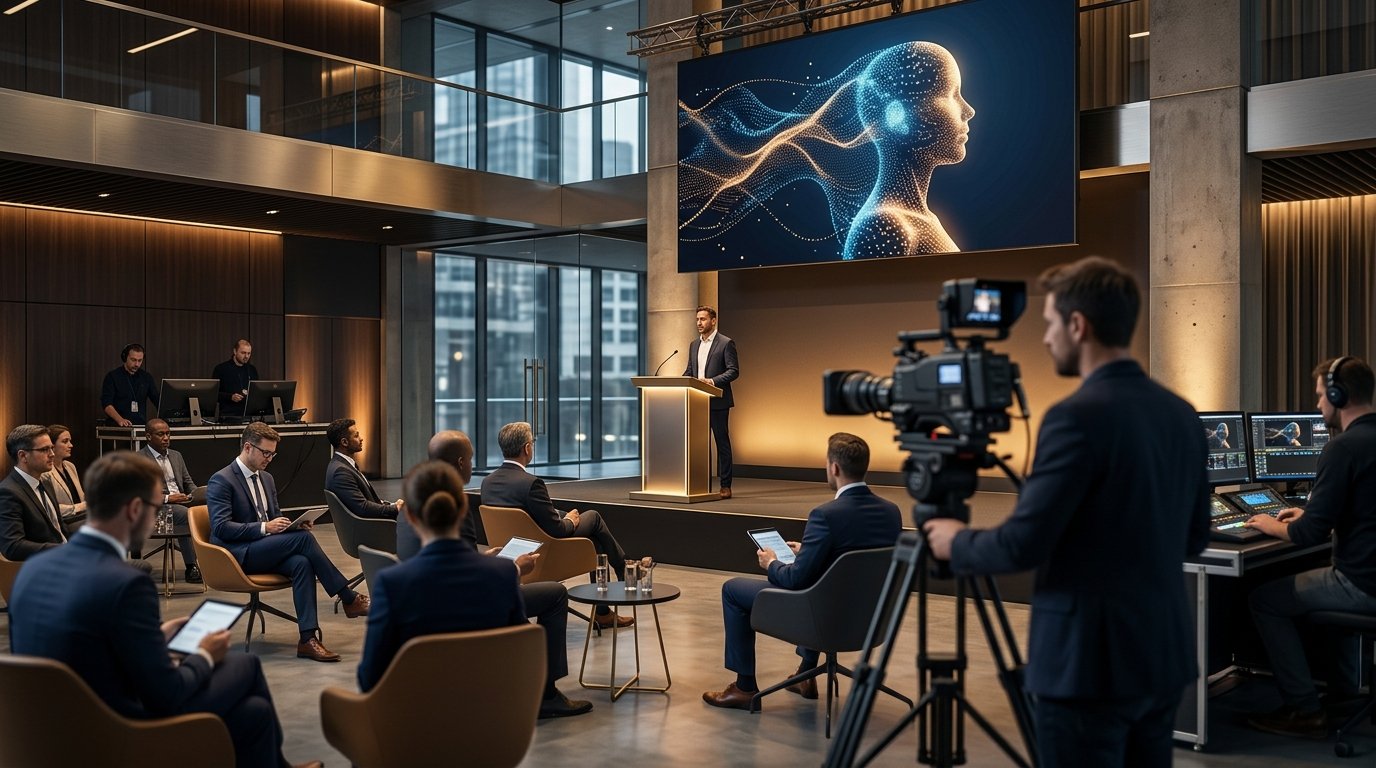
AI & Human Craft: Lessons from WPP’s London Production Hub
Is the future of event storytelling written in code or captured through the lens? WPP's new London hub proves that the most powerful content emerges where human artistry meets cutting-edge AI. As the industry moves toward a more integrated, tech-forward approach, the lessons from Devon’s Point provide a roadmap for corporate leaders looking to elevate their brand presence through sophisticated media production.
How is AI transforming high-end event production and videography?
The launch of WPP’s Devon’s Point in London marks a definitive shift in how we perceive professional media creation. This 34,000-square-foot facility is not merely a studio; it is a statement that AI-powered tools are no longer experimental—they are foundational. For the corporate event industry, this transformation manifests in the speed and scale of content delivery. When we look at our own visual gallery, the demand for same-day delivery of high-end assets has become the industry standard. AI enables this by automating the technical heavy lifting—color grading, noise reduction, and initial rough cuts—allowing creators to focus on the narrative arc that defines a successful B2B summit.
In the context of events like the Bloomberg Technology Summit or major financial conferences, AI-driven production allows for 'agentic marketing'—the ability to generate personalized, high-quality video content for thousands of attendees almost instantaneously. However, the integration of AI tools like WPP Open into the production workflow is not about replacing the camera; it is about augmenting the output. The efficiency gained in the edit suite translates directly to a higher volume of social-ready assets, ensuring that a single day of filming at a corporate event generates months of strategic marketing material. This is the new baseline for ROI in event production.
Beyond simple speed, AI is revolutionizing the metadata layer of event content. Imagine a three-day conference with fifty speakers; AI can now index every spoken word, facial expression, and slide transition in real-time. This allows production teams to pull specific highlights—such as every mention of 'sustainability' or 'market volatility'—within seconds of the session ending. This level of granular searchability was previously impossible without weeks of manual logging. By leveraging these computational strengths, production houses can provide clients with a searchable library of their own intellectual property, turning a one-off event into a permanent, accessible knowledge base. While WPP builds the global infrastructure for AI-powered production, Alesia RSVP applies this same 'human-plus-tech' philosophy to the high-stakes world of premium B2B events, ensuring that technological efficiency never compromises the bespoke quality required by luxury brands. The goal is to move from reactive coverage to proactive storytelling, where the technology anticipates the needs of the audience before the keynote speaker has even left the stage.
Why does human craft remain essential in an AI-driven media landscape?
Despite the massive investment in AI tools, WPP’s new hub still relies on a global division of 10,000 production professionals. This is a critical distinction for corporate decision-makers to understand: AI lacks judgment. In high-stakes environments—such as a closed-door executive session or a high-pressure keynote—the ability to read the room, anticipate a speaker's emotion, and capture a fleeting moment of genuine connection is a purely human skill. As noted in recent Industry Discussion: WPP AI-Powered Production Hub, the synthesis of human craft and machine speed is where the real value lies.
For a Marketing Director, the risk of over-reliance on AI is the loss of brand authenticity. AI-generated imagery can often feel sterile or 'uncanny,' which is the last thing a brand wants when trying to build trust at a B2B conference. Professional event photography and videography are about editorial choice—deciding what to show and, more importantly, what not to show. The human eye understands the nuance of corporate hierarchy and the subtle cues of a successful networking interaction. These are the details that build a brand's legacy. We believe that the camera is a tool for storytelling, and while the tool is getting smarter, the storyteller remains the most important factor in the equation.
Consider the role of a Director of Photography (DP) on-site. A DP must manage shifting lighting conditions, navigate physical obstacles in a crowded ballroom, and make split-second decisions about framing that reflect the brand’s prestige. An AI can optimize a pixel, but it cannot understand the 'prestige' of a specific angle or the importance of a candid smile between two CEOs. Furthermore, human craft involves the ethical management of a brand's image. In an era of deepfakes and generative manipulation, the 'human in the loop' serves as the ultimate arbiter of truth. They ensure that the content remains a faithful representation of the event while still being polished to a professional standard. This human oversight is what prevents the 'homogenization' of content—where every corporate video starts to look and feel the same because they are all using the same underlying algorithms. True differentiation comes from the creative risks and intuitive choices that only a seasoned professional can make.
What can B2B event organizers learn from WPP’s Devon’s Point innovation?
The most significant takeaway from WPP’s 'Elevate28' strategy is the push for simplification and integration. By bringing creative technology, virtual production, and human talent under one roof, they have eliminated the friction that often plagues large-scale projects. For those planning Corporate Events London, this integrated model is the blueprint for success. Managing multiple vendors for photography, live streaming, and event management often leads to fragmented results and communication breakdowns.
Alesia RSVP mirrors this integrated approach by offering a single point of contact for all AV and management needs. When production and management are siloed, the visual output often fails to reflect the strategic goals of the event. By contrast, an integrated team ensures that every shot captured by a photographer and every frame of a live stream is aligned with the overall event narrative. WPP's move proves that the industry is moving away from fragmented service providers toward comprehensive production partners who can handle the technical complexity of modern B2B communications.
Integration also extends to data and asset management. In a traditional setup, the photographer hands over a drive, the videographer sends a link a week later, and the social media team struggles to find content that fits their specific dimensions. In an integrated hub model, all assets flow into a centralized system. This allows for 'cross-pollination' of content. A high-resolution still from a video feed can become a social post; a transcript from a live stream can become a blog post; and the lighting data from a virtual set can be saved for future use in other markets. This 'capture once, use many' philosophy is essential for maximizing the budget of a B2B event. It transforms the event from a line-item expense into a content engine that fuels the marketing department for the rest of the fiscal year. Organizers should look for partners who don't just 'show up and shoot,' but who understand how the captured media fits into the broader corporate ecosystem.
How to integrate virtual production into your next corporate event strategy?
Virtual production, a centerpiece of the Devon’s Point facility, is no longer reserved for Hollywood sets. It is becoming a powerful tool for corporate broadcasts and hybrid summits. By using real-time rendering and LED volumes, brands can create immersive environments that far surpass the visual quality of a traditional green screen. This technology allows for 'digital twins' of event spaces, enabling speakers from around the world to appear as if they are on the same stage in London or Dubai. According to the Latest Event Technology Trends on BizBash, virtual production is the key to maintaining attendee engagement in an increasingly distracted digital world.
Integrating these tools requires a partner who understands both the technical requirements and the corporate context. It isn't just about the technology; it's about how that technology serves the brand's message. Whether it is a multi-camera live stream for a global AGM or a high-end podcast recording on-site, the goal is to create a seamless experience for both the physical and virtual audience. Virtual production also offers a sustainable alternative to traditional set building. Instead of shipping tons of timber and plastic to a venue only to discard it after 48 hours, brands can build elaborate, high-fidelity digital environments that can be updated with a click. This reduces the carbon footprint of the event while actually increasing the visual 'wow' factor.
Furthermore, virtual production enables a level of interactivity that was previously impossible. Imagine a keynote where the background environment reacts in real-time to the speaker's data points, or where a remote audience can vote on a topic and see the results visualized as 3D elements floating on the stage. This is the future of B2B engagement. It moves the audience from being passive observers to active participants in a shared digital experience. As we look toward the future of B2B events, the brands that succeed will be those that embrace these technological advancements while maintaining a firm grip on the human-led storytelling that makes an event worth attending. Alesia RSVP stands at this intersection, providing the high-end production and strategic management necessary to navigate this new era of event excellence. We ensure that the 'virtual' never feels 'distant,' and the 'production' never overshadows the 'purpose.'
FAQ
Will AI replace photographers and videographers at B2B events?
No, AI is an augmentative tool rather than a replacement. While AI can speed up post-production tasks like editing, color grading, and asset tagging, the human ability to capture candid moments, understand corporate nuances, and exercise artistic judgment remains irreplaceable. High-end events require a level of emotional intelligence and situational awareness that algorithms cannot replicate. The most successful productions use AI to handle repetitive tasks, freeing up human creators to focus on the creative strategy and high-level storytelling that drives brand value.
How does virtual production improve the ROI of corporate event content?
Virtual production allows for the creation of high-end, immersive environments that can be repurposed across multiple digital channels without the cost of physical set builds. It enables 'digital twins' of venues, allowing for hybrid experiences that look as polished as a television broadcast. By reducing physical waste and travel requirements, and by creating assets that are easily editable for future campaigns, virtual production significantly lowers the cost-per-asset while increasing the overall engagement and lifespan of the event content.
What are the benefits of combining real-world assets with AI in event storytelling?
Combining real-world footage with AI tools allows for rapid content personalization at an unprecedented scale. It enables production teams to deliver magazine-quality aftermovies, personalized attendee highlight reels, and social media clips within hours of an event's conclusion. This ensures the brand remains relevant in the immediate post-event conversation. Additionally, AI can analyze real-world footage to provide insights into attendee engagement and sentiment, helping organizers refine their strategy for future events while maintaining the authentic 'human' feel of the original content.
What is 'agentic marketing' in the context of event production?
Agentic marketing refers to the use of AI systems that can autonomously perform complex tasks to achieve specific marketing goals. In event production, this might involve AI 'agents' that automatically select the best shots of a specific speaker, add appropriate branding and captions, and distribute that clip to the speaker's social media channels the moment they step off stage. It represents a shift from manual content creation to automated, intelligent workflows that deliver highly relevant content to specific audiences in real-time.
Frequently Asked Questions
Will AI replace photographers and videographers at B2B events?
No, AI is an augmentative tool rather than a replacement. While AI can speed up post-production tasks like editing, color grading, and asset tagging, the human ability to capture candid moments, understand corporate nuances, and exercise artistic judgment remains irreplaceable. High-end events require a level of emotional intelligence and situational awareness that algorithms cannot replicate. The most successful productions use AI to handle repetitive tasks, freeing up human creators to focus on the creative strategy and high-level storytelling that drives brand value.
How does virtual production improve the ROI of corporate event content?
Virtual production allows for the creation of high-end, immersive environments that can be repurposed across multiple digital channels without the cost of physical set builds. It enables 'digital twins' of venues, allowing for hybrid experiences that look as polished as a television broadcast. By reducing physical waste and travel requirements, and by creating assets that are easily editable for future campaigns, virtual production significantly lowers the cost-per-asset while increasing the overall engagement and lifespan of the event content.
What are the benefits of combining real-world assets with AI in event storytelling?
Combining real-world footage with AI tools allows for rapid content personalization at an unprecedented scale. It enables production teams to deliver magazine-quality aftermovies, personalized attendee highlight reels, and social media clips within hours of an event's conclusion. This ensures the brand remains relevant in the immediate post-event conversation. Additionally, AI can analyze real-world footage to provide insights into attendee engagement and sentiment, helping organizers refine their strategy for future events while maintaining the authentic 'human' feel of the original content.
What is 'agentic marketing' in the context of event production?
Agentic marketing refers to the use of AI systems that can autonomously perform complex tasks to achieve specific marketing goals. In event production, this might involve AI 'agents' that automatically select the best shots of a specific speaker, add appropriate branding and captions, and distribute that clip to the speaker's social media channels the moment they step off stage. It represents a shift from manual content creation to automated, intelligent workflows that deliver highly relevant content to specific audiences in real-time.